A gambling app incident response runbook tells the on-call team who declares an incident, which failures demand immediate containment, who may change production systems, and how players and stakeholders are updated. The priority is to protect players and financial records while restoring a trustworthy service—not simply to make an error-rate graph return to normal.
Quick answer: Declare a production incident as soon as credible evidence indicates material service disruption, an unsafe player-protection control, an incorrect balance or settlement, or a security concern. Assign an incident commander, classify severity by impact, appoint technical and communications leads, preserve evidence, contain unsafe functions, publish a timed update, and reopen only after functional and financial checks pass.
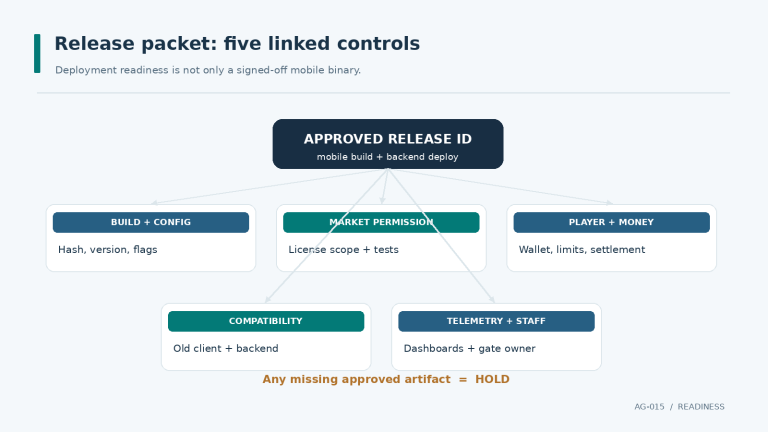
This runbook is an editable operational model for licensed gambling operators, SRE teams and support leaders. All scenarios, severity labels and response times below are illustrative, not evidence from a real operator or universal regulatory requirements. It covers unplanned production events; the phased rollout plan governs scheduled release exposure and deployment stop decisions.
Trigger and Declare a Production Incident
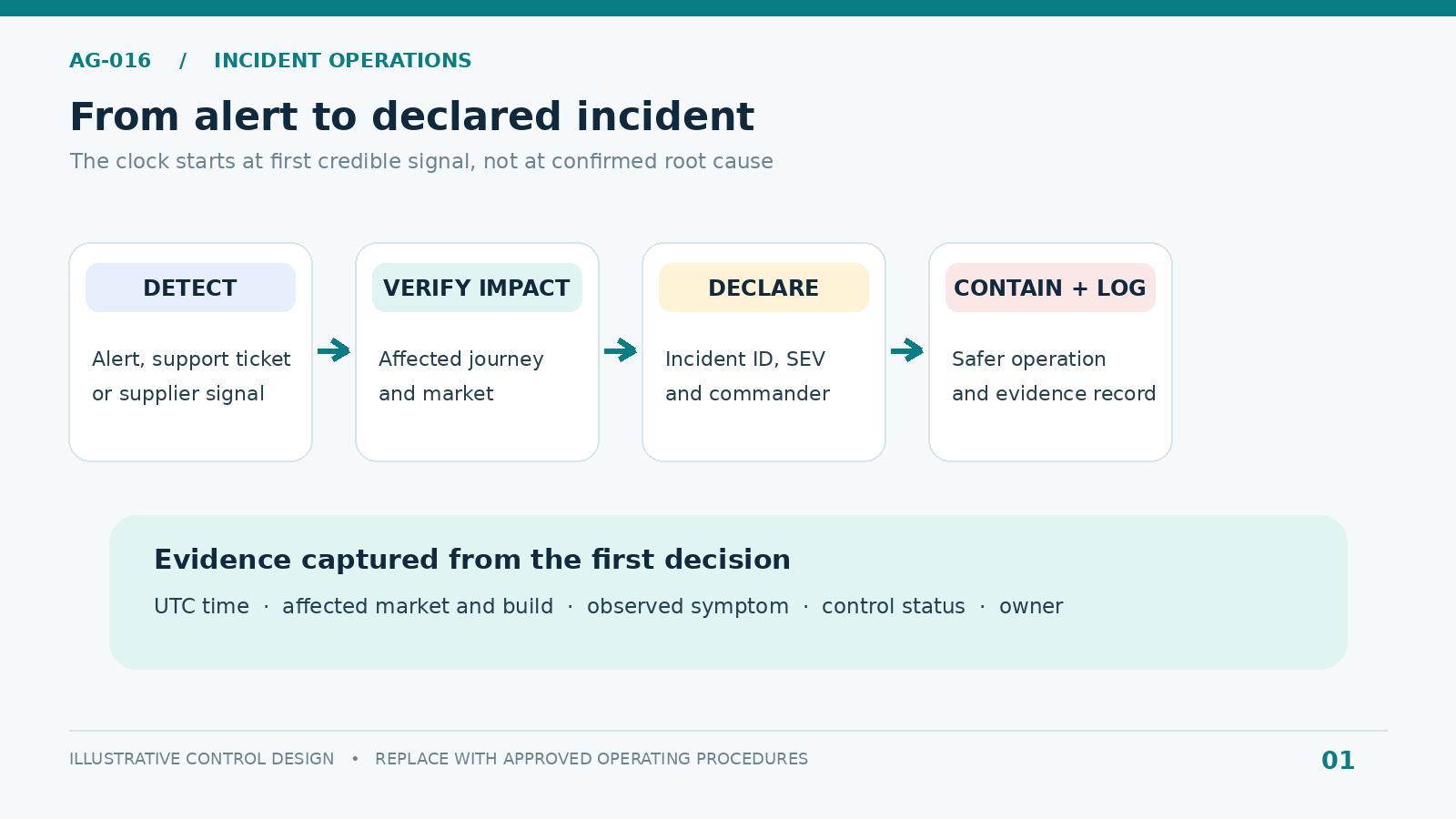
A monitoring alert is a signal, not an incident record. Confirm the affected service and player-facing symptom, then declare the incident promptly when the risk is credible. A single verified failure of a self-exclusion block or a material settlement discrepancy may justify immediate action even if overall uptime appears normal.
Production signals may arrive through synthetic checks, API and payment telemetry, customer support, fraud operations, a game supplier, an accessibility report or a regulator-facing compliance channel. Each route needs an out-of-hours owner.
- Open an incident ID with UTC detection time, reporter, affected markets, app versions and known player journeys.
- Record what is observed, what is only suspected, and which data sources support each claim.
- Appoint an incident commander (IC) and establish one decision channel and one incident log.
- Preserve relevant audit logs, configuration snapshots and transaction references under the approved access and retention rules.
- Restrict unsafe activity while the technical lead investigates; do not run live wager or payment experiments outside approved procedures.
Use the quality KPI dictionary to interpret baseline error and reliability signals. The incident record must go further: which players were affected, whether any protected account could act when it should not, and whether balances and outcomes can be trusted.
Classify Severity by Player Harm and System Impact
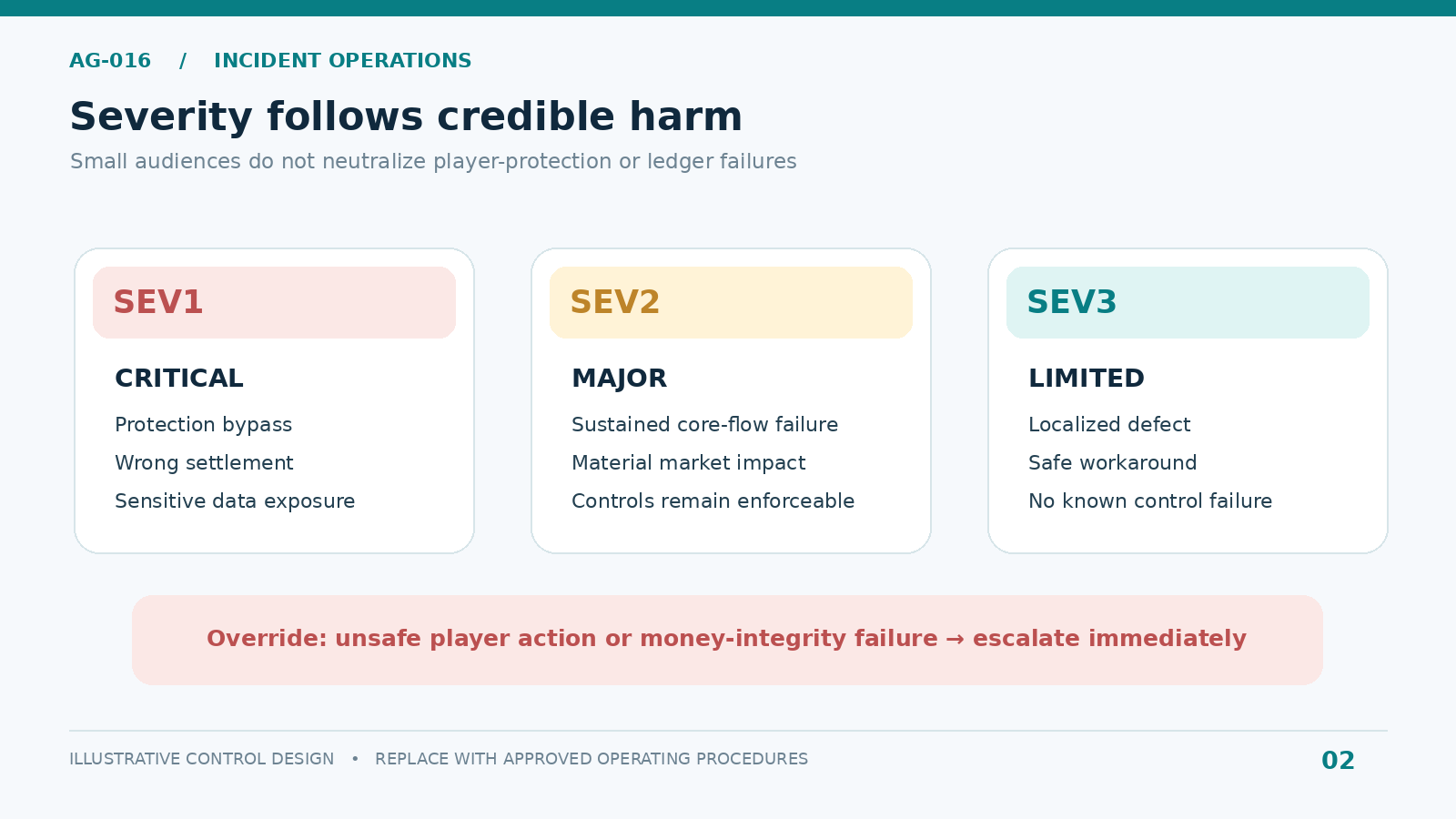
Severity determines response priority, staffing and update cadence. Classify by the highest credible consequence, not by outage percentage alone. Record the initial severity and revise it when evidence changes. The following rubric is a starting point; each operator must map it to approved thresholds, regulatory rules and contractual obligations.
| Level | Example trigger (fictional) | Default response | Reassess when |
|---|---|---|---|
| SEV1 — critical | Player-protection bypass; incorrect settlement or wallet ledger; suspected exposure of sensitive player data; broad inability to access funds | Declare immediately; IC plus security/compliance, payments and safety owners; contain affected function; assess mandatory notices | Transaction integrity, protection enforcement and scope are evidenced |
| SEV2 — major | Sustained login, geolocation or cashout failures in a licensed market; substantial but contained customer impact | IC and operations lead; support and compliance informed; targeted mitigation and frequent updates | Impact expands, controls fail or the affected population changes |
| SEV3 — limited | Localized non-financial malfunction with a safe workaround and no identified protection failure | Named owner and timed review; escalate if duration or scope grows | Workaround fails, repeat rate rises or player harm appears |
A narrow safeguard failure can still be SEV1. Validate event spikes against authoritative services and support reports.
Illustrative scenario: A game displays a prize different from the settlement ledger for a small group. Declare a high-severity incident, suspend the affected game or settlement path through approved controls, preserve immutable transaction references, and involve the relevant game supplier and finance owner. Do not silently rewrite historical records or promise reimbursement before reconciliation and compliance review.
Assign Command, Operations and Escalation Owners
Following the division of responsibilities described in Google’s SRE incident management guidance, assign one incident commander to coordinate decisions, an operations lead to direct technical changes, and a communications lead to handle updates. A scribe can maintain the timeline. Small incidents may combine roles, but never leave command ownership ambiguous.
| Role | Owns during the incident | Escalates to / coordinates with |
|---|---|---|
| Incident commander | Severity, priorities, decision log, shift handoff and closure authorization | Duty executive and compliance lead as impact warrants |
| Operations lead | Diagnosis, change control, containment, technical verification | Mobile/backend SRE, payment processor, game or identity supplier |
| Communications lead | Support briefing, player notices, stakeholder updates, next update time | Support, legal, compliance and communications approval |
| Compliance / player-safety owner | Control exposure, licensed-market scope, reportability assessment | Counsel, MLRO/security/privacy contacts where applicable |
| Payments / finance owner | Ledger integrity, transaction reconciliation, reversals and exception tracking | Finance control, processor and customer-remediation team |
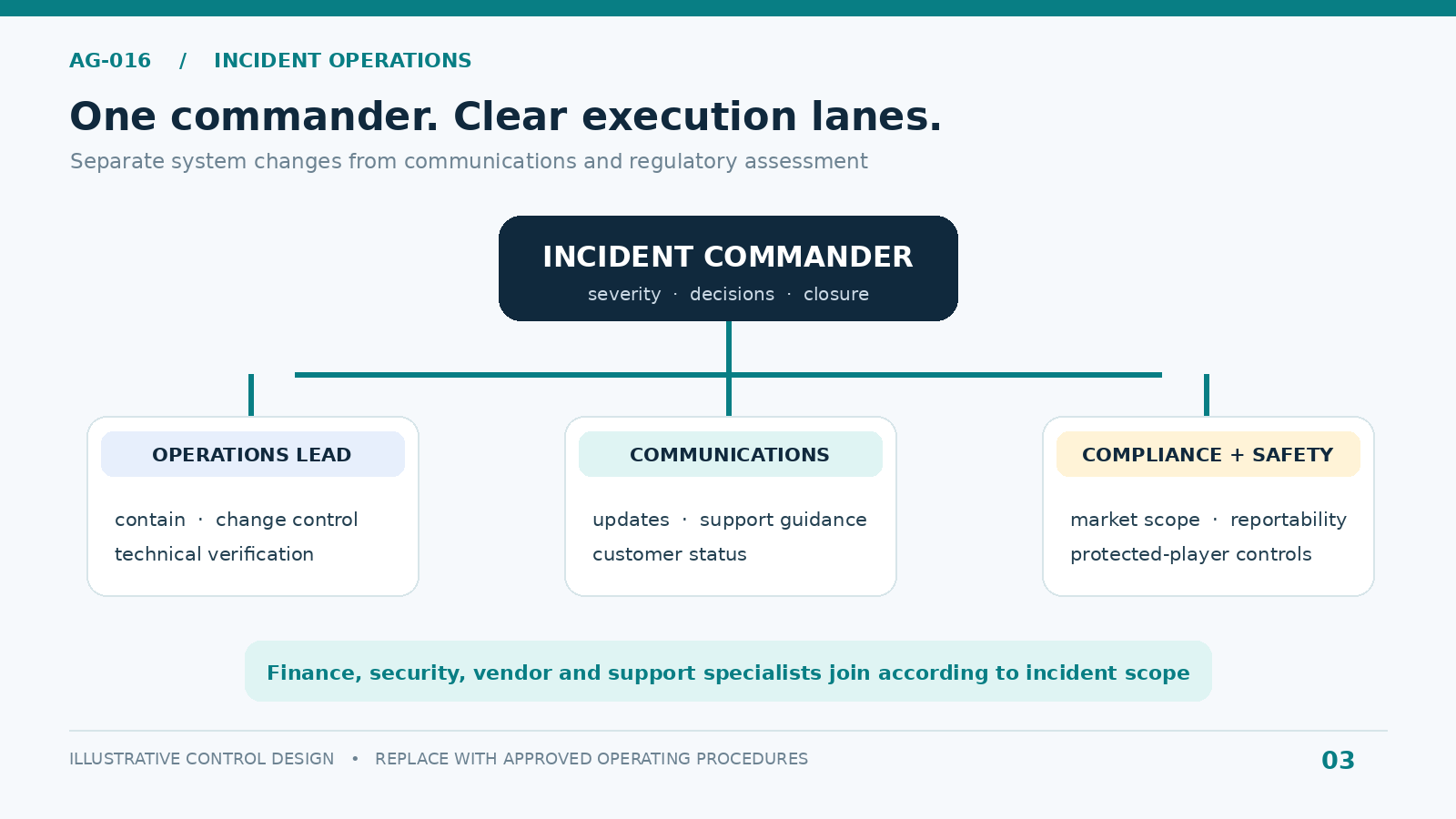
The gambling app outage escalation matrix needs primary and backup owners, tested contacts and an acknowledgement fallback. If an on-call owner cannot be reached, the IC moves to the documented deputy, then to the duty executive. For a suspected security compromise, initiate the separate security-response procedure and preserve forensic evidence before changes that may destroy it. NIST’s SP 800-61 Revision 3 provides a current cybersecurity-response framework, but it does not replace a service-specific gambling operations runbook.
Preserve Evidence and Send Time-Boxed Updates
Create an append-only incident timeline with timestamps, observers, decisions, commands executed, approvals, affected versions and service state. Do not paste player identities into open chats; follow approved access, retention and chain-of-custody rules. The SDK privacy audit addresses third-party data paths; during an incident, document what those services actually received and whether they contributed to exposure.
A first update should distinguish confirmed impact from an investigation hypothesis. State the next update time even when no restoration estimate is available. The table shows an example internal cadence, not a regulatory clock or service-level commitment.
| Audience | First message (example target) | Subsequent messages | Required content |
|---|---|---|---|
| Incident team | At declaration | Continuously in incident log | Facts, owners, decisions, blockers |
| Support and operations stakeholders | Within 15 minutes for SEV1 | Every 30 minutes or meaningful change | What players experience, approved guidance, next review |
| Players / public status channel | As soon as facts and approval permit | At the published next update time | Affected functions/markets, safe next step, time of next notice |
| Regulator or other authority | According to applicable law, licence and event type | As required by the applicable process | Verified facts, affected period, impact, mitigation and follow-up |
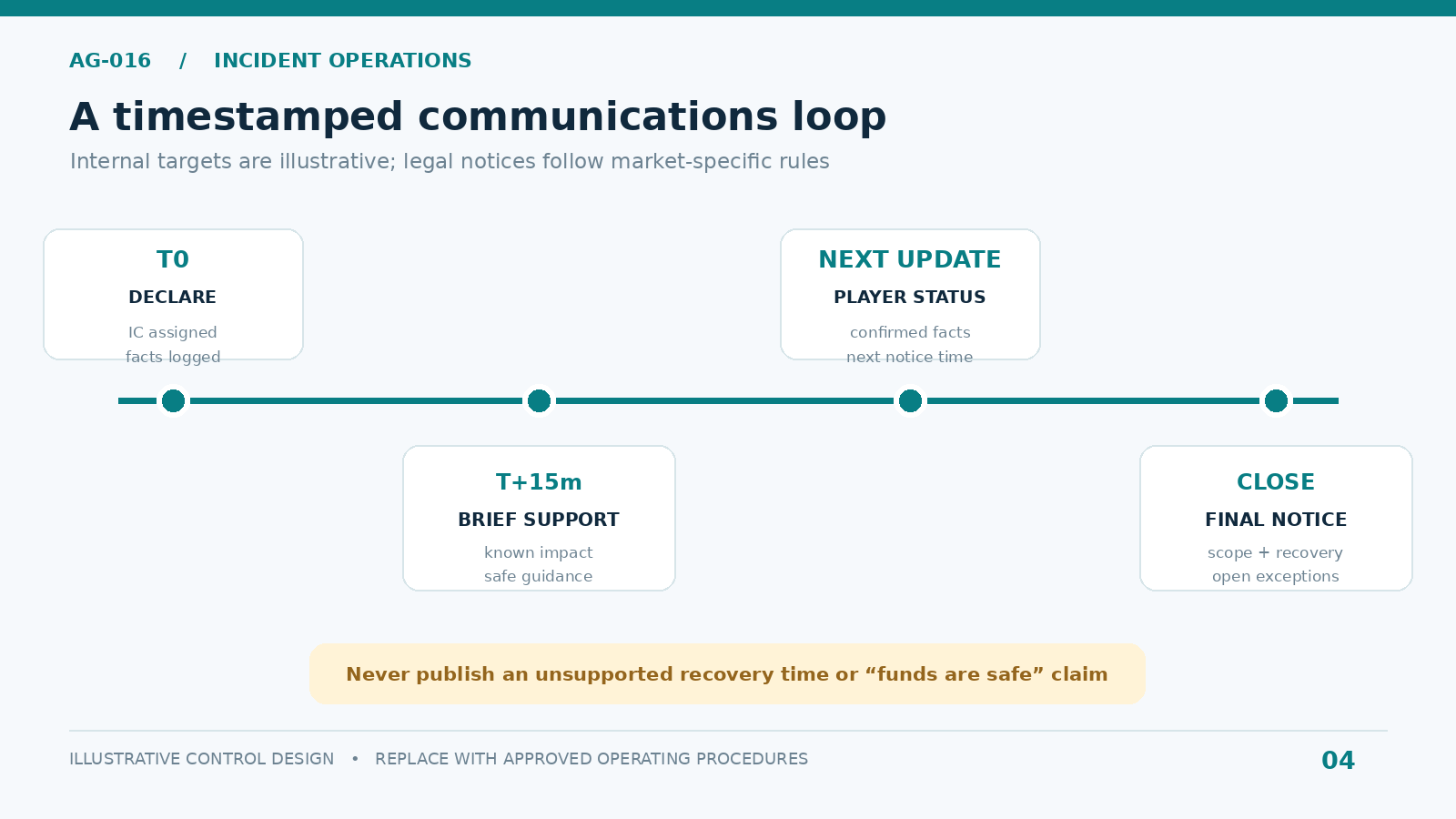
Sample gambling app incident communication template — initial player notice:
We are investigating a problem affecting [feature] for some customers in [market] since approximately [time and time zone]. [Confirmed unavailable actions] may not work as expected. Please do not repeat a pending payment or wager until its status is confirmed. We will post our next update by [time].
Sample internal update:
[Incident ID] · [SEV] · [UTC time]. Confirmed: [impact and evidence]. Unknown: [open question]. Mitigation: [approved action and owner]. Player/financial control status: [verified, at risk, or unknown]. Next decision: [owner and UTC time].
Replace placeholders with verified facts. Never claim funds are safe, a payment failed, or no data was exposed without checks. The communications lead coordinates approvals without preventing support from giving urgent, preapproved safety guidance.
Check jurisdiction-specific reporting separately
For example, the Great Britain Gambling Commission lists certain security breaches and gaming-system faults among reportable key events under LCCP condition 15.2.1. Its guidance addresses events involving incorrect player payments and specific security impacts, and describes reporting through the regulator’s digital service. See the Commission’s gaming system fault guidance. This GB example is not a global notification rule; counsel must check the operator, event, deadline and affected territory. Record that assessment even when the decision is “not reportable.”
Contain, Restore and Verify the Player Journey
A technical mitigation may stop new harm without repairing earlier damage. Depending on the defect, the team may disable a game, restrict a payment route, isolate a service, restore an approved configuration or deploy a fix. Each action needs an owner, a predicted blast radius, a rollback path and explicit permission. Keep an audit trail of flag changes and supplier instructions.
Do not equate recovery with a green uptime dashboard. Confirm the affected market and build variants, then check the player journey from identity and location eligibility through account restrictions, payment state, gameplay and settlement. Reconcile financial records against authoritative systems before declaring money-impacting incidents resolved. A failed wallet update should not be corrected by retrying blindly if the original transaction’s outcome is unknown.
| Recovery gate | Evidence for closure | Sign-off |
|---|---|---|
| Unsafe action contained | Disabled-path test; no new prohibited operations | Operations and safety owner |
| Identity, location and limits | Synthetic negative-path tests in affected markets | QA and compliance owner |
| Wallet / bets / settlements | Ledger-to-processor or game-record reconciliation; exceptions assigned | Payments / finance owner |
| Technical health | Build- and market-specific error, latency and success trends | SRE lead |
| Player and regulator follow-up | Approved notice, cases and reportability decision recorded | Communications and compliance |
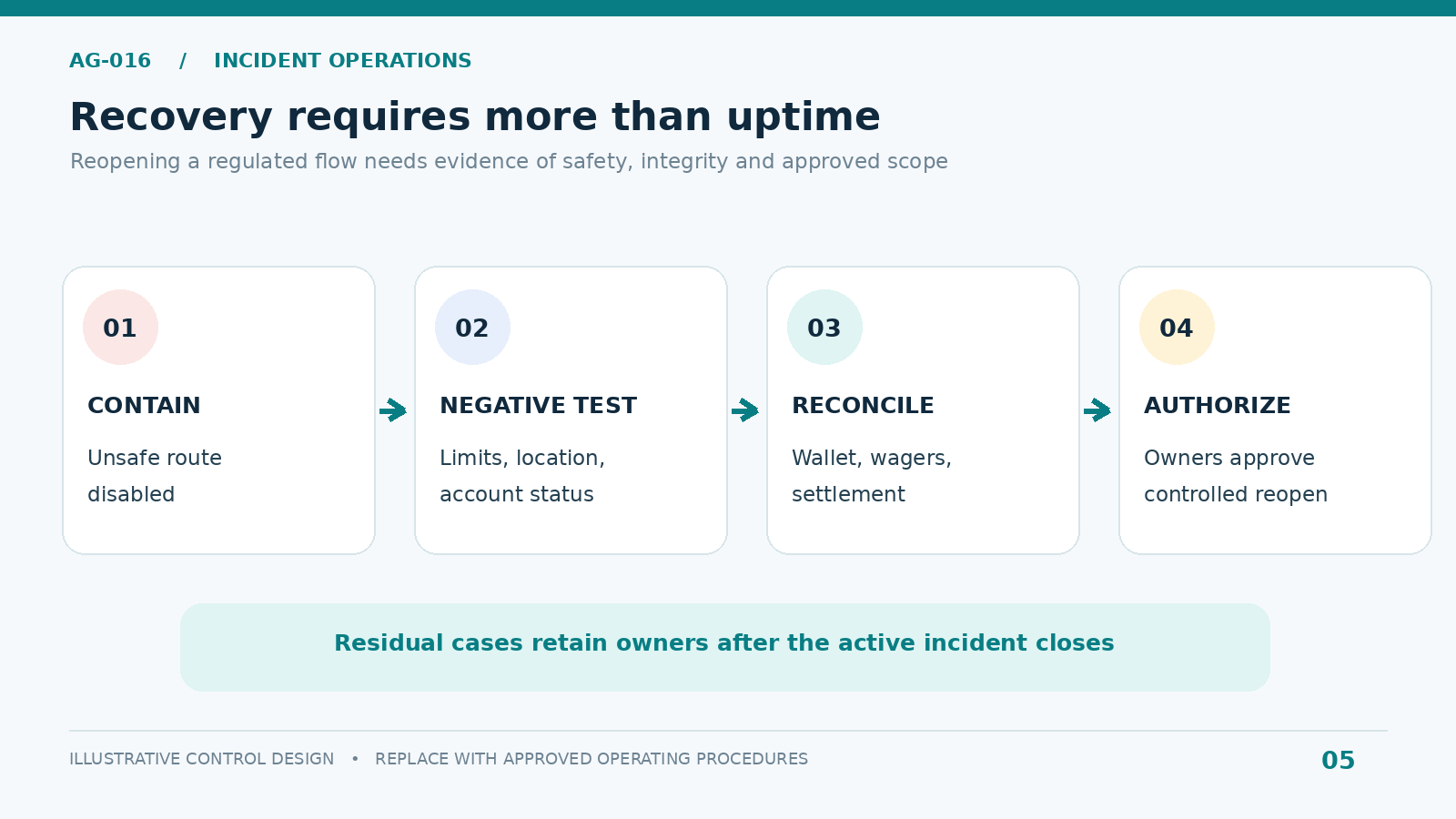
Partial restoration may leave a game, market or withdrawal route unavailable. Track those cases to completion and transfer evidence across shift changes. The commander records residual risk and owners before closure.
Complete the Postmortem and Preventive Actions
Start the postmortem from the recorded timeline, not participants’ recollections. Include the trigger, detection gap, initial and final severity, player impact, market and build scope, mitigation decisions, communications, financial or privacy exposure, recovery verification and any required notifications. Separate known cause, contributing conditions and unresolved questions. Google’s postmortem practice guidance recommends explicit impact assessment, root-cause analysis and vetted action items rather than blame.
Give each corrective action an owner, due date, acceptance test and evidence link. Useful categories include alert coverage, privileged change controls, supplier escalation, support macros, transaction reconciliation and rehearsal of the exact failure mode. Do not close an action merely because a ticket was created.
| Follow-up item (fictional) | Owner | Completion proof |
|---|---|---|
| Alert on settlement/display divergence | Payments engineering | Synthetic mismatch triggers the right page |
| Add backup contact for game supplier | Vendor operations | Successful out-of-hours escalation drill |
| Validate affected-player reconciliation | Finance control | Signed exception report and case disposition |
Download the incident severity rubric, escalation matrix, communication templates, postmortem outline and incident response workbook. These are empty or clearly fictional operating templates; fill in authorized contacts, market obligations and controls before using them in production.
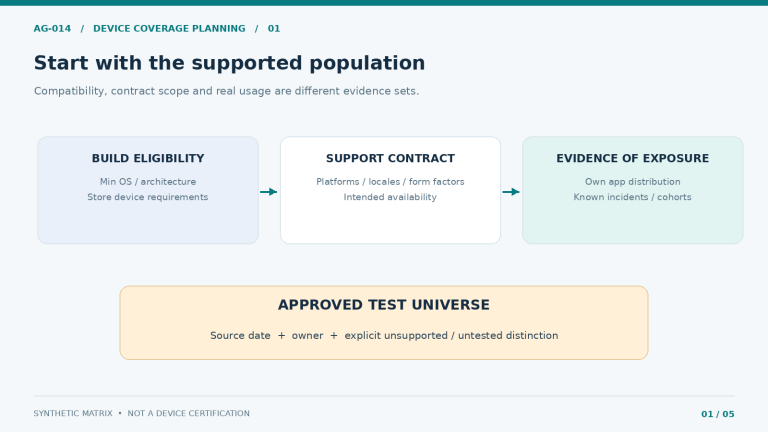
For cross-device verification after recovery, document the tested OS and hardware combinations in the device testing matrix (AG-014). Production monitoring alone does not prove the affected client versions are safe.
FAQ
What should trigger a SEV1 gambling app incident?
A credible failure in player protection, transaction or game-outcome integrity, sensitive data security, or a severe service interruption can justify SEV1 under the operator’s approved rubric. The affected user count is only one input.
Who owns external incident updates?
The communications lead prepares and coordinates player and stakeholder updates. Compliance or legal reviewers assess regulated statements. The incident commander retains overall operational control, including the next-update commitment.
Is a stopped app rollout the same as a resolved incident?
No. Halting distribution limits new exposure but cannot reliably remove a defective binary from installed devices or reconcile prior financial events. Use the rollout plan for store controls and this runbook for recovery and communications.
When can the incident be closed?
When verified player journeys and safeguards are restored, financial exceptions are reconciled or formally assigned, communications and reporting decisions are recorded, and the IC accepts documented residual risk. Long-running remediation can continue in tracked follow-up work.
Editorial and legal note: All severity levels, incident scenarios, communication wording and update intervals in this article are examples. This guide is not a legal opinion, a regulator-approved runbook or a substitute for the licensed operator’s emergency procedures. Sources reviewed on 3 November 2026; confirm current rules, notices, owners and event definitions in each market before publication or operational use.