Gambling app development cost estimation starts with scope, not a price per screen. A usable budget breaks the proposed product into work packages, assigns low/base/high effort assumptions, prices any external services separately, and reserves money for clearly described uncertainty. The output should be a planning range with documented exclusions, not a vendor quote masquerading as a market average.
For a real-money product, geography and permission to operate affect the workload before design begins. Identity checks, location restrictions, player-protection controls, security reviews and store submission may require different implementations or evidence by market. This guide explains how to cost those dependencies without claiming that any single checklist constitutes legal clearance.
Quick answer: calculate development labor from estimated hours and a project-specific rate; add one-time third-party and assurance allowances; apply a risk allowance using a stated base; then budget recurring operations separately. Download the editable worksheet to replace every illustrative assumption with your own.
What a Gambling App Development Estimate Covers
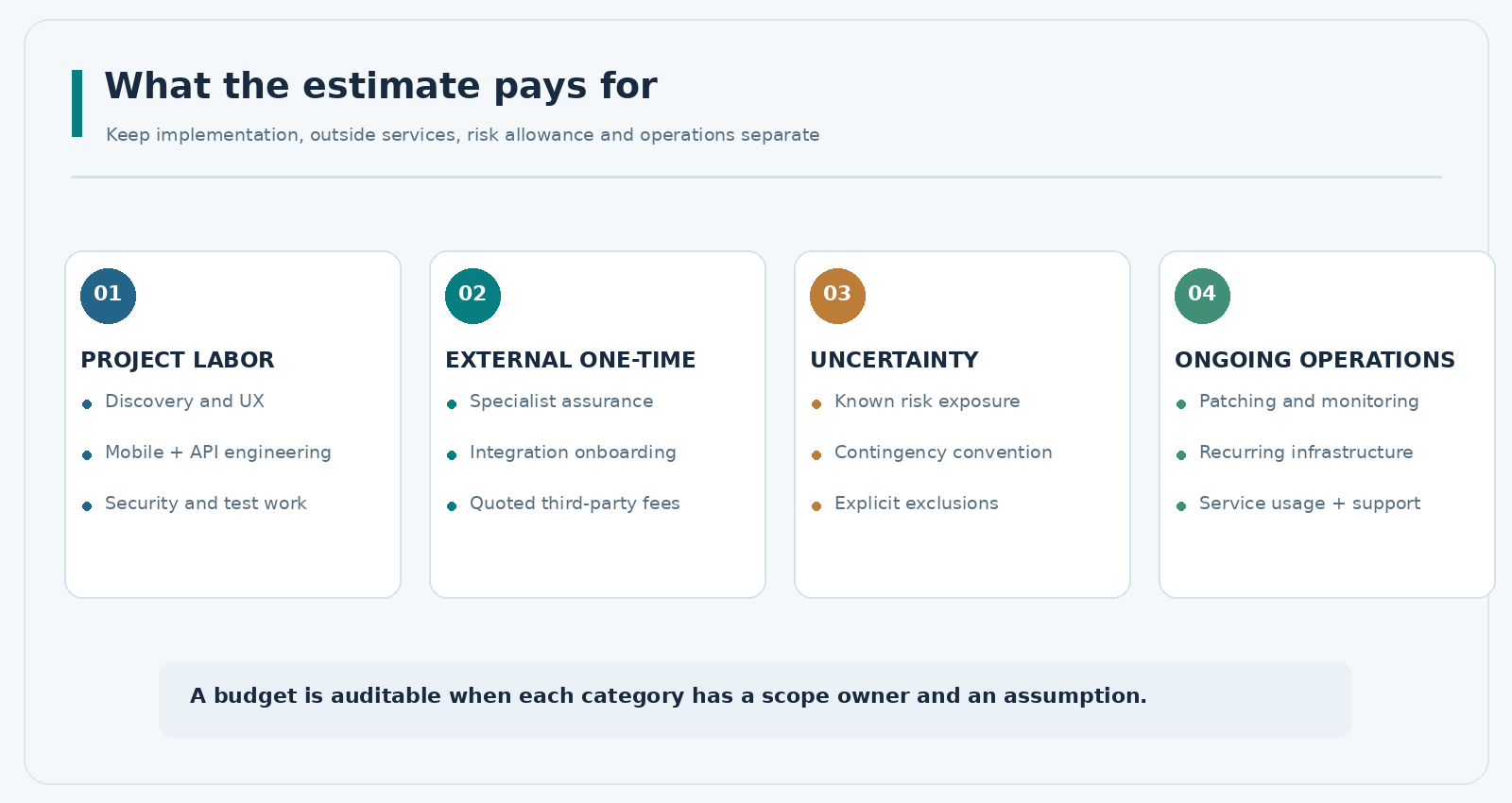
An estimate should distinguish implementation cost, external one-time cost and ongoing operating cost. Combining them into one unexplained total makes proposals difficult to compare and hides costs that survive the initial release.
| Budget category | Include in the estimate | Keep separately identified |
|---|---|---|
| Product discovery and design | Requirements workshops, UI states, acceptance criteria and design QA | Research participation, translation and external brand assets if not contracted |
| Application and service engineering | iOS/Android screens, APIs, authentication, account controls and integration handling | Existing platform upgrades and unknown third-party source-system work |
| Security, privacy and assurance | Threat review, secure build practices, audit evidence and test remediation | Independent laboratory or legal review fees until quoted |
| Release readiness | Device testing, accessibility testing, store-review packages and defect fixes | App-store approval outcome and jurisdictional permissions |
| Post-release operations | Monitoring, patching, support engineering and infrastructure | Payment processing charges, licenses and usage-based vendor charges |
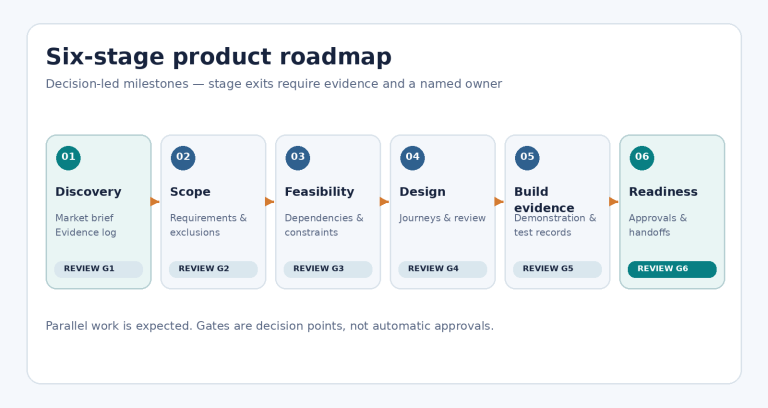
Write down the estimate boundary: supported markets, platforms, feature list, API owners, languages, accessibility criteria, integrations and the expected completion condition. A budget for an existing backend plus two mobile clients is not interchangeable with a proposal that also builds and operates the backend. Use the product roadmap (AG-001) to agree scope and decision ownership before estimating hours.
The U.S. Government Accountability Office’s Cost Estimating and Assessment Guide describes useful estimating disciplines: define the technical baseline, use a work breakdown structure, document assumptions, examine uncertainty and update the estimate against actual results. These are general estimating practices, not gambling-industry price data.
Scope and Integration Cost Drivers
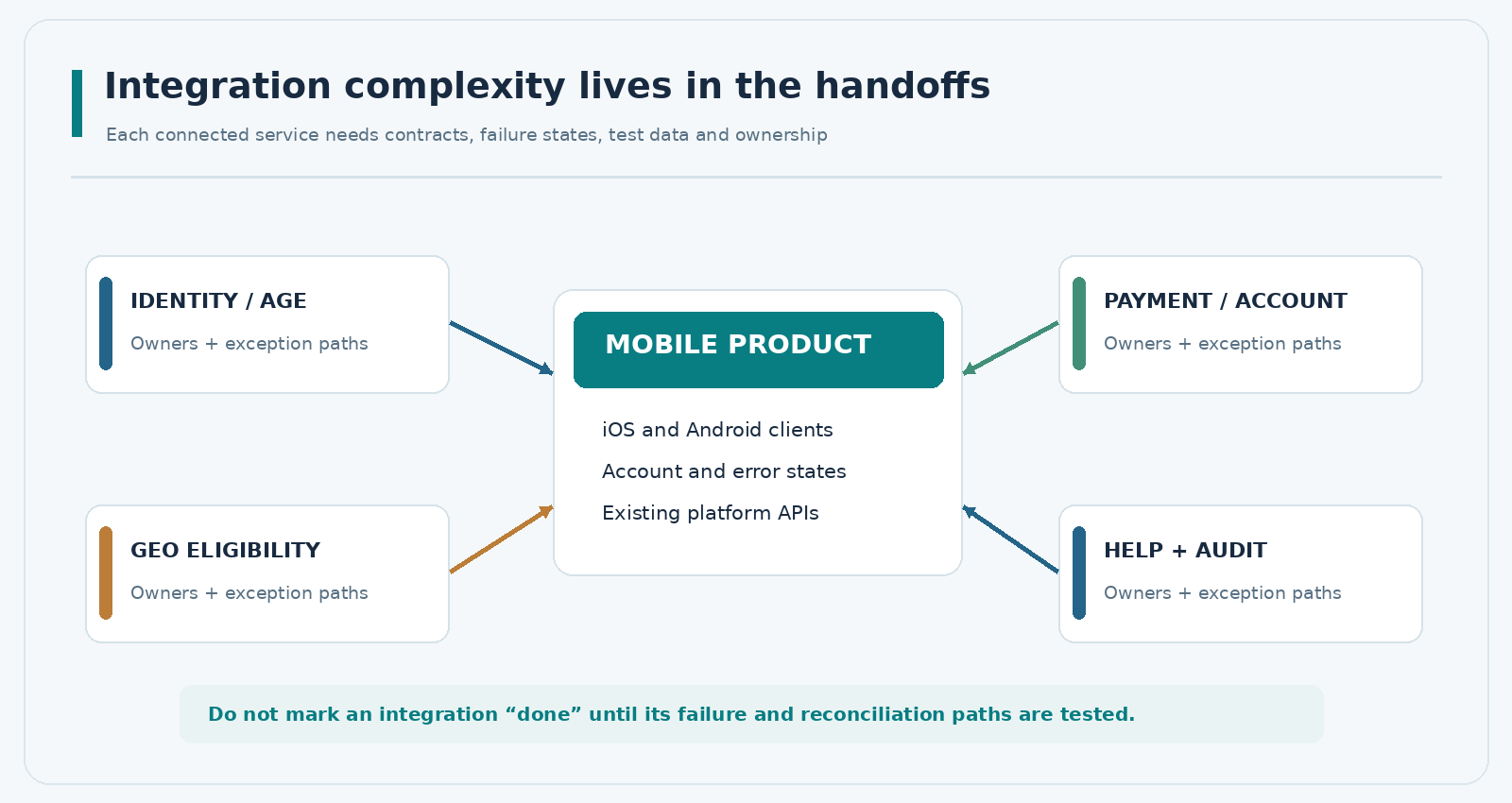
The largest budgeting errors often begin with undefined interfaces or a vague definition of “done.” Estimate a feature as a set of workflows, states, integrations and acceptance checks rather than as a single UI screen. For example, an account-verification feature may have an intake form, retry states, manual review handling, failure messaging, evidence retention decisions and several back-office callbacks.
Use these questions to size the work:
- Platform reach: Are iOS and Android both in scope? Which device and OS versions need full testing? What implementation can genuinely be shared?
- Backend readiness: Are documented, stable APIs available? Does the budget include service contracts, error handling, rate limits and integration environments?
- Identity and location checks: Which vendors, jurisdictions, exception paths and dispute cases must be supported? Who supplies test credentials and approval evidence?
- Payments and account records: Which payment and reconciliation functions are already provided? Who owns callbacks, reversals, error recovery and transaction support?
- Responsible-gambling features: Which user controls and audit evidence are required for the selected products and markets? Who defines and signs off the rules?
- Localization and accessibility: Which languages, currencies, time zones, screen readers and accessibility tests are in the acceptance scope?
Separate new construction from configuration and integration. An existing identity service may reduce custom implementation while still requiring mobile states, operational procedures, test environments and accessibility review. Conversely, an API described as “ready” may turn out to lack required fields or reliable staging data.
For each high-dependency feature, record an owner, integration contract, evidence available, unresolved decision and potential rework trigger. Put a discovery task against any critical unanswered question instead of burying the uncertainty in a flat percentage.
Platform and Compliance Dependencies That Change the Budget
A license, a store distribution approval and a working technical control are separate matters. Apple says real-money gaming apps must have the necessary permissions where used and be geo-restricted; Google Play has an application and eligibility process with country and product-category conditions. Confirm the applicable rules before deciding how many regional variations need implementing. See the dedicated app submission requirements checklist for distribution evidence, rather than treating a cost worksheet as submission guidance.
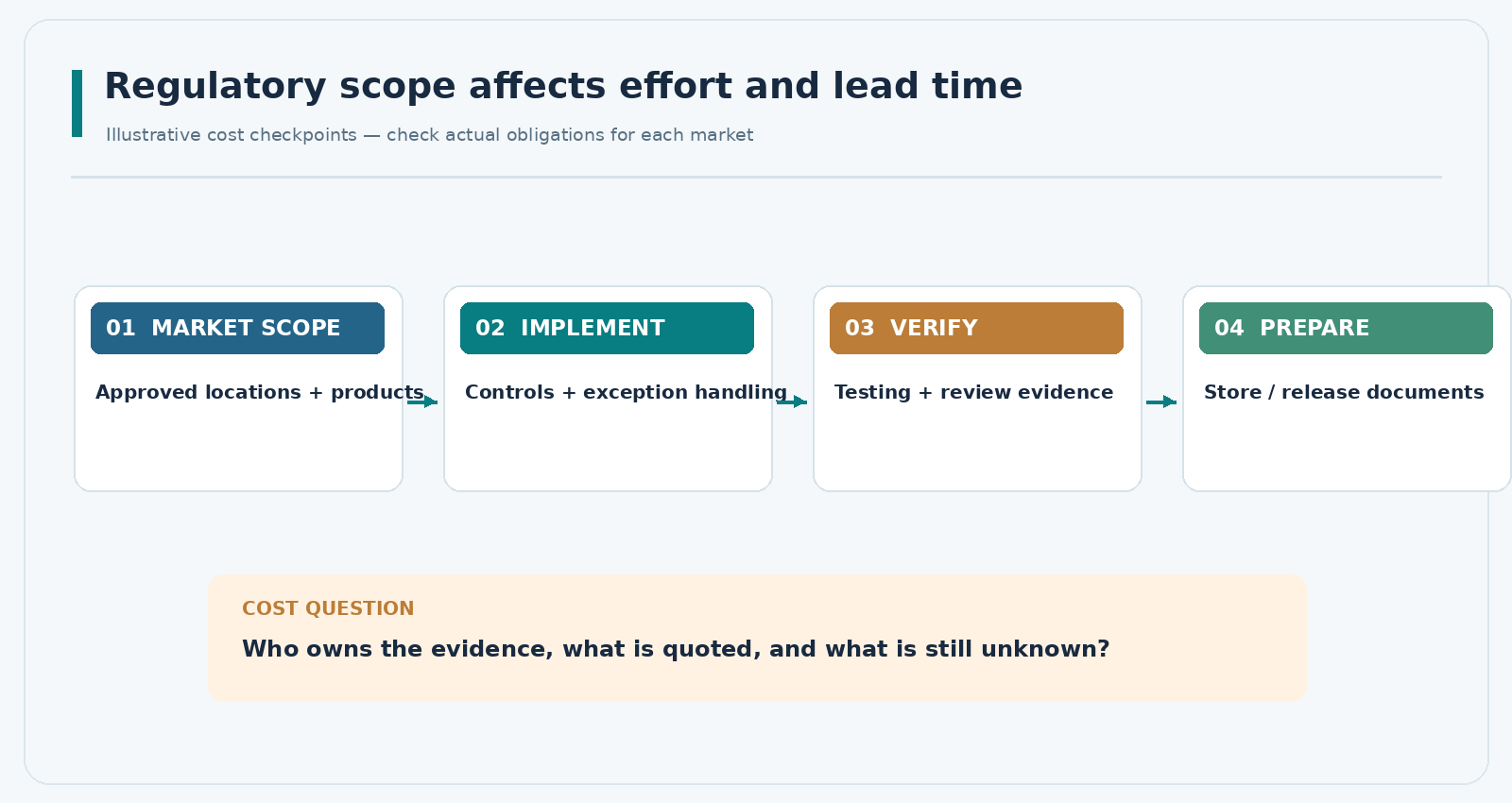
Compliance-related work should have explicit line items for regulatory interpretation, implementation, validation and evidence preparation. Not every jurisdiction imposes the same obligations, and a development budget does not include a license by default.
| Dependency | Possible engineering or review work | Evidence or assumption required |
|---|---|---|
| Market eligibility | Region controls, location failure states, release configuration | Approved market list, legal sign-off, store eligibility |
| Age and identity | Verification flows, handling exceptions, vendor callbacks | Approved policy, API documentation, test coverage |
| Player-protection controls | Account limits, help access, state handling and logs | Market-specific product rules and acceptance tests |
| Security and privacy | Secure development, access controls, data minimization and remediation | Data-flow map, threat model, reviewer responsibilities |
| Independent assurance | External technical testing where required | Named standard, accredited provider, written quote and lead time |
The UK Gambling Commission’s remote gambling and software technical standards and its testing strategy illustrate why technical implementation and testing can be separate cost drivers in a regulated market. They are UK-specific references, not a global requirements list. Security budgeting can use the NIST Secure Software Development Framework to identify work that routine feature estimates often omit; NIST SP 800-218 version 1.1 is final, while its version 1.2 revision was still a public draft at this source check.
Do not invent regulatory or laboratory fees. Leave them as TBD external allowances until the relevant regulator, supplier and assurance provider confirm amounts, scope and timing.
QA, Security and Maintenance Allowances
Testing must appear as planned work packages, not the margin left after development. Cover functional paths, integration errors, device and OS combinations, accessibility checks, performance investigations and regression after changes. Allocate ownership for fixing defects uncovered by independent assurance or store review.
Treat security and accessibility as recurring design and engineering tasks with verification, not one-time certificates. NIST’s SSDF recommends integrating secure development practices into the software lifecycle. The W3C WCAG 2.2 Recommendation can inform relevant accessibility acceptance criteria, although applicability and assessment methods for native mobile apps need their own defined scope. Budget both test execution and remediation cycles.
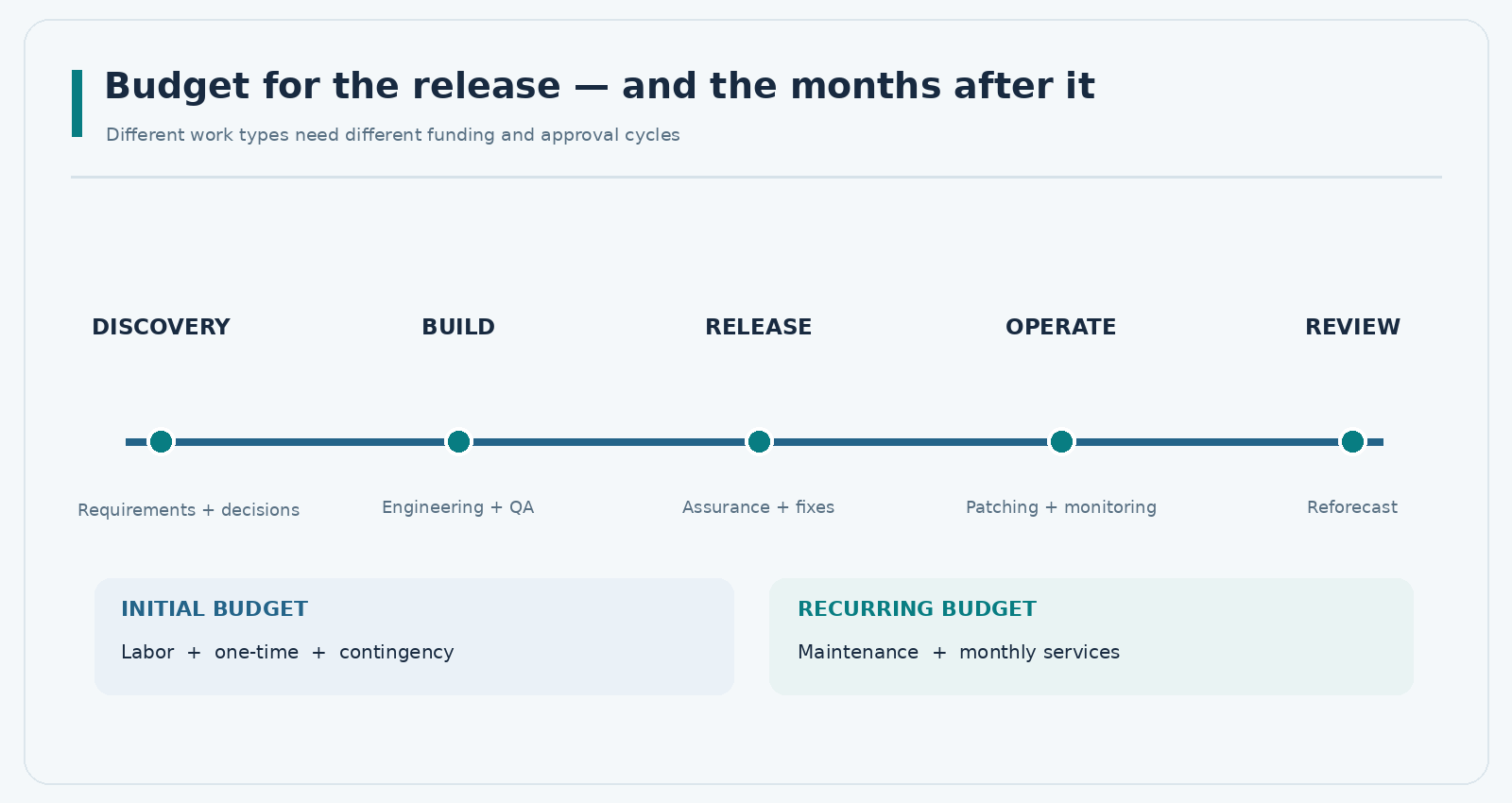
After the initial release, model these costs by month or year:
- Engineering maintenance: OS updates, SDK changes, urgent fixes, security patches and technical debt.
- Infrastructure and vendor usage: Hosting, observability, messaging, identity checks and service quotas, using quoted minimums or usage tiers.
- Operational monitoring and support: Alerts, incident participation, defect triage and customer-service integrations.
- Recurring assurance and market change: Retesting, new regional requirements, policy changes and third-party audits when applicable.
The maintenance model should specify response coverage, named service owners and whether on-call work is included. A recurring retainer and a variable incident budget are different financial commitments; keep them separate. For service-quality definitions after release, use the quality KPI framework rather than embedding unsupported service-level targets in the estimate.
Assumption-Based Estimation Formula
Build the calculation from work-package effort, not a single all-in multiplier. For work package i, multiply estimated hours by the relevant loaded hourly rate. When several disciplines have different rates, calculate each line separately instead of averaging them without explanation.
Development labor = sum of (hours by work package × applicable rate)
Initial project budget = (development labor + one-time external allowances) × (1 + contingency fraction)
Year-one planning total = initial project budget + (monthly engineering maintenance + monthly recurring services) × months in scope
These formulas are a worksheet convention, not an accounting standard. Some teams apply contingency only to selected uncertain work packages; others separate management reserve from identified risk costs. Choose a convention, document it and avoid double-counting the same risk in both effort and contingency. Taxes, financing, licensing and payment processing may be excluded if not priced.
Worked Example — Fictional Assumptions Only
Suppose a scoped two-platform product uses 2,420 development hours, a $100/hour illustrative loaded rate, $20,000 in one-time external allowances and a 12% contingency. Estimated initial funding is (2,420 × $100 + $20,000) × 1.12 = $293,440. With 35 monthly maintenance hours, $1,200 per month in recurring services and 12 months of operations, the additional allowance is (35 × $100 + $1,200) × 12 = $56,400. The resulting year-one planning total is $349,840.
Nothing in this example represents a market quote, typical team rate, regulatory fee, certified cost or expected budget. It is an arithmetic demonstration. The downloadable spreadsheet uses these assumptions so readers can inspect and replace them.
Budget Worksheet and Three Scenarios
The companion gambling-app-budget-estimator.xlsx includes editable work-package effort ranges, cost assumptions and automatically calculated scenario summaries. The CSV export is suitable for importing the scope into planning software, but the spreadsheet is the version that recalculates totals.
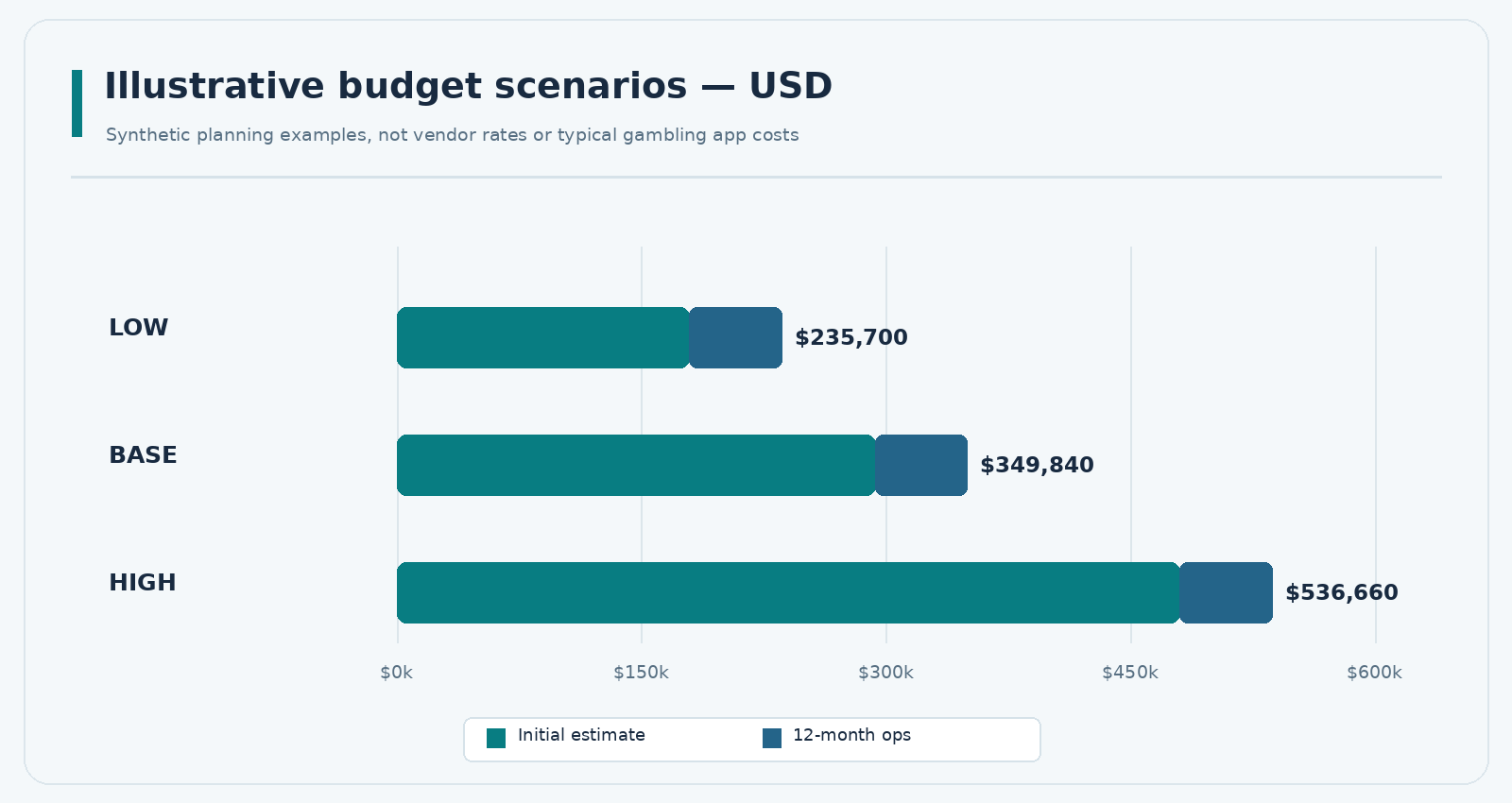
| Scenario | Dev. hours | Labor at $100/h | One-time external | Contingency | Initial estimate | With 12-month operations |
|---|---|---|---|---|---|---|
| Low | 1,530 | $153,000 | $10,000 | 10% | $179,300 | $235,700 |
| Base | 2,420 | $242,000 | $20,000 | 12% | $293,440 | $349,840 |
| High | 3,720 | $372,000 | $35,000 | 18% | $480,260 | $536,660 |
All values are synthetic placeholders. Low/base/high are sensitivity cases, not confidence bounds or industry pricing.
To use the estimator:
- Duplicate the workbook and name the real product, markets, release boundary and owning team.
- Replace every sample work-package hour range using engineering and QA estimates supported by evidence.
- Enter your loaded hourly rate or extend the model to use discipline-specific rates.
- Obtain quotes for specialist audits, licenses, service minimums and external integrations; leave unknown amounts explicitly unpriced.
- Review risk assumptions, calculate low/base/high totals and name the decision owner for the approved estimate.
- Re-estimate after discovery and at material changes in scope; compare estimate to actual effort rather than preserving obsolete numbers.
What’s Excluded Until Confirmed?
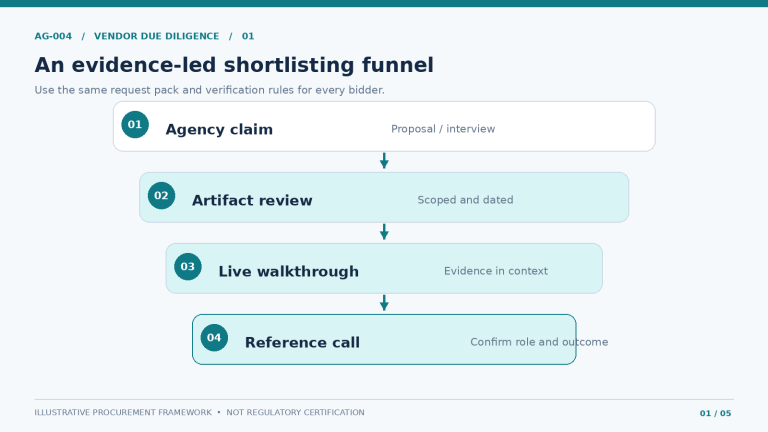
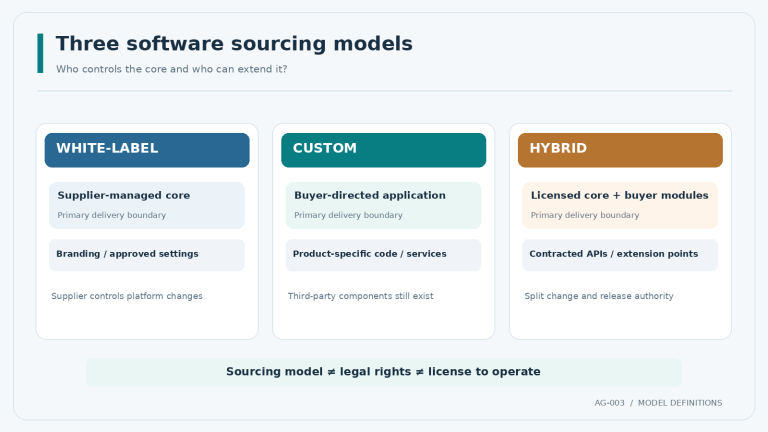
The template does not price specific gambling licenses, taxes, payment transaction charges, marketing, customer acquisition, support staffing beyond the stated engineering allowance, intellectual-property transfers or source-system replacement. It also does not decide the procurement model. For sourcing rights, ownership and vendor exit issues, see the white-label versus custom comparison (AG-003); for procurement evidence, see the agency due-diligence checklist (AG-004).
A defensible estimate is one a reviewer can revise: each figure has a scope owner, supporting assumption and explicit exposure to change. It should never be mistaken for legal authorization or a binding commercial offer.
Editable resources: budget estimator (Excel); cost assumptions register (CSV). These templates contain example inputs and require project-specific review before operational use.
Frequently Asked Questions
How much does it cost to develop a gambling app?
There is no dependable universal price. The budget depends on the product scope, existing backend capability, device coverage, integration maturity, jurisdiction-specific controls, testing expectations and post-release commitments. Start with documented work packages and actual supplier rates rather than an unsourced range.
What usually changes a gambling app development estimate?
Changes to target markets, integration readiness, payment and identity flows, supported platforms, QA requirements and assurance evidence can alter effort. Re-estimate when these assumptions change and keep signed scope decisions alongside the numbers.
Should licensing and compliance costs be included?
Include confirmed, project-specific external licensing and review costs if they are in your agreed project boundary. Otherwise show them explicitly as unpriced exclusions or allowances. Do not assume a software development estimate includes operator permission to offer gambling.
Is a contingency percentage the same as a risk assessment?
No. A percentage is a budgeting input. A risk assessment identifies specific uncertain events, their drivers and response owners. Use both and explain how they interact so you do not reserve twice for the same exposure.
Does the worksheet estimate ongoing operating costs?
Yes, using editable monthly engineering-maintenance hours, recurring service spend and months in scope. It does not estimate all operating costs, taxes, transaction fees or every future regulatory change.
Reference Sources
- U.S. GAO — Cost Estimating and Assessment Guide: cost baselines, work breakdown, assumptions and risk analysis.
- Apple — App Review Guidelines, section 5.3: real-money gambling distribution conditions.
- Google Play — Real-Money Gambling, Games, and Contests: eligibility and application requirements.
- UK Gambling Commission — Remote Gambling and Software Technical Standards: UK-specific technical requirements.
- UK Gambling Commission — Testing Strategy: UK-specific assurance requirements.
- NIST SP 800-218 — Secure Software Development Framework 1.1: secure-development activities.
- W3C — WCAG 2.2: accessibility guideline reference.