A gambling app phased rollout plan controls when an approved update reaches more devices, what evidence permits expansion, and who can stop it. It must also define what happens to users who already installed the build. Neither Apple’s phased release nor Google Play’s staged rollout is a universal downgrade button.
Quick answer: Freeze the release candidate and its market approvals, appoint gate owners, select the store exposure schedule, and monitor build-specific reliability alongside location, identity, wallet, settlement and player-protection controls. Advance only on recorded approval. If a safety or money-integrity control fails, stop expansion, contain the affected function and follow the incident runbook; do not wait for a crash-rate threshold.
This is a production-deployment playbook for teams operating licensed gambling products. It assumes the build has passed store eligibility and submission review. The tables and downloadable workbook are editable operating examples, not regulator-approved thresholds or evidence of a real release.
Assemble the Release Readiness Inputs
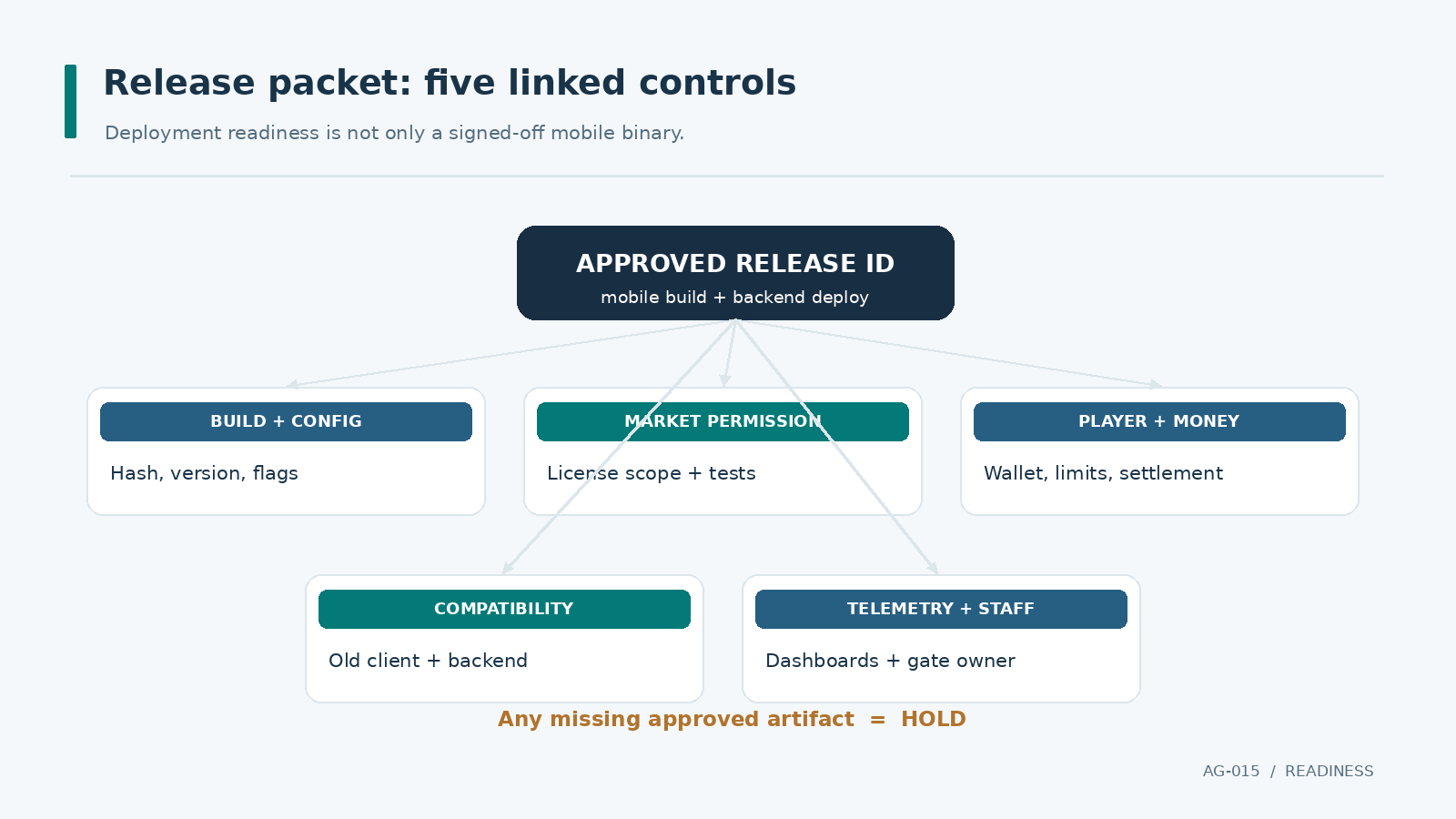
Begin with a versioned release packet that identifies exactly what will change. The packet should contain the iOS version and build number, Android version code and app bundle, backend deployment identifiers, feature-flag states, database migration plan, target markets, and the scheduled release window. Link each item to an owner and a verifiable artifact.
Require a production-representative smoke test of login, age and identity gating, location eligibility, deposits and withdrawals where applicable, bet or game settlement, account restrictions, and customer-support entry points. Include adverse paths: a rejected payment, an ineligible location, a self-excluded account, an expired session and a failed transaction retry. Use synthetic accounts and approved test environments; never create unapproved live wagers to validate a deployment.
Before the first cohort, check that an older app can still communicate safely with the new backend. Mobile clients remain in circulation after a release is stopped. A destructive database migration or a server change that rejects older clients can turn a narrow app defect into a wider outage. Record whether each change can be disabled remotely, reversed safely, or corrected only by a new store build.
| Required input | Evidence to attach | Who validates it |
|---|---|---|
| Approved binary and backend versions | Build hashes, deployment and change IDs | Release engineering |
| Licensed markets and player controls | Market matrix, compliance sign-off, control tests | Compliance and player safety |
| Compatibility and recovery | Old-client test, migration rehearsal, restoration method | Backend lead and SRE |
| Production telemetry | Version, OS, territory and core-flow dashboards; alert test | SRE and analytics |
| Release window and coverage | Gate times, on-call rota, decision channel | Release manager |
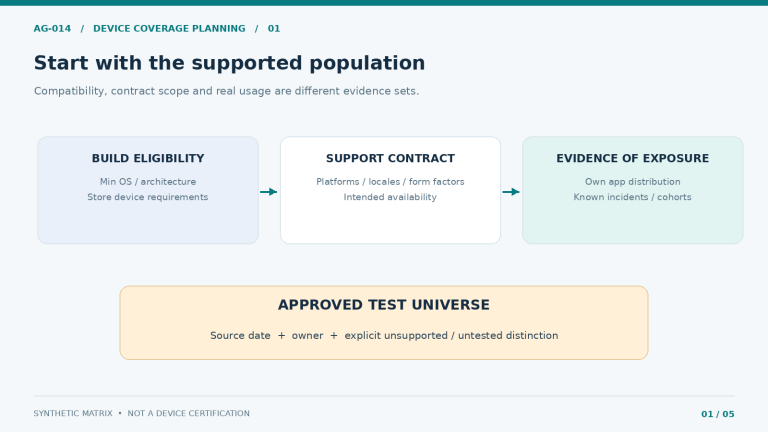
The discovery sequence belongs to the product roadmap; store approval evidence belongs to the app-store submission checklist. Neither is a substitute for the production-specific gate above.
Assign Go/No-Go Owners Before Opening the Rollout
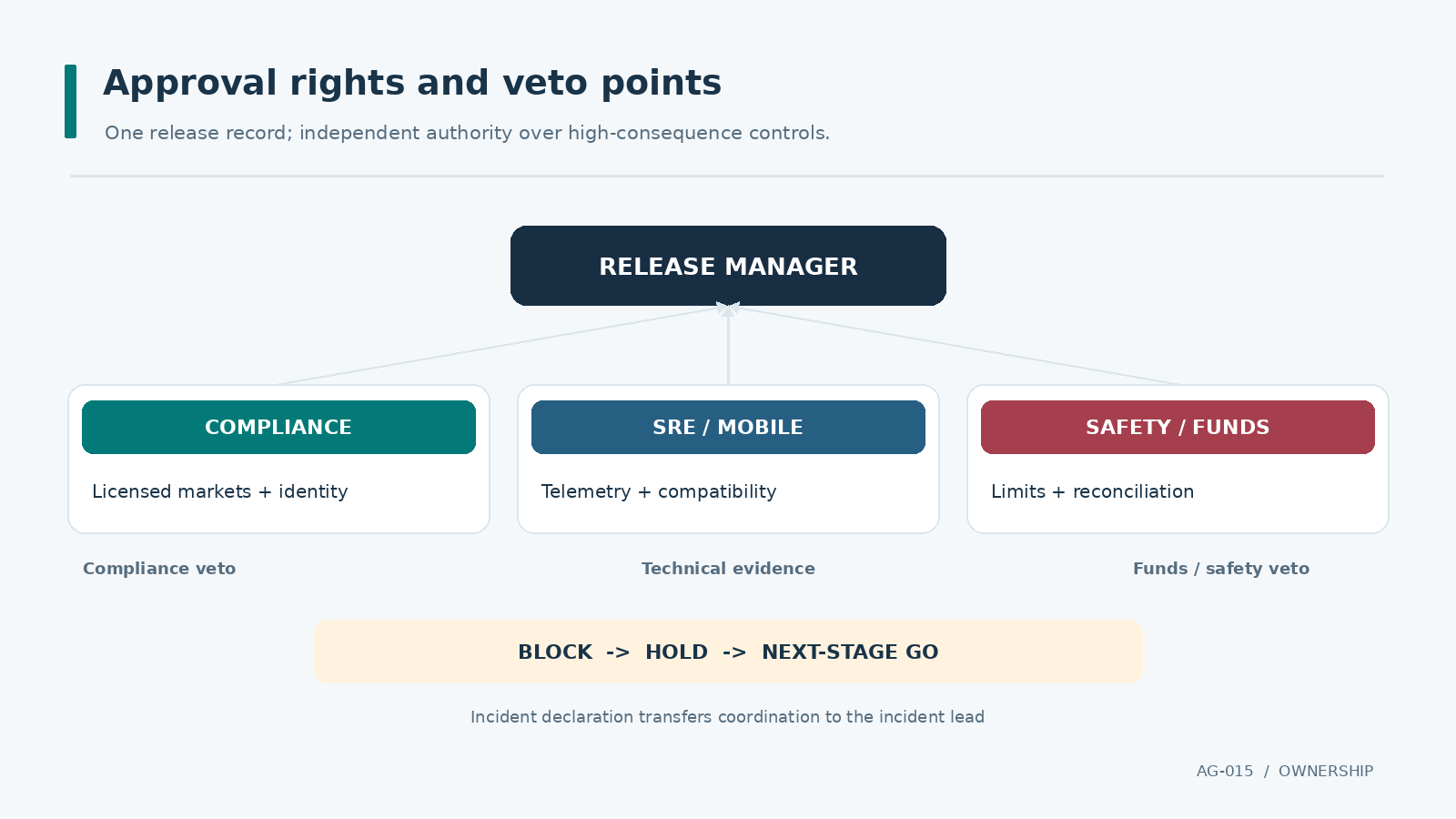
A release manager records the decision, but should not unilaterally override compliance or player-safety blocks. Name an accountable person for each gate and a deputy for the release window. The incident commander owns containment once an event is declared; this avoids a release meeting competing with an emergency response bridge.
The RACI below is a starting point. A = accountable; R = responsible for execution; C = consulted; I = informed. Adapt it to the licensed operator’s actual segregation-of-duties rules.
| Decision or control | Release manager | SRE / mobile | Compliance | Payments / safety | Incident lead |
|---|---|---|---|---|---|
| Approve exposure increase | A | R | C | C | I |
| Validate monitoring and compatibility | A | R | C | C | I |
| Clear market and player-control gate | I | C | A | R | I |
| Halt distribution for severe defect | A | R | C | C | I |
| Declare incident and coordinate containment | I | R | C | C | A |
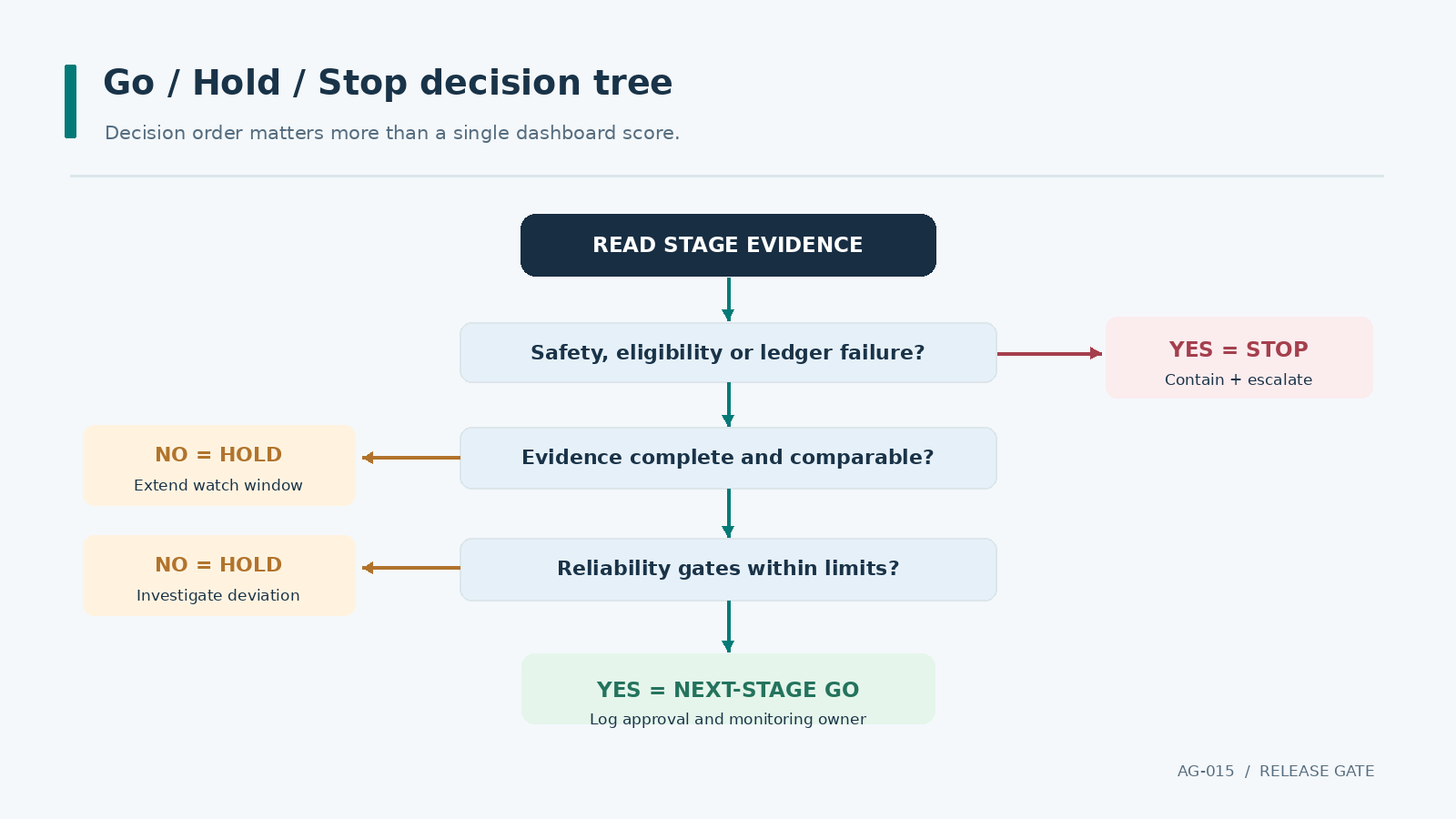
Keep decision rights explicit in the record: GO, HOLD, or STOP. GO permits only the next approved stage, not unrestricted expansion. HOLD keeps the current stage while the team gathers evidence; STOP prevents further exposure and triggers the relevant containment actions. A missing approver, incomplete telemetry or insufficient cohort size is HOLD, never an inferred pass.
Choose the Store Rollout Mechanism and Calendar
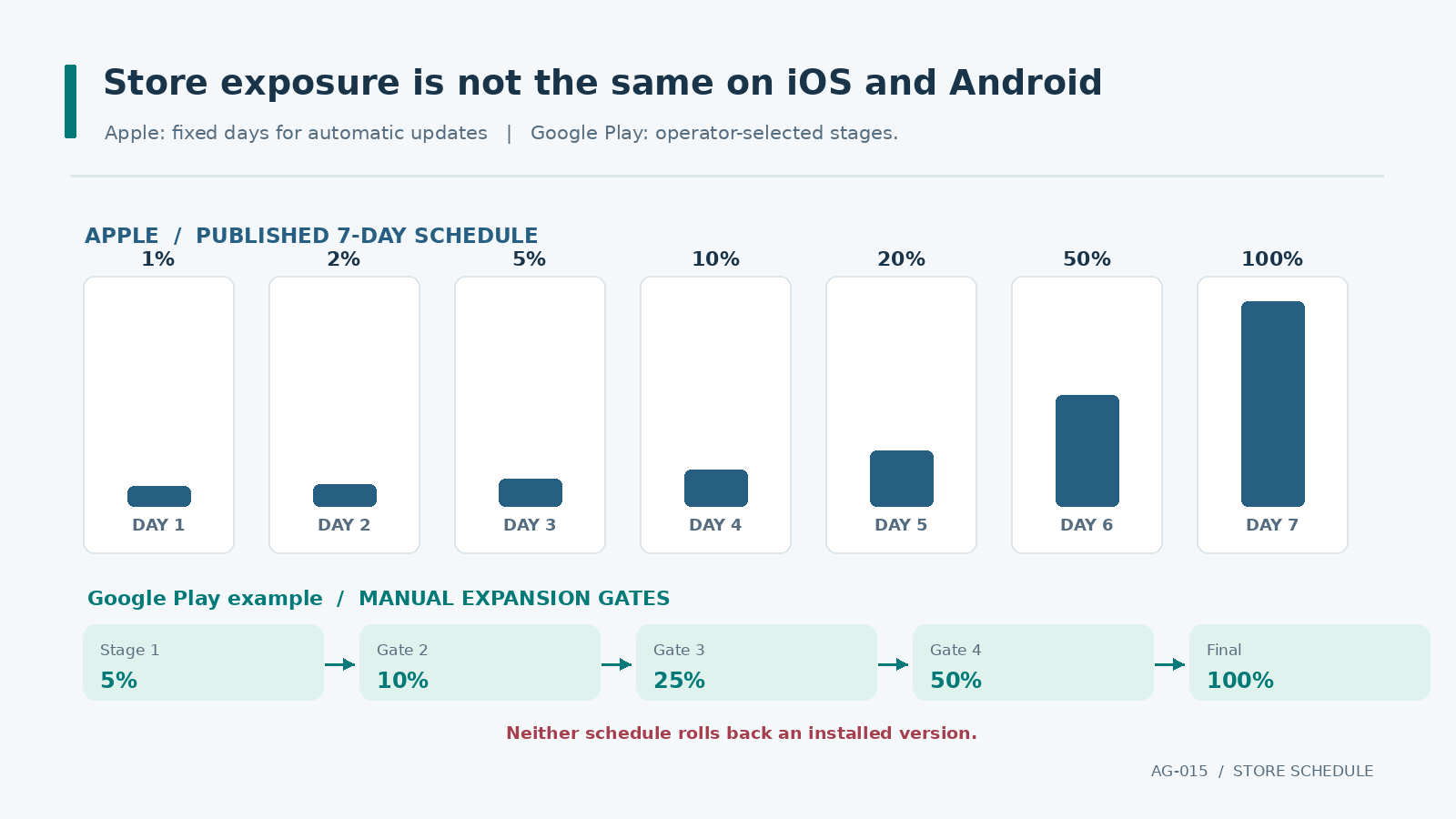
Apple and Google use different scheduling models. According to App Store Connect’s phased-release instructions, Apple’s seven-day sequence for eligible automatic updates is 1%, 2%, 5%, 10%, 20%, 50%, 100%. Users can manually download the new version during that period. The percentage is therefore not a hard cap on all installed copies.
Google Play staged rollouts let a team select and increase an update’s percentage manually. They apply to updates, not a first publication, and newly eligible users may receive the update over time. A halted and resumed rollout continues with the same user selection at a given percentage. Google also supports country selection for production staged releases, but the country restriction is based on the Google Play account’s location, not a legal determination of the player’s physical location.
| Operational question | Apple App Store | Google Play |
|---|---|---|
| First public app release | No phased-update option | No staged-update percentage |
| Exposure progression | Fixed seven-day automatic-update schedule | Manual percentage changes |
| Ability to pause a partial update | Pause for up to 30 days total | Halt, then resume or replace release |
| Who may still receive the update? | Manual downloaders in eligible storefronts | Users selected for the rollout; existing recipients retain build |
| Territory controls | Storefront availability is separate from phased selection | Country selection possible; account location is not geofencing |
A practical cross-platform calendar might call for Android 5% → 10% → 25% → 50% → 100%, with explicit observation and sign-off at each step. Those Android percentages are illustrative, not Google defaults. Apple cannot be configured to match that sequence; plan staffing around its actual schedule and pause when a gate is not met.
Store selection does not replace in-app location, identity or licensing controls. Apple’s gambling review rules and Google Play gambling policy require appropriate authorization and geographic restrictions. Resolve eligibility in the submission workflow, then recheck its functioning at every rollout gate.
Define Measurable Go/No-Go Quality Gates
Use a small number of decision metrics with population, denominator, observation window, baseline, threshold and owner recorded in advance. Segment by build, OS, device class and licensed market wherever your instrumentation permits. A fleet-wide average can conceal a fault affecting one release or one jurisdiction.
| Gate | Example observation | Example decision rule — customize before use |
|---|---|---|
| Critical player protection | Self-exclusion, age and geo-block negative tests | Any verified bypass = STOP |
| Wallet and settlement integrity | Ledger reconciliation, duplicate transaction checks | Any unresolved money mismatch = STOP |
| Login and key journeys | Synthetic probes plus version-filtered production attempts | HOLD on material unexplained regression |
| Crash and ANR health | Affected-user rate by version and device | HOLD if above an approved baseline tolerance |
| API latency and errors | p95 by endpoint, market and build | HOLD after sustained breach of the agreed limit |
| Telemetry confidence | Version tagging, event ingestion, sample coverage | HOLD if the gate cannot be measured |
The STOP rules for verified safety and ledger failures reflect the template’s risk policy, not a universal statutory threshold. For reliability, a sample release rule might be “p95 login latency above 1.2× its pre-release baseline for two successive 30-minute windows triggers HOLD.” That number is deliberately fictional; replace it with a threshold based on your system and business risk. Choose the minimum sample size and observation window before launch. If the cohort is too small to distinguish signal from noise, extend the watch period rather than declaring success.
Google’s Android vitals includes user-perceived crash and ANR rates; App Store Connect Analytics provides app usage and crash metrics subject to collection and privacy limitations. These are useful lagging views, not necessarily real-time release brakes. Own operational signals such as ledger exceptions and eligibility denials must be instrumented separately. For KPI definitions rather than release logic, use the gambling app quality KPI guide.
Plan Stop Actions and Rollback Constraints
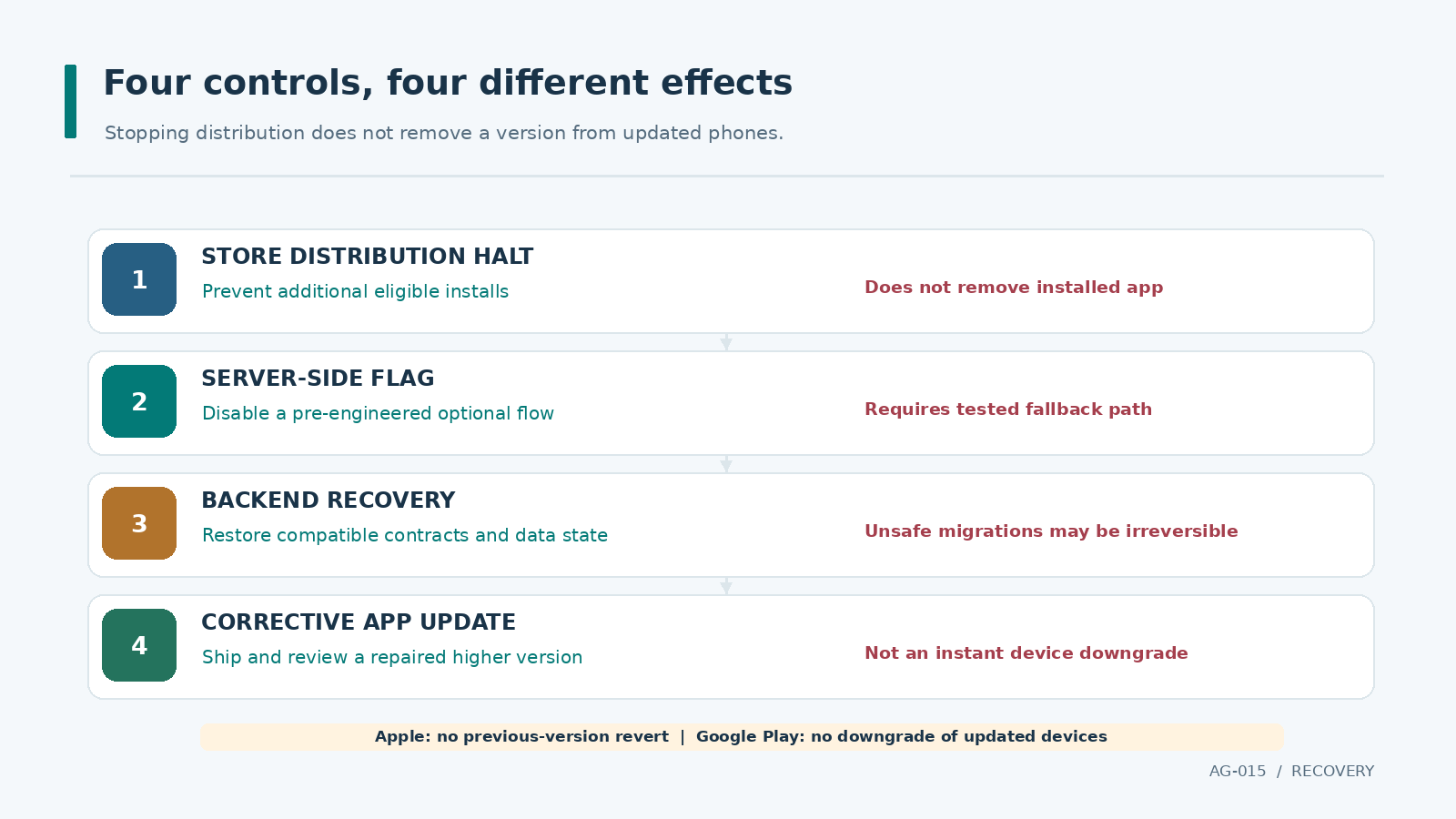
A rollout stop is not the same as a rollback of software already installed. Keep four separate controls in the runbook: distribution halt, remote feature disablement, backend recovery, and corrective app update. Test each independently. A flag can disable a risky optional flow only if it was built and tested to do so; it cannot repair arbitrary native crashes, unreverse a settled payment, or guarantee that a disconnected client will receive a new configuration.
On Apple, the phased-release control can pause the automatic-update progression for 30 days cumulatively. Manual download remains possible while the app is available. Apple also states that you cannot revert the App Store to a previous version; a correction requires submission of a new version. Removing an app from sale is not a routine rollback switch and can end the phased release for that version.
On Google Play, halting a partial staged rollout prevents additional users from receiving that version, but existing recipients remain on it. Google now also documents halting a fully rolled-out release: on eligible tracks, a previously live fully rolled-out version can become available again to new users and users not on the halted version. This does not downgrade devices that already installed the defective release; the first release on a track cannot use this mechanism, and an ineligible previous version cannot be restored.
| Fault class | Immediate containment | What containment does not do |
|---|---|---|
| Optional feature defect | Halt expansion; turn off approved server flag | Remove the installed code |
| Native app crash | Halt distribution; prepare fixed build | Downgrade updated devices |
| Backend API incompatibility | Restore a compatible server contract or deploy a safe fix | Reverse an unsafe migration automatically |
| Settlement or eligibility breach | Stop affected activity; preserve evidence; activate incident process | Replace reconciliation or legal reporting |
Record the Decision and Hand Off to Incident Response
At each stage, record the following in one decision log rather than reconstructing approvals from chat messages:
- Release, app-build and backend-deployment IDs; platform and approved markets.
- Current exposure, proposed next exposure and observation window.
- Dashboard links, sample coverage and any unresolved control failures.
- Named approvers, decision time and GO, HOLD or STOP outcome.
- Exception rationale, next review time and related change or incident ID.
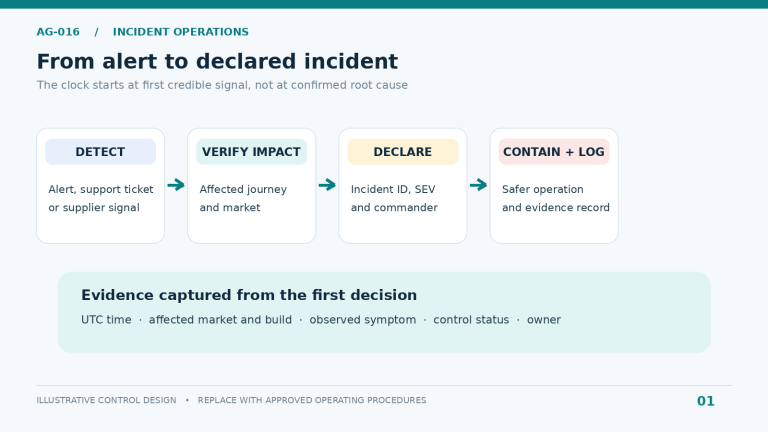
If a STOP reveals player harm, disputed funds, a security breach or substantial service interruption, transfer control to the incident commander. Freeze the expansion, preserve timestamps and affected-version information, record whether account restrictions and financial records remain accurate, and let the incident process coordinate investigation, required notifications and user communications. The proposed gambling app incident response runbook owns severity and communication procedures; this rollout plan owns only the deployment stop and transition. Device selection and pre-release coverage are separately addressed in the planned device testing matrix.
The companion go/no-go workbook provides pending-by-default release gates, approvals, stage planning, a stop-control reference and a decision log. Download the release gate CSV, RACI template and rollback control matrix to import the same fields into an existing release tool. The workbook defaults to NO-GO / HOLD until required controls have evidence and named approval. Do not use its sample entries as proof of readiness.
FAQ
Can Apple phased release be stopped before all users update?
Yes. Apple permits a cumulative 30 days of pauses during the seven-day automatic-update rollout. Pausing does not stop eligible users from manually downloading the version, and it does not remove it from devices that have already updated.
Does halting Google Play staged rollout roll users back?
No. A partial rollout halt stops additional distribution of that version. A separate Google Play feature can halt certain fully rolled-out releases and serve an eligible previous version to other users, but users already on the affected version are not automatically downgraded.
Should an Android 5% cohort use the same threshold as Apple day one?
Not automatically. The platforms select and expose users differently. Review the actual installed-build sample, territories, device mix, telemetry delay and observed risk before comparing cohorts or promoting either release.
What overrides normal go/no-go metrics?
A verified bypass of player-protection controls, a material wallet or settlement mismatch, or an uncontained security issue should trigger the applicable STOP and incident path under the operator’s approved risk policy—even when crash and latency dashboards look normal.
Editorial and regulatory note: This is a technical release-governance template, not legal advice or authorization to distribute gambling products. The threshold examples and Android schedule are fictional. Apple and Google documentation was checked on 3 November 2026. Before publication or live use, verify the current store controls, licensed markets, actual platform permissions, monitoring reliability and approved incident procedures.