A gambling app SDK privacy audit checks what third-party code actually receives, why it receives it, who controls the information and what happens when a player refuses consent or requests deletion. It is not complete when a team has collected privacy policies or filled in app-store disclosures. The defensible result is an approved inventory linked to observable data flows, vendor evidence, legal decisions and release tests.
Quick answer: List every embedded SDK and server-side service; identify data types, recipients and purposes; capture network traffic in controlled test environments; map applicable lawful bases and platform permissions; inspect vendor contracts and retention commitments; then block release of any flow whose purpose or safeguards remain unresolved. Run the same checks when a library, configuration or recipient changes.
This guide is for privacy engineers, mobile product owners and vendor managers working on licensed gambling products. It focuses on data-processing governance rather than event naming, quality KPI selection or app-store eligibility. The proposed inventory and examples are synthetic; they do not describe any particular operator or SDK vendor.
Identify Every SDK and Data Recipient
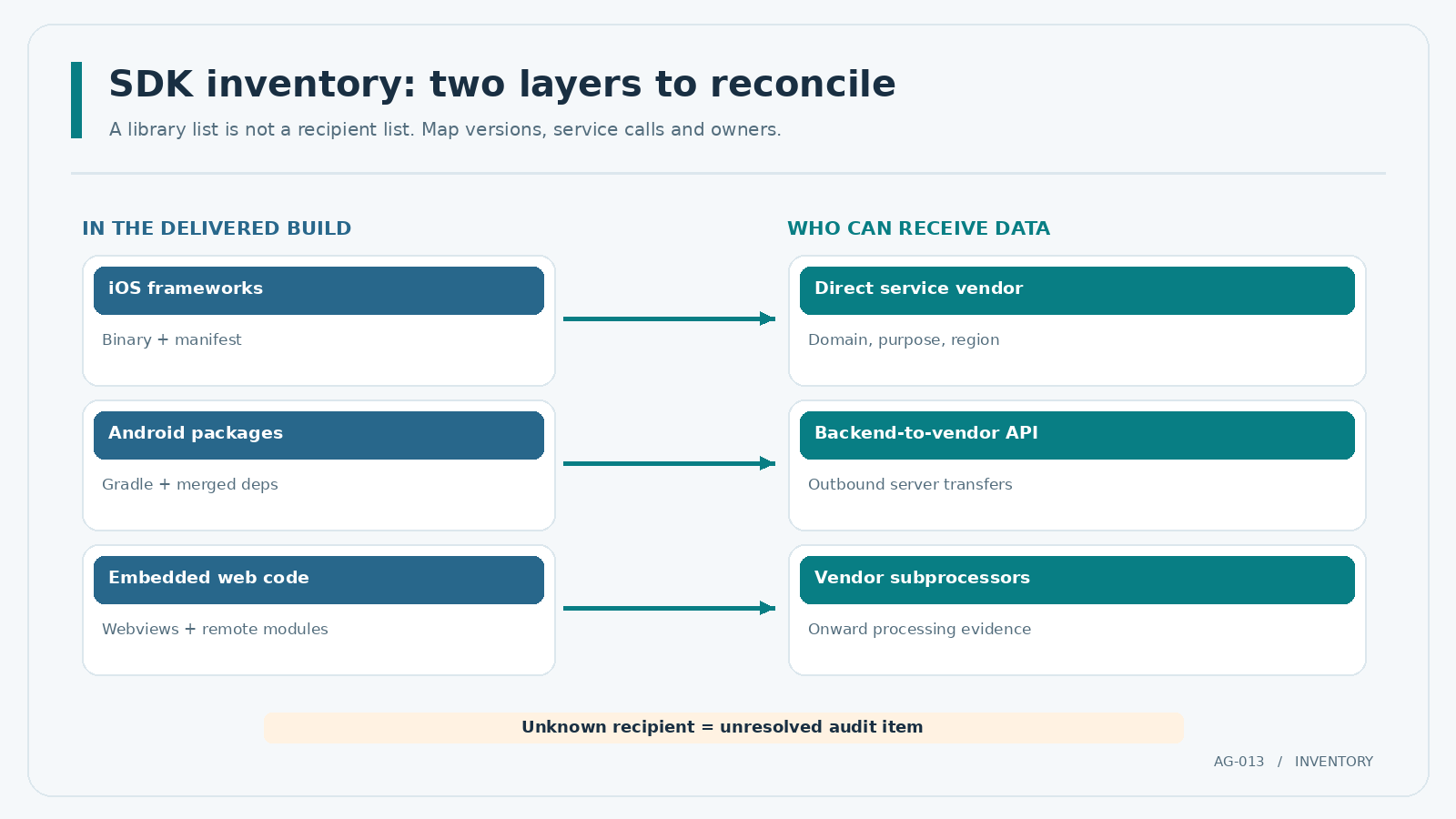
Start from the deployed build, not a supplier questionnaire. A dependency list might show a crash-reporting SDK, identity verification component, support-chat library, payment-related module and geolocation service. Yet some of their processing may occur through embedded webviews, remote configuration, backend-to-vendor APIs or subcontracted subprocessors that are invisible in the app’s package list.
Compare iOS dependency records, Android Gradle dependencies, compiled frameworks, network observations and the vendor register. Record exact versions where possible. Include native code pulled in transitively, remotely loaded components, web SDKs used inside the app and services that receive data from your backend. The audit must distinguish code installed on a device from organisations receiving data; one SDK can communicate with several recipients.
For each entry, name a product owner and a technical owner. Record why the integration exists and what would fail if it were removed. Mark unknown behaviour as unverified, not as no collection. Apple’s third-party SDK requirements make clear that developers are responsible for third-party code they integrate; Google’s SDK guidance likewise calls for knowing SDK permissions, collected data and purposes.
| Audit field | Example entry (fictional) | Evidence to retain |
|---|---|---|
| Component and version | ExampleCrash SDK 4.x | Package lockfile; build identifier |
| Function and owner | Error diagnostics; mobile SRE | Approved service request |
| Data types and identifiers | Crash trace, device model, pseudonymous app ID | Vendor data dictionary; captured requests |
| Recipients and locations | Vendor endpoint; hosting region pending review | Network log; vendor hosting statement |
| Purpose and approval | Reliability; pending legal assessment | Purpose register; reviewer decision |
| Retention and deletion | Vendor schedule not yet verified | Contract clause; deletion-test record |
| Review status | Blocked until evidence is complete | Issue ID and named decision owner |
Map Data Flows, Not Just Data Categories
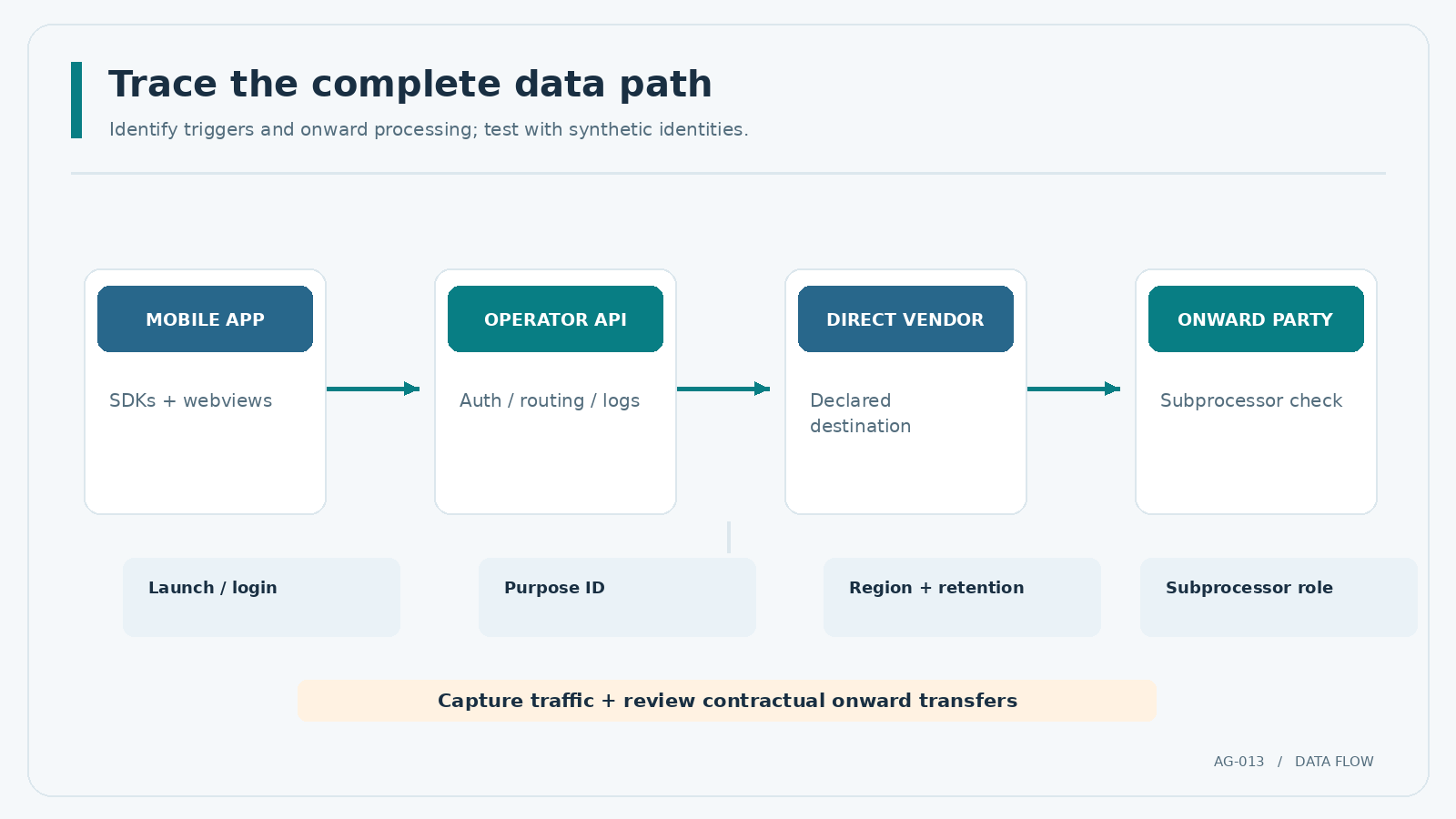
For each purpose, create an arrow from the source to the recipient, and annotate the data categories, conditions, transfer method and retention point. In gambling apps, the same account may interact with fraud checks, age and identity verification, responsible-gambling safeguards and technical support. Those purposes should not be collapsed into one generic field called “analytics.”
A useful map separates the app, the operator’s backend, service providers and any onward processors. It should show when a request starts: at installation, first launch, login, permission grant, transaction, crash or support contact. A vendor’s statement that data is “pseudonymous” does not prove that it cannot be linked to a person when identifiers, precise location or account context are present.
Validate the map in a staging environment with test identities, after consent refusal and after consent withdrawal where relevant. Review request destinations, payload categories, embedded identifiers and configuration flags. Do not insert real player records into diagnostic traffic captures; redact secrets and control access to the evidence repository. Check server-to-server transfers separately, because observing the phone cannot reveal every onward data recipient.
| Fictional flow | Decision question | Recommended audit evidence |
|---|---|---|
| Crash diagnostics → diagnostics provider | Are account identifiers removed or necessary? | Test capture; SDK settings; purpose approval |
| Identity check → verification vendor | Which records move onward, and for how long? | Data map; processor terms; retention schedule |
| Location check → eligibility service | Is precise location necessary for the approved market? | Technical specification; market/legal review |
| Support message → helpdesk | Can notes contain sensitive account information? | Field controls; access review; deletion procedure |
| Attribution component → external endpoint | Is this necessary, permitted and disclosed? | Recipient analysis; tracking and consent assessment |
The Apple App Privacy guidance requires developers to describe data collected by integrated third-party partners. Google’s Data safety instructions cover collection and sharing by SDKs, with precise definitions and exceptions. The declarations are reporting outputs derived from the audit, not substitutes for packet-level and contractual evidence.
Review Consent, Legal Basis and SDK Initialization
Avoid a single “consent: yes/no” field. Each processing purpose needs an approved basis under applicable law, a separate platform-policy assessment and a technical rule for when the SDK may initialize or transmit data. A processor doing essential account security work can have different requirements from a library that measures advertising attribution.
For a UK example, the ICO explains that consent is one possible lawful basis, not the default for every processing activity. Where consent is the chosen basis, it needs a genuine choice and a workable withdrawal mechanism. Relevant device or platform permission prompts do not by themselves establish a complete legal basis. Obtain counsel’s decision for each target jurisdiction and product category; this worksheet cannot make that decision automatically. See the ICO’s lawful-basis guidance and consent guidance.
On iOS, Apple’s App Tracking Transparency guidance addresses permission for defined cross-company tracking and access to the advertising identifier. On Google Play, the User Data policy includes prominent disclosure and affirmative consent requirements in specified circumstances, especially where sensitive data use would not be reasonably expected. Neither rule means that every SDK requires the same prompt. Record which rule applies, why, and how the product enforces it.
Test the initialization sequence explicitly:
- Launch with no saved preference and capture pre-choice transmissions.
- Decline an optional purpose; verify the relevant SDK does not collect or transmit data for that purpose.
- Accept the permitted purpose; verify only approved recipients and fields appear.
- Withdraw the choice; check future collection stops and that previously collected data is handled according to the approved rules.
- Reopen the app, switch accounts and update the SDK; repeat the test across both platforms.
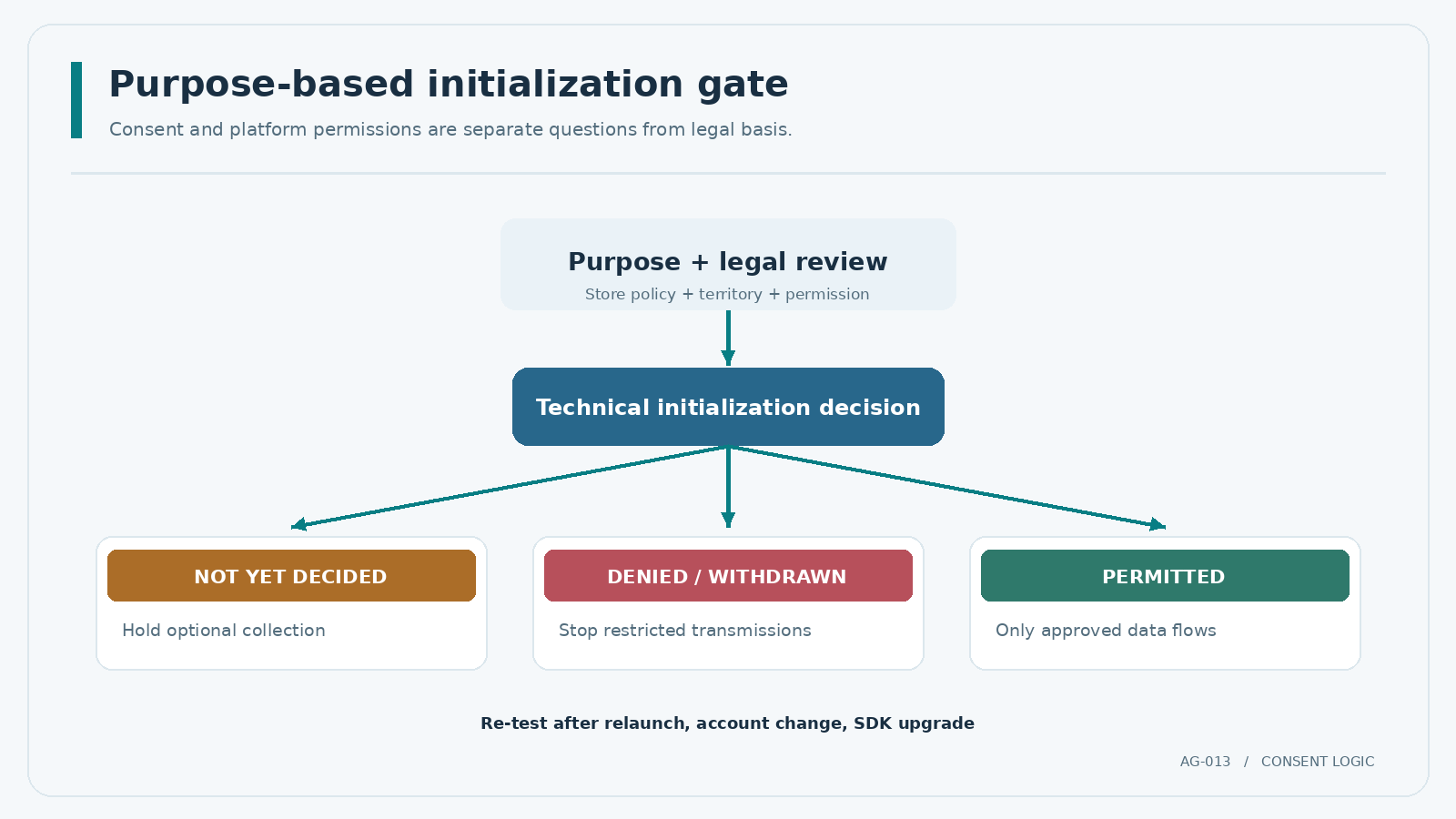
These tests should use explicit environment and build IDs. A locally disabled SDK does not demonstrate that a vendor has deleted existing records. Treat prevention of new collection and erasure of retained data as separate controls.
Request Vendor Evidence and Check Contractual Controls
Supplier responses are useful only when linked to a specific product, SDK version, service configuration and contract. Request the vendor’s data categories, processing purposes, recipient map, subprocessors, hosting and transfer arrangements, security controls, breach-notification commitments, retention schedule, deletion interfaces and change-notification practice. Keep the version and retrieval date of each document.
Where a vendor acts as a processor under the relevant UK GDPR framework, the ICO’s contracts guidance identifies obligations covering documented instructions, confidentiality, security, subprocessor arrangements, assistance with individual rights, end-of-contract treatment and audit provisions. The legal classification must be determined for the actual relationship: a provider calling itself a “processor” on a website does not settle its role for every data use.
Prioritize gaps, not document volume. A security certificate cannot explain an undisclosed recipient; a vendor privacy policy cannot verify a deletion API; and a privacy manifest cannot prove that runtime traffic matches declared behaviour. Escalate conflicts between contract wording, SDK documentation and observed network data rather than choosing the most reassuring document.
| Evidence request | Responsible reviewer | Escalate if… |
|---|---|---|
| Current data map and subprocessors | Privacy / vendor management | A recipient or independent purpose is unknown |
| Contract, roles and transfer terms | Legal / procurement | Rights, instructions or regional transfers lack approval |
| SDK privacy manifest and dependency record | iOS engineering | Required declarations are missing or inconsistent |
| Google Play SDK / Data safety information | Android engineering | Disclosure does not match actual processing |
| Security and incident commitments | Security / operations | No credible reporting or access-control route exists |
| Retention, export and erasure process | Privacy / service owner | Deletion cannot be demonstrated or exceptions are unexplained |
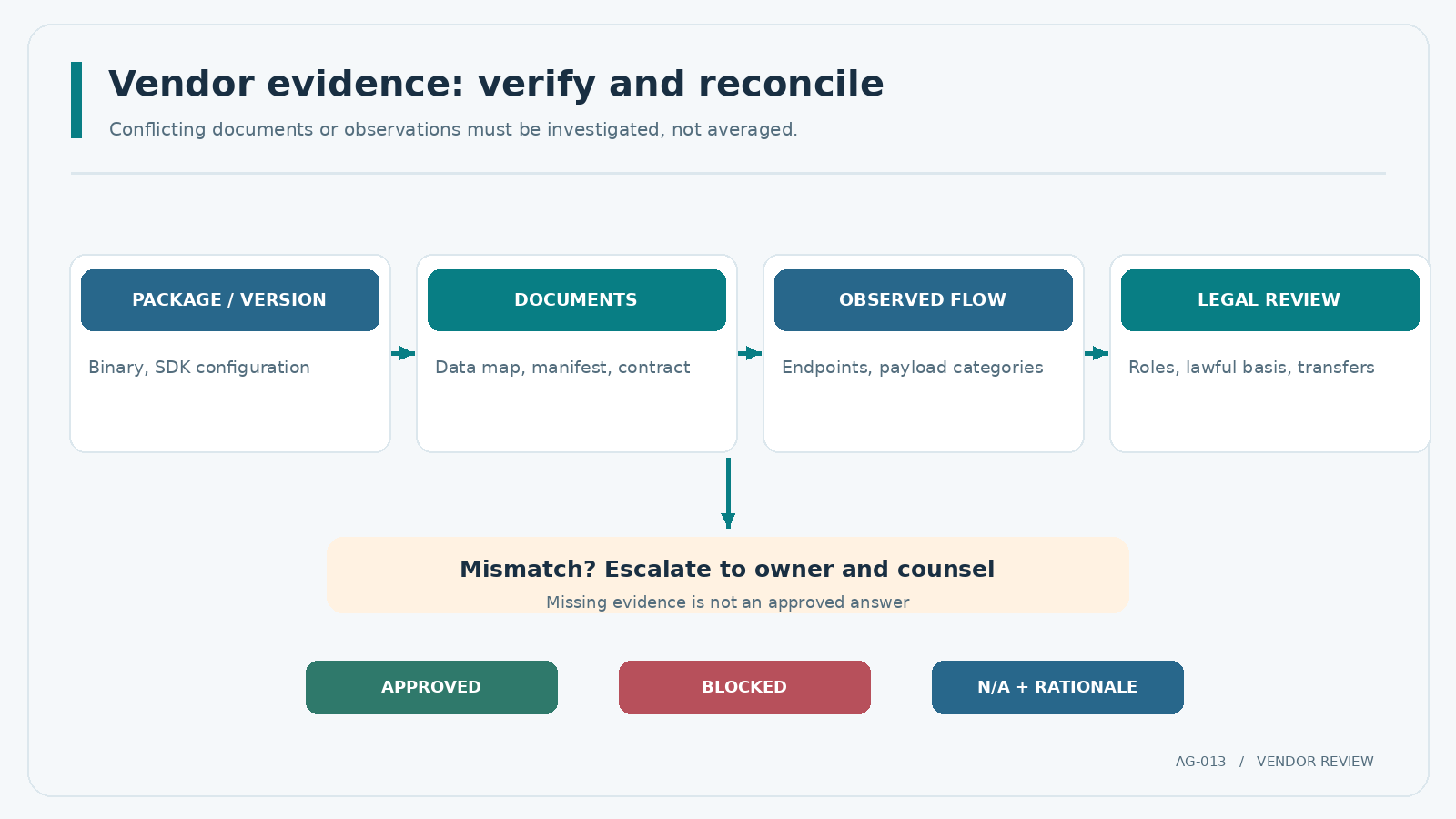
For iOS, privacy manifests, required-reason API declarations and SDK signatures have specific Apple requirements; determine which apply to the bundled SDK. On Android, the Google Play SDK guidance and policy notices help identify some version-related problems. Passing these checks does not certify the whole integration as privacy-compliant.
Verify Retention, Deletion and Change Handling
A retention policy is not a tested control. Record the retention trigger, period, deletion mechanism, backup treatment, exceptions and proof of completion for each vendor-held dataset. Account closure, withdrawal of optional consent and a valid deletion request may trigger different workflows. Statutory record-keeping requirements can also limit immediate erasure; counsel should document any applicable exception rather than silently treating every record as deletable.
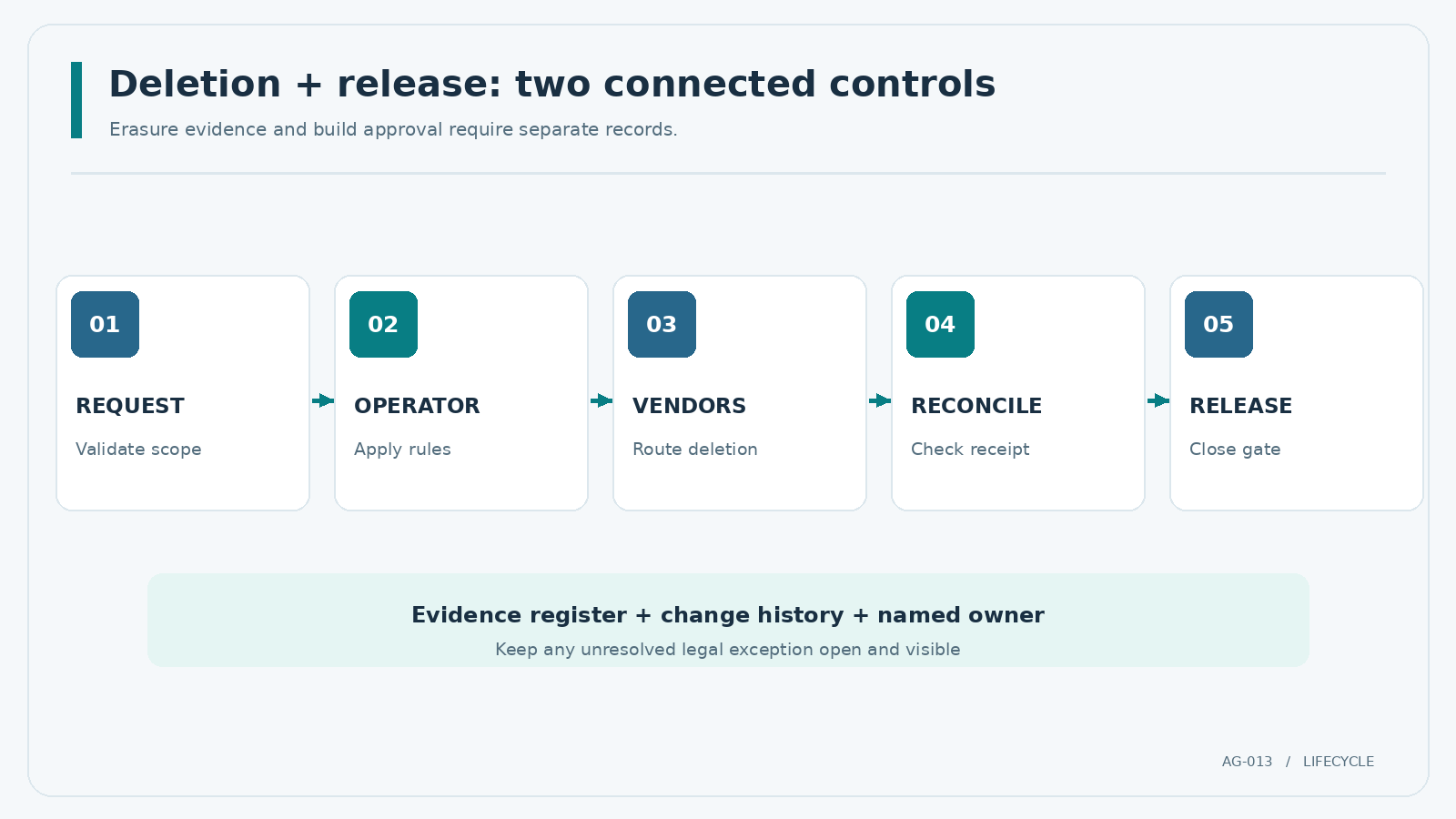
Run a synthetic deletion exercise. Create a test record, confirm it reaches the approved recipient, initiate the relevant deletion path, verify acknowledgments and examine whether the vendor can provide evidence that the record was removed or restricted under the applicable rule. Do not equate the removal of an app’s local cache with deletion from the operator’s systems or the provider’s archives.
Repeat the assessment when a new SDK is introduced, a permission changes, a vendor adds a subprocessor, a data field is added, the destination region changes, or a retention period is revised. The release request should link the prior approval to the new code or configuration diff. Keep a dated history so reviewers can reconstruct what was approved for each version.
Use a Release-Ready Privacy Audit Worksheet
A useful gambling app third-party SDK inventory is a working control register, not a static procurement spreadsheet. Attach a data-flow ID and a purpose ID to every integration. Assign engineering ownership of the observed behaviour, legal ownership of lawful-basis decisions and procurement ownership of vendor evidence. Each item should finish in one of three states: approved, blocked, or not applicable with documented justification.
The companion workbook contains a synthetic SDK register, purpose-and-flow inventory, vendor evidence requests, a retention review and release gates. Its example rows are intentionally open; they must not be copied into a production sign-off as completed evidence. The release decision should remain blocked when a critical flow lacks approved purpose, verified recipient, applicable legal assessment, vendor evidence or runtime test.
Before signing off, compare the approved register with Apple App Privacy details, Apple’s privacy-manifest report, Google Play Data safety answers, the in-app privacy notice and the current build. Differences trigger investigation, not retroactive rewriting of the audit to match a store form. This article does not replace the app-store submission requirements, the quality KPI dictionary or the planned analytics event taxonomy. Agency procurement questions are covered separately in the development partner due-diligence checklist.
A practical review cadence is at onboarding, before each material integration change and after a relevant vendor or policy alert. Record the review date rather than implying that a one-time sign-off covers future SDK releases.
Editable resources: SDK privacy audit workbook (Excel); vendor evidence requests (CSV). These templates contain example inputs and require project-specific review before operational use.
FAQ
Is an SDK privacy manifest enough for an iOS audit?
No. A privacy manifest provides structured declarations and supports App Store reporting, but an operator should still verify actual network behaviour, recipient purpose, contracts and retention practices. Apple’s requirements apply to particular API uses and third-party SDK circumstances.
Does every gambling app SDK need consent?
Not necessarily. The applicable legal basis and platform requirements depend on the purpose, data, market and processing arrangement. Optional tracking, essential security processing and regulatory checks should not be grouped under a single invented rule. Counsel must approve the distinctions.
How can an audit identify undeclared SDK data transfers?
Compare packaged dependencies and vendor records with controlled network captures, both before and after relevant permissions or choices. Check embedded webviews and server-to-server integrations separately. An unexplained endpoint requires further investigation; a network log alone does not prove legal compliance.
When should a privacy audit be repeated?
Repeat the affected checks after SDK upgrades, new recipients, modified purposes, permission changes, regional hosting changes or altered retention terms. Archive the old and new versions with a named approver and the exact build tested.
Editorial and legal note: This is a technical governance template, not legal advice or a finding about any real gambling operator or software provider. Platform policies and privacy rules vary across jurisdictions and change over time. Official sources were checked on 3 November 2026. Publish only after an authorized reviewer confirms the target market, legal basis, vendor evidence and the live build.