A gambling app event taxonomy is a versioned contract between the mobile app, the analytics pipeline and the team checking data quality. It identifies which approved quality signals may be collected, what each event means, which properties it accepts, and how engineers prove that instrumentation works. Without that contract, similar screen failures acquire different names, optional fields silently become required, and a blank dashboard can be mistaken for a healthy product.
Quick answer: Start from an approved quality-measurement requirement; assign one event owner and a precise trigger; document a fixed name and typed, allowlisted properties; require a privacy decision before collection; then test the event at source, transport and destination. Treat a missing event as an observability question, not proof that a user completed a task. The examples below are entirely fictional and do not authorize collecting real player data.
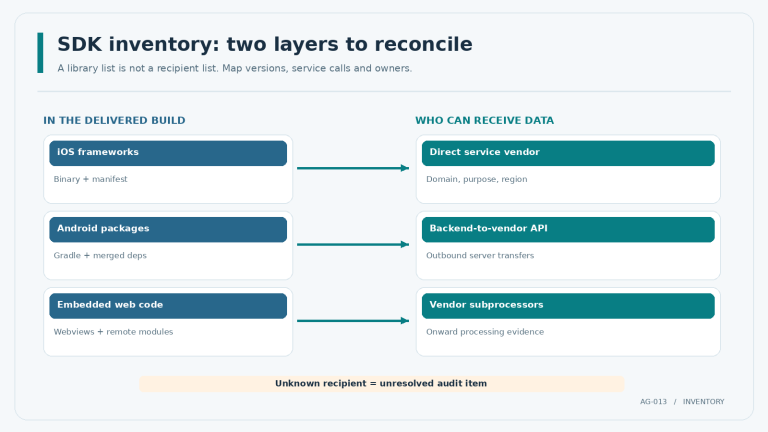
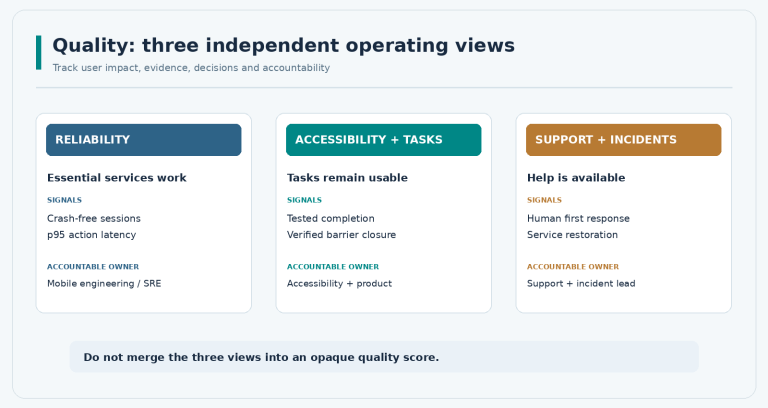
This guide addresses technical instrumentation only. The quality KPI dictionary defines which outcomes matter and how their denominators work. The SDK privacy audit owns vendor, consent, retention and disclosure decisions. This specification implements neither player profiling nor revenue optimization.
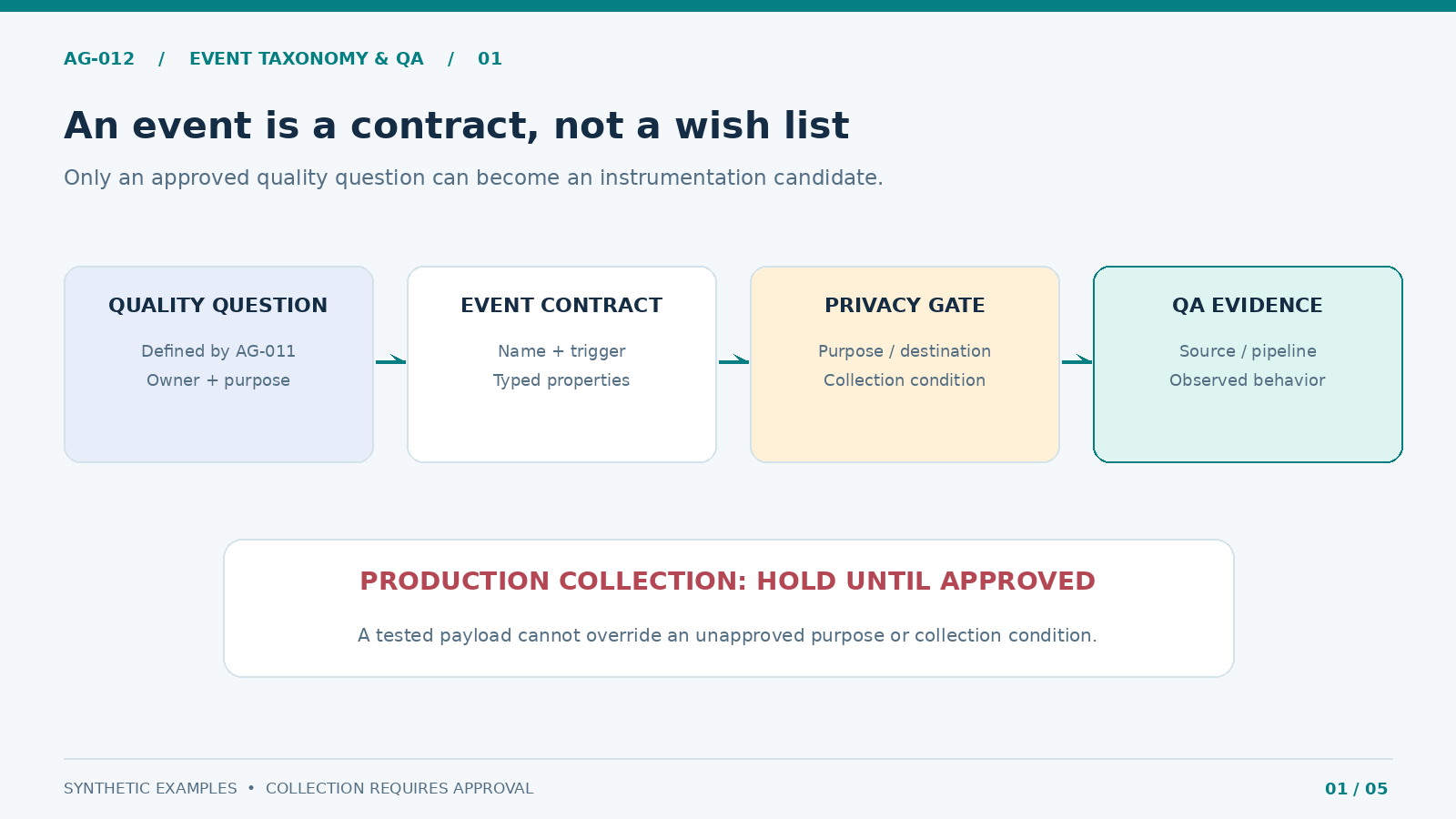
1. Convert Approved Quality Questions Into Event Contracts
Before writing instrumentation code, ask for the quality question, its approved purpose, its decision owner and the evidence that cannot be obtained from a less intrusive source. Start with device crash tooling, backend service monitoring or supervised QA results when those can answer the question without adding player-linked analytics events.
For each proposed event, write a short contract: trigger → source → allowed properties → expected delivery → owner → test case. Keep user-interface state separate from server truth. For example, rendering an “available” status in the app shows that a component displayed; it does not establish that the underlying request succeeded. A backend success event and a UI-ready event should not be substituted for each other.
| Approved quality question | Example signal | Boundary that prevents misreading |
|---|---|---|
| Did a non-sensitive service response reach the client? | api_request_finished |
Client-side observation; not a server availability record |
| Was a screen technically ready to interact with? | app_screen_ready |
Rendering is not task completion or accessibility conformance |
| Was an error state visibly presented? | client_error_displayed |
Only allowlisted error classes; no free-text error messages |
| Was the support entry point operable in a test? | support_entry_opened |
Optional event; does not measure case resolution |
| Did a retry display a recovered state? | app_recovery_completed |
Require a matched QA scenario; not financial transaction success |
The event dictionary in the companion workbook includes these synthetic contracts. Each remains blocked for production collection until purpose, minimization, collection conditions and tests are reviewed. The accepted signal inventory should be much smaller than the list of all possible user interactions.
2. Set Naming Rules Before Instrumentation Starts
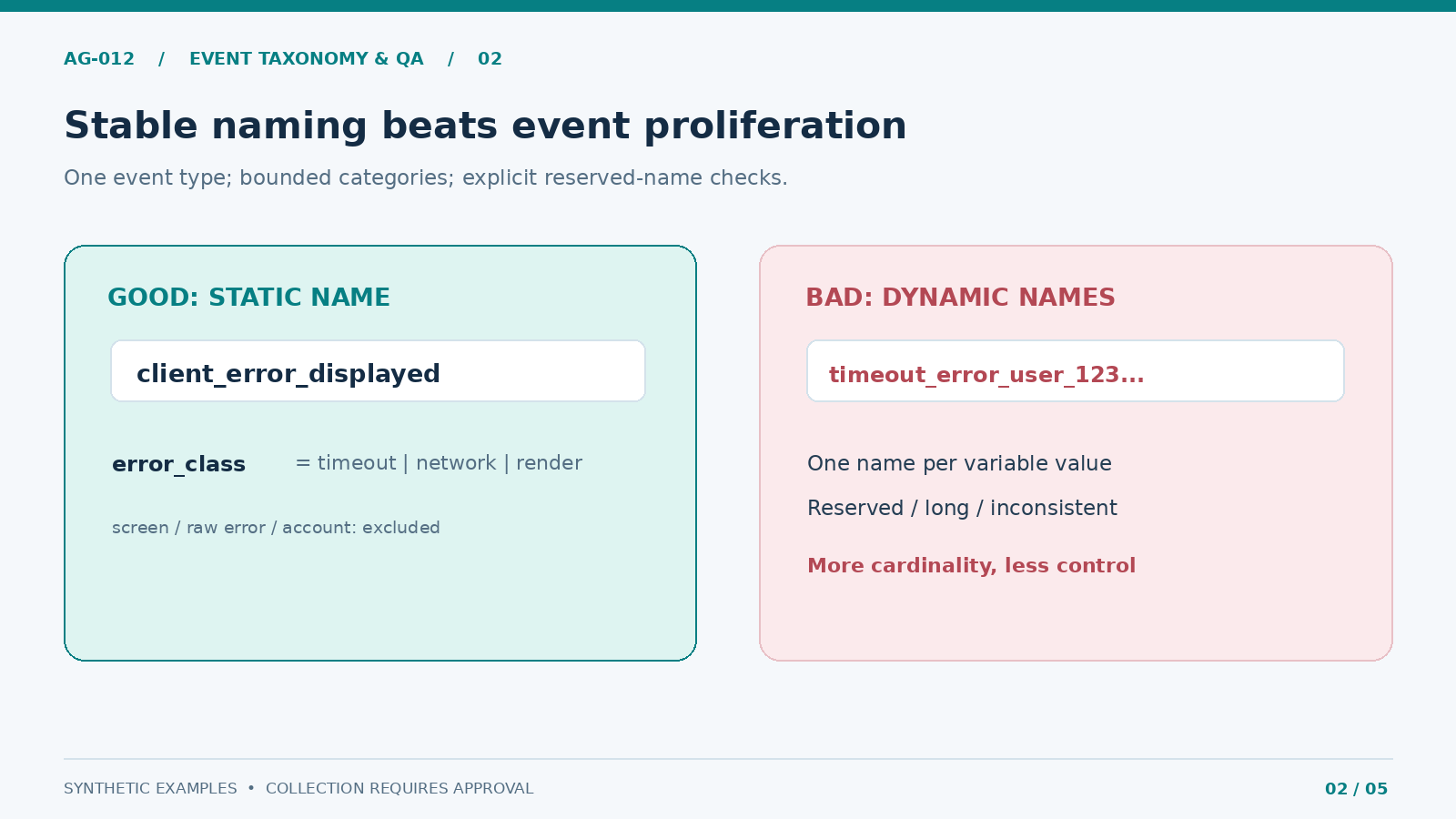
Choose one naming convention and enforce it in code review and CI. A practical house style is lowercase snake_case, with a stable object and a past-tense outcome, such as client_error_displayed. Use an enum property for a bounded category instead of generating event names from screen titles, error strings or dynamic identifiers. client_error_displayed with error_class=timeout is easier to govern than hundreds of timeout_error_on_... names.
If Google Analytics for Firebase is the destination, its event naming rules matter: names are case-sensitive, begin with a letter and use letters, numbers and underscores; some names and prefixes are reserved. Google’s collection limits include 40 characters per event name and 25 parameters per event. These are provider limits, not universal rules across analytics tools. Check the current SDK and destination documentation before deciding whether the same payload works everywhere.
Recommended local rules:
- Prefer one stable event for one observable outcome; state the exact moment it fires.
- Do not embed timestamps, OS builds, language values, names or identifiers in event names.
- Keep event naming identical on iOS and Android when the meaning truly matches; document platform exceptions.
- Mark system-automated or SDK-provided events as observed, not as new custom events; avoid collision with reserved names such as
session_startorapp_exception. - Never create a new event solely to evade a failed property contract. Revise the registry and re-test.
A registry entry needs an immutable event_id for documentation, even if the emitted event name changes. Keep deprecated aliases in the change log with a sunset date so old app versions remain interpretable. Names alone are not a versioning strategy.
3. Publish an Event Property Dictionary With Types and Allowed Values
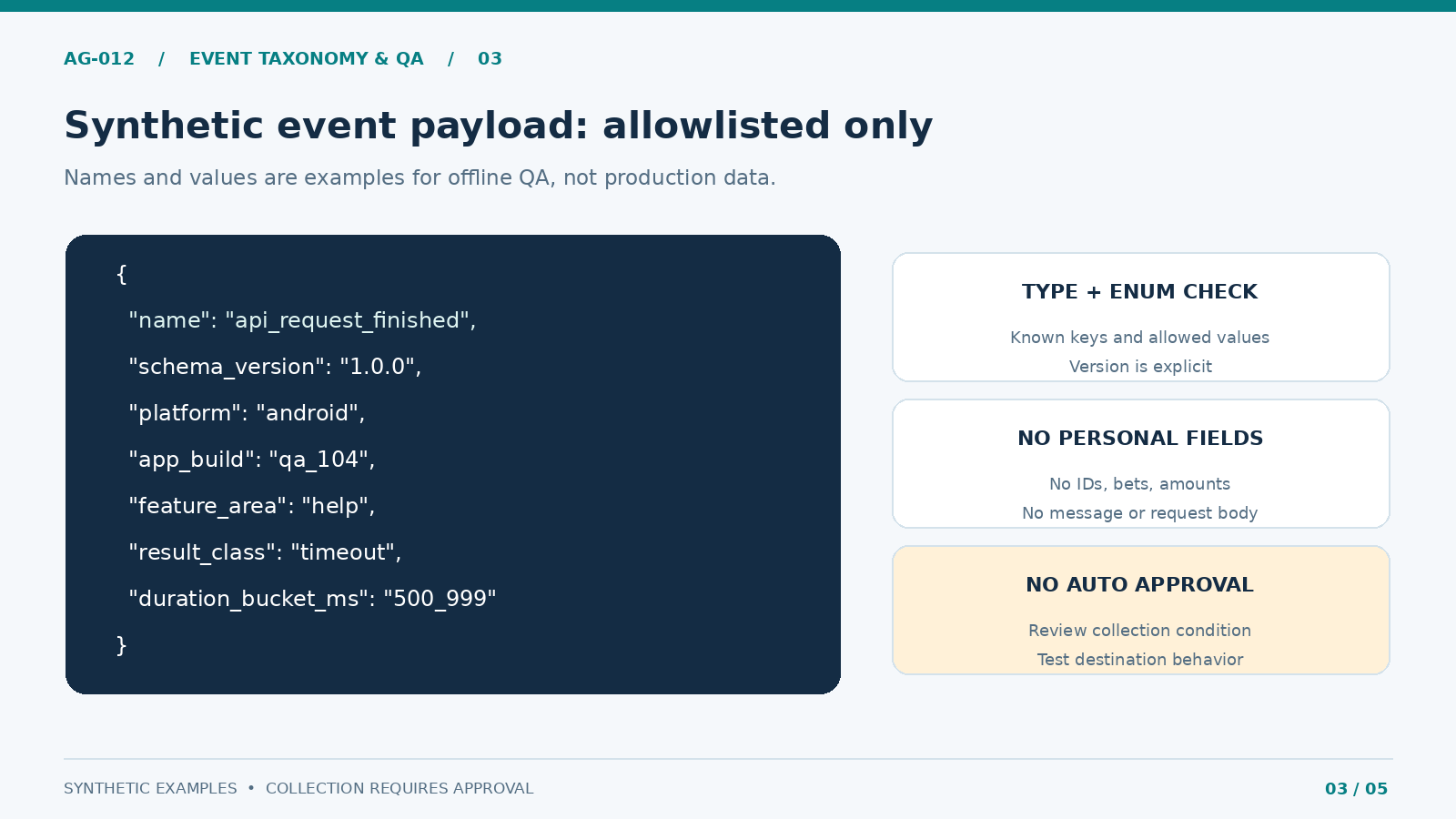
A schema should say what a property means, not merely that it is a string. Use typed, controlled categories such as platform (ios, android) and result_class (success, timeout, error). When a field can be missing, specify whether it means unknown, not applicable or a genuine collection failure. Those states must not be silently merged.
| Property | Example value | Type / allowed values | Collection rule |
|---|---|---|---|
schema_version |
1.0.0 |
String, registered version | Required for every custom contract |
platform |
android |
Enum: ios, android |
Required; no device identifier |
app_build |
qa_104 |
Allowlisted build label | Required for QA; deployment policy review for production |
feature_area |
help |
Enum: help, general, account_ui |
Technical category; no game title or monetary details |
result_class |
timeout |
Enum: success, timeout, error |
Only for request/recovery events |
duration_bucket_ms |
500_999 |
Enum of fixed latency ranges | Optional; do not send high-resolution traces |
error_class |
network |
Enum: network, render, unknown |
No raw exception, URL, account or message |
Do not copy request bodies, free-text form inputs, precise geolocation, account IDs, government identifiers, gambling choices, amounts or support conversation text into analytics. A field named metadata or context does not make unrestricted JSON safe. Where diagnostic logs are essential for operations, treat them as a separate system with its own access, purpose and retention decisions.
The registry should record default values, nullability, maximum length, ownership, redaction behavior, sample payload, downstream mapping and test assertions. The attached property dictionary CSV is an editable starting point. Ask each destination owner to confirm whether it accepts the proposed types: SDK-specific transformations can truncate, rename or ignore a field without stopping the app.
4. Put Privacy and Schema Review Before the Send Path
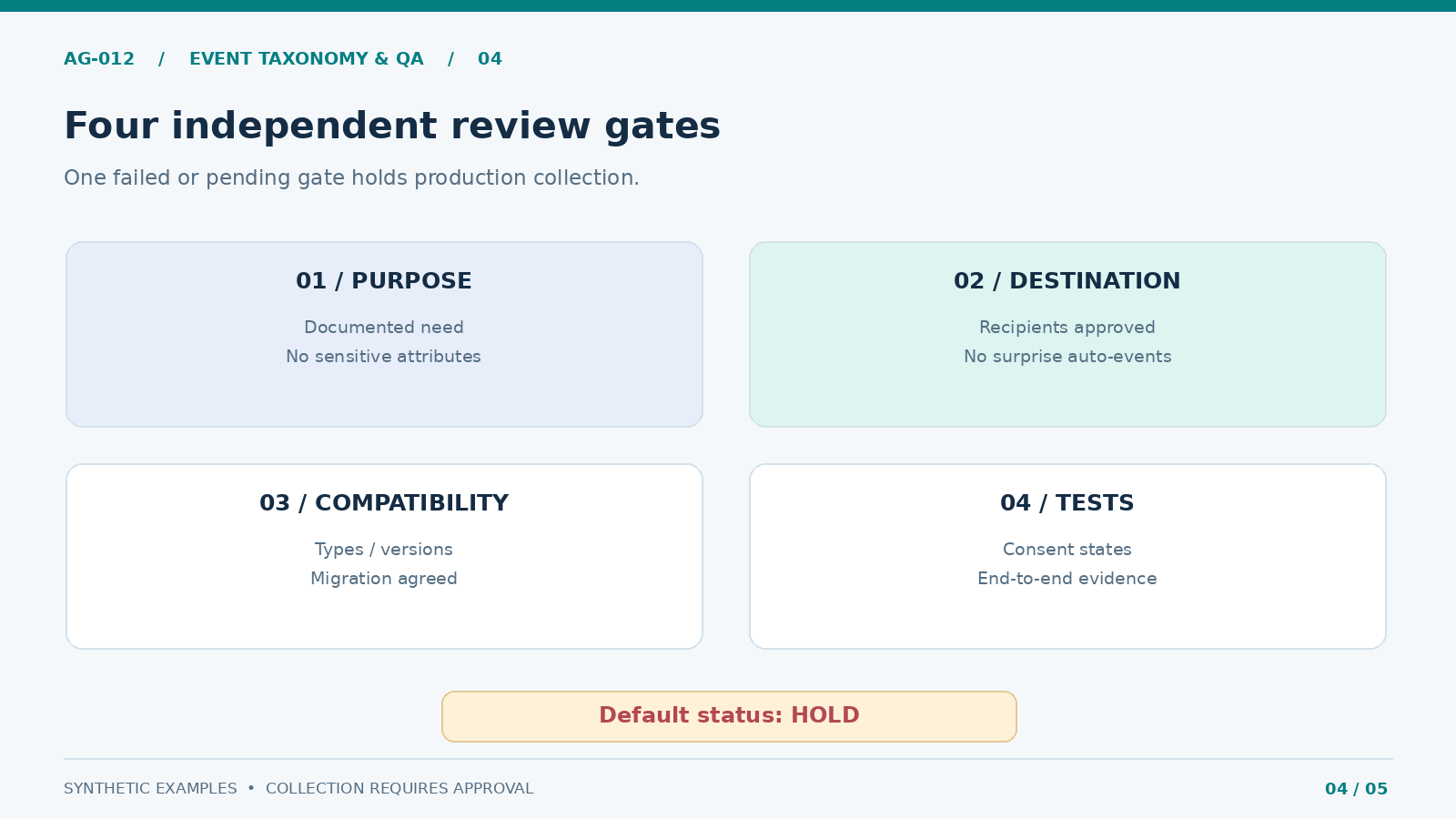
An analytics implementation should fail closed when collection authorization is unresolved. Each event needs a documented purpose, data classification, allowed destinations, retention decision and collection condition, reviewed against the applicable jurisdiction, platform policies and product architecture. “No direct name included” is not enough to establish anonymity or a lawful basis. The legal/privacy team determines when notices or consent are required; the instrumenting developer implements the approved control.
Test both permitted and not-permitted states. Some SDKs collect events automatically or buffer them before a custom logEvent call. For Firebase, the iOS and Android documentation describes collection enable/disable controls; verify actual SDK initialization and traffic, not only an in-app UI toggle. Apple’s App Privacy Details and Google Play’s Data safety guidance require a broader inventory of collection and sharing. That inventory belongs in AG-013, not in this event dictionary.
Use a schema-change request whenever event meaning, requiredness, property type, enum set, collection purpose or destination changes. A workable convention is MAJOR.MINOR.PATCH: increment major for breaking semantic/type changes, minor for approved backward-compatible optional fields, patch for documentation-only corrections. This is a team convention, not a rule imposed by an analytics platform. Maintain the registry effective date and supported app versions; never overwrite what an earlier version emitted.
| Gate | Reviewer | Block condition |
|---|---|---|
| Purpose and data minimization | Product owner + privacy reviewer | Purpose, classification or approval missing |
| SDK and destination mapping | Data engineering + privacy | Unexpected recipient, field or auto-collected data |
| Schema compatibility | Analytics engineering | Breaking change without migration/version plan |
| Test evidence | Mobile QA + analytics | Missing/duplicate events, wrong payload or untested refusal state |
5. Validate Source, Transport and Destination — Including Missing Events
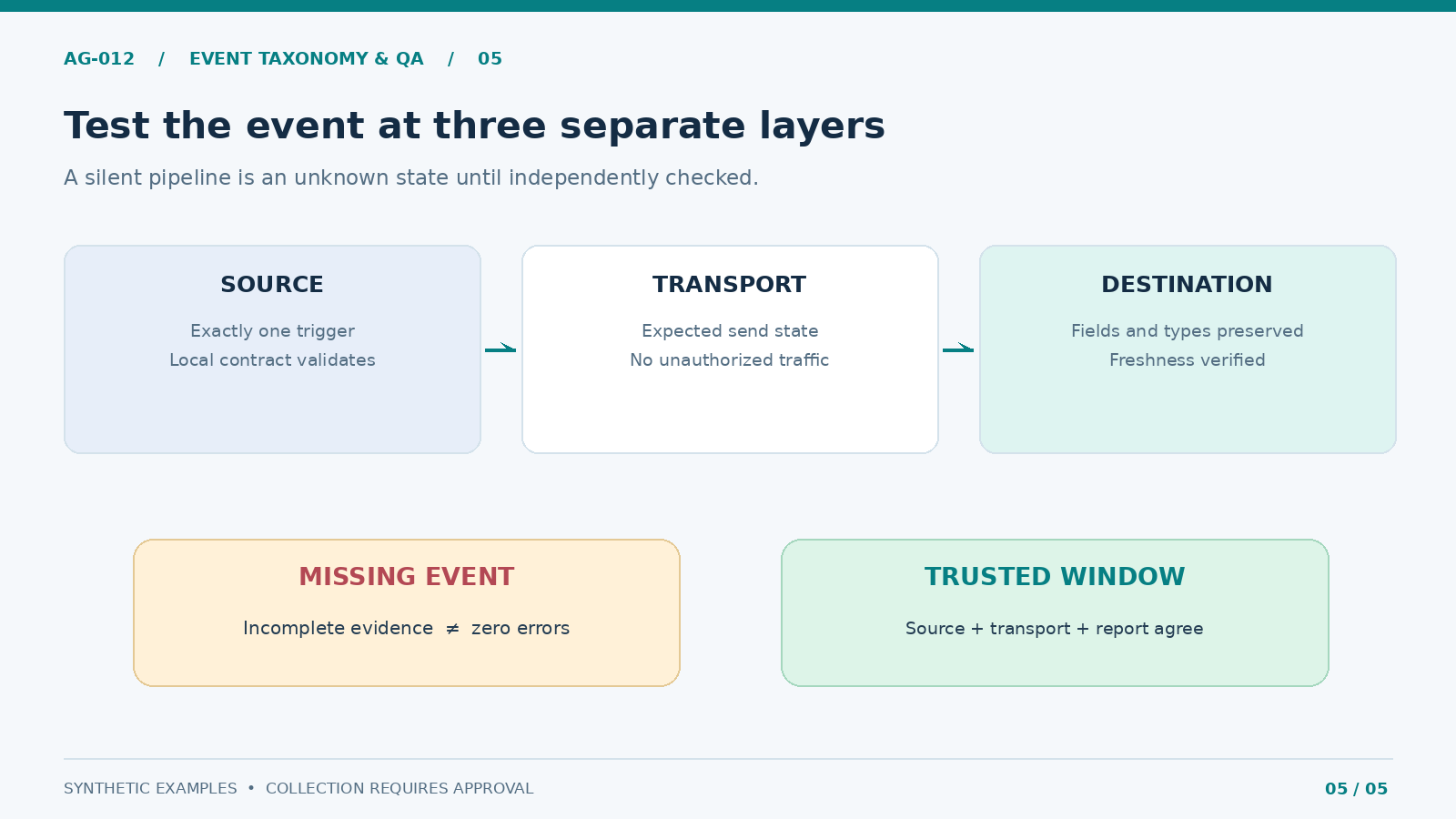
Run instrumentation QA on an isolated staging build with synthetic accounts and no real player data. Validate the source trigger first: one controlled action should produce one expected logical event, including after an app is backgrounded, a network request times out or a screen is rebuilt. Document when retries are expected and how duplicates are recognized in QA; never introduce persistent user identifiers merely to deduplicate analytics.
Then check the serialized payload against the versioned schema. Reject unknown fields and wrong types in a local validation step; a destination accepting a payload does not prove it meets your contract. For Firebase, DebugView provides near-real-time inspection of development-device events. The Google Analytics Measurement Protocol validation endpoint checks server-submitted requests; it is not a substitute for testing a mobile SDK send path or for a product-specific schema validator. Debug/test events may still reach exports, so isolate and filter them according to provider documentation.
Test these failure classes independently:
- Absent event: trigger occurs locally but no callback or payload is observed; report missing instrumentation, not zero incidents.
- Unexpected duplicate: one logical trigger produces two app events after navigation, retry or lifecycle change.
- Payload drift: the event arrives with a field missing, renamed, too long or outside its enum.
- Unauthorized send: an event or SDK automatic collection occurs in a state where the approved collection policy forbids it.
- Destination mismatch: client debug output is valid, but warehouse or reporting transforms drop a field or distort its type.
- Late/offline delivery: a queued event appears later or not at all; record the permitted buffering policy and measurement limitation.
In an operational dashboard, include a data freshness and coverage check alongside the quality chart. A drop in received events may reflect a healthy build, lack of eligible collection, telemetry breakage or transport delay. The event pipeline alone cannot distinguish those explanations. Test against independent synthetic probes or service metrics where permitted, and annotate affected periods rather than filling absent rows with zero.
6. Release a Versioned Tracking Plan and Keep It in Sync
The downloadable instrumentation workbook includes an event registry, property dictionary, QA cases, privacy approvals, version log and an explicit HOLD dashboard. It ships with synthetic data and pending review states; no sample record is production authorization. The sample payloads, JSON schema and offline validator let engineering test the local example without sending data to an SDK or network endpoint.
Add the following to each mobile ticket: registry event ID and schema version; the exact firing condition; allowable properties; test-build reference; privacy gate; QA scenario ID; expected receiving system; and link to the owner-approved dictionary. Contract tests belong in CI for shared schema files. QA should run on iOS and Android release candidates, including cold start, background/foreground, offline/reconnect and rejected-collection cases. The device testing matrix covers risk-based device selection; this article defines the assertions those devices must satisfy.
When a contract changes, update the registry, sample fixtures, app instrumentation, validation tests and downstream transformations in one change request. The analytics owner approves semantic compatibility, QA approves observed behavior, privacy approves collection conditions, and the release owner accepts any remaining scope limitation. Retain the previous version long enough to understand supported builds, with retention handled by the separate privacy program.
A useful handoff is deliberately unglamorous: one dictionary, one set of allowed fields, explicit collection conditions, reproducible QA evidence and a named owner for every change. That is how a team can trust quality data without turning telemetry into a record of gambling behavior.
FAQ
What is an event taxonomy in a gambling app?
It is a documented inventory of approved event names, exact firing conditions, typed fields, destinations, versions, ownership and QA requirements. This article limits the example taxonomy to technical product-quality signals, not wagering activity or player engagement profiling.
Is Firebase DebugView enough to approve tracking?
No. It shows development-device events and parameters, but does not prove a local schema is correct, that downstream transformations preserve fields, or that collection is permitted. Use source assertions, traffic checks, pipeline verification and independent privacy review.
Should an event name include a screen, account number or error message?
No dynamic identifiers or free-text content should enter event names. Prefer stable lowercase names and bounded properties. Reject account numbers, full error text, transaction details and other personal or sensitive values from this quality-analytics sample.
How should missing events affect a quality dashboard?
Mark the affected measurement window as incomplete or unknown until independently checked. Do not interpret event absence as a zero error rate, successful task completion or proof that the collection gate worked.