A gambling app localization workflow is a controlled handoff between product, engineering, translators, QA and market compliance. It covers more than translated labels: every supported locale needs tested interface strings, numeric formatting, error messages, help content and an owner who can approve changes.
Quick answer: Inventory the in-app content, assign stable string IDs, attach screenshots and variable rules, review sensitive copy with a market-qualified approver, run pseudolocalization and native-speaker QA, then ship only the locale/build combinations with recorded acceptance evidence. Do not use translation completion percentage as a release decision by itself.
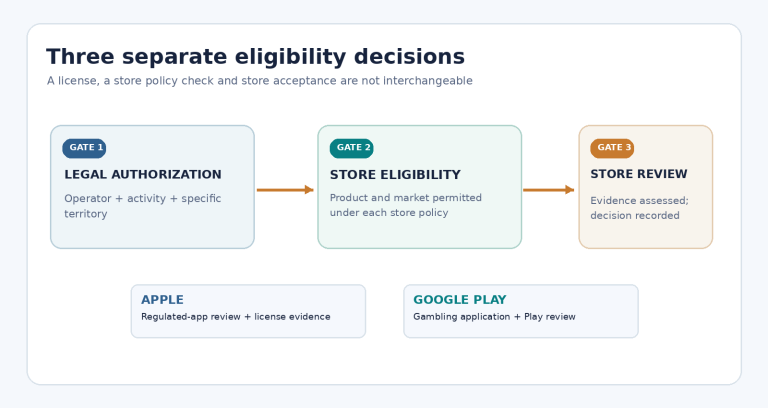
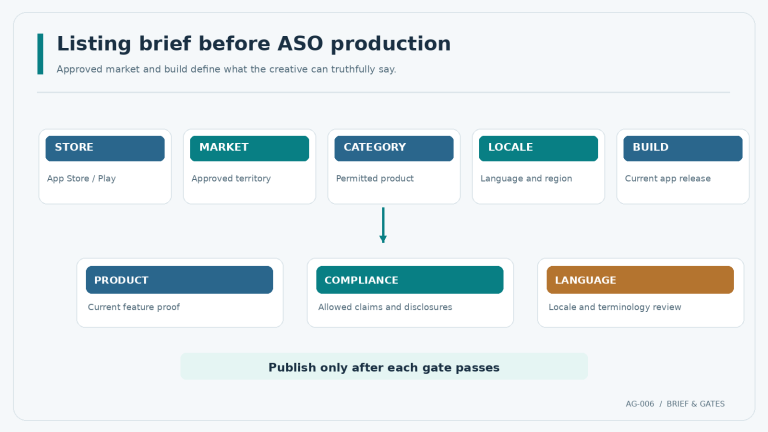
This guide focuses on in-app localization, not App Store or Google Play metadata. Store listing content belongs in the gambling app ASO checklist; whether a product can be offered in a market belongs in the store submission requirements. A language setting must never be treated as proof that a player is eligible to access real-money services.
1. Build the Locale Inventory and Assign Owners
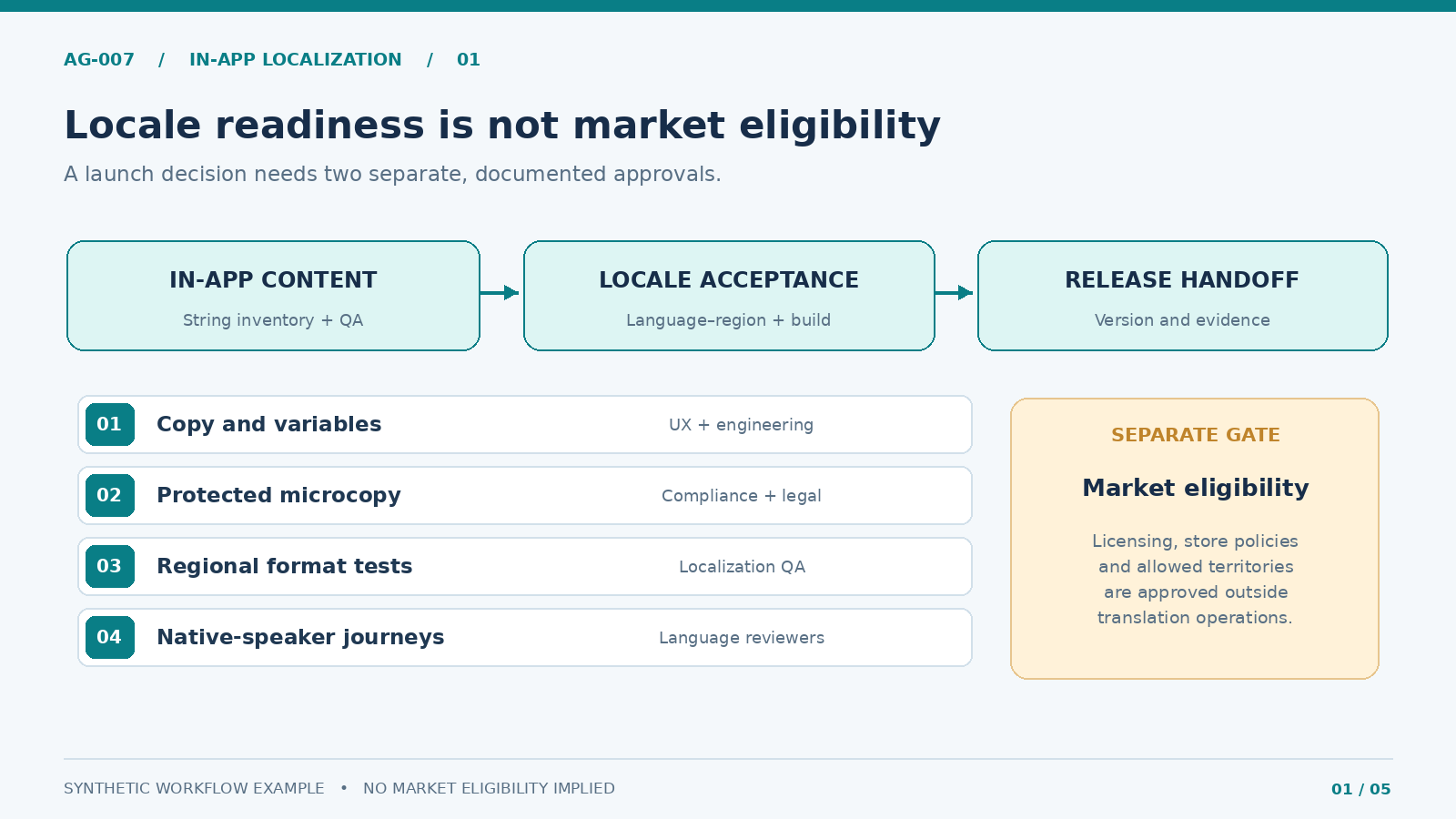
Start with supported language–region combinations, not a list of countries with assumed launch dates. en-GB and fr-CA, for example, are distinct locale identifiers; neither confirms legal distribution, operator licensing or permitted payment methods. Keep a separate market-eligibility register owned by legal and compliance.
For each proposed locale, record platform, app version, fallback language, content families, high-risk journeys, owner and acceptance status. Include account creation, verification, geolocation errors, deposits, withdrawals, game results, limits, self-exclusion, support and transactional notifications. Backend-controlled content and remote-config messages belong in the inventory too; resource files alone are not a complete picture.
Use a simple ownership split:
| Content class | Draft / implement | Review authority | Release evidence |
|---|---|---|---|
| Navigation, settings, forms | UX writing + mobile engineering | Localization lead | String ID, build and screenshot |
| Money, dates, game status | Product + engineering | Finance/product control owner | Formatting and state tests |
| Limits, exclusion, warnings | Product + compliance | Market-qualified compliance/legal reviewer | Approved wording revision and journey test |
| Help, support and notices | Support operations | Support lead + compliance as needed | Contact-route and content checks |
Release rule: A market-specific regulated message with no approved target text is a blocking exception, even if the remaining translated strings are complete. A safe fallback may be appropriate for low-risk UI labels; critical controls need an explicitly reviewed fallback decision.
2. Extract UI Strings with Context and Stable Keys
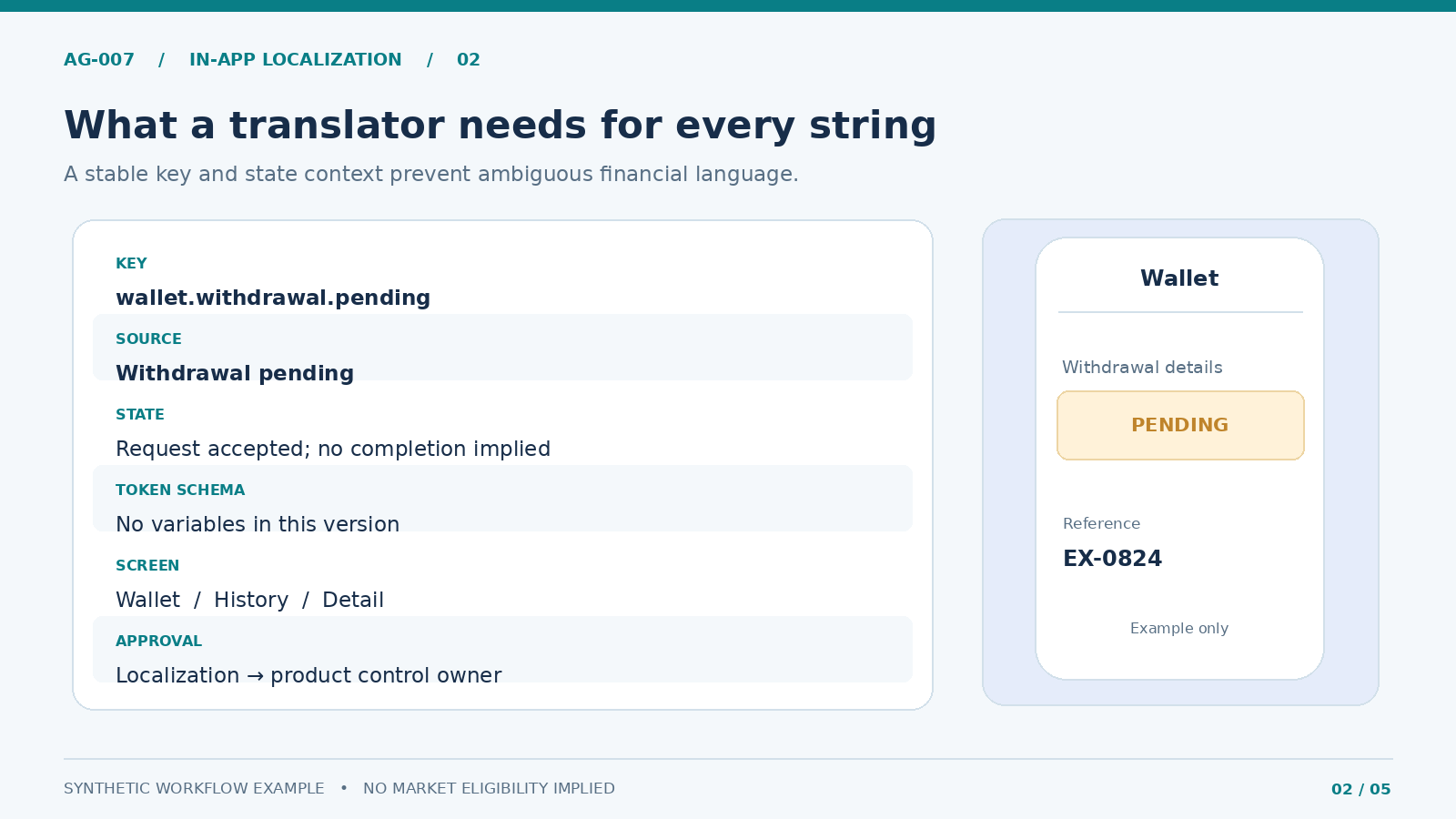
Create a single source of truth for localizable content. Avoid concatenating phrases such as “Withdraw” + amount + “now”; word order, case and grammar may change between languages. Give each message a stable semantic key, source text, usage note, variable schema, character-space guidance and reference screen. A key such as withdrawal.pending.status is easier to review than label_247.
Apple’s Xcode string catalogs support string extraction, translator comments, plural variants and device variants. Android recommends externalizing text into string resources, retaining default resources and documenting placeholders. Whatever the stack, export and import through versioned files or a localization management system rather than sending untracked spreadsheets by email.
A useful context brief answers five questions: Where does this appear? What action or state triggers it? What must remain unchanged? How much room is available? Who approves a change? Attach a redacted screenshot or annotated design frame. For transactional language, clarify whether “pending” means accepted for processing, authorized, settled or awaiting third-party confirmation.
| Example string ID | Source message | Developer context | Protected token |
|---|---|---|---|
wallet.withdrawal.pending |
Withdrawal pending | Status after server acceptance; not completed | None |
limits.daily.remaining |
Remaining today: {amount} | Display value supplied by authoritative service | {amount} |
account.exclusion.confirm |
Confirm self-exclusion | Confirmation action; do not soften the meaning | None |
support.case.reference |
Case reference: {case_id} | Identifier copied from support system | {case_id} |
Placeholders are data, not editable prose. Protect their identifiers and types, supply examples, and validate that translated strings retain required tokens. Use language-aware plural and message formatting instead of expecting a single English template to work everywhere. The Unicode CLDR rules underpin locale-sensitive numbering, plural rules and date conventions.
3. Set Translation and Regulatory Microcopy Review Gates
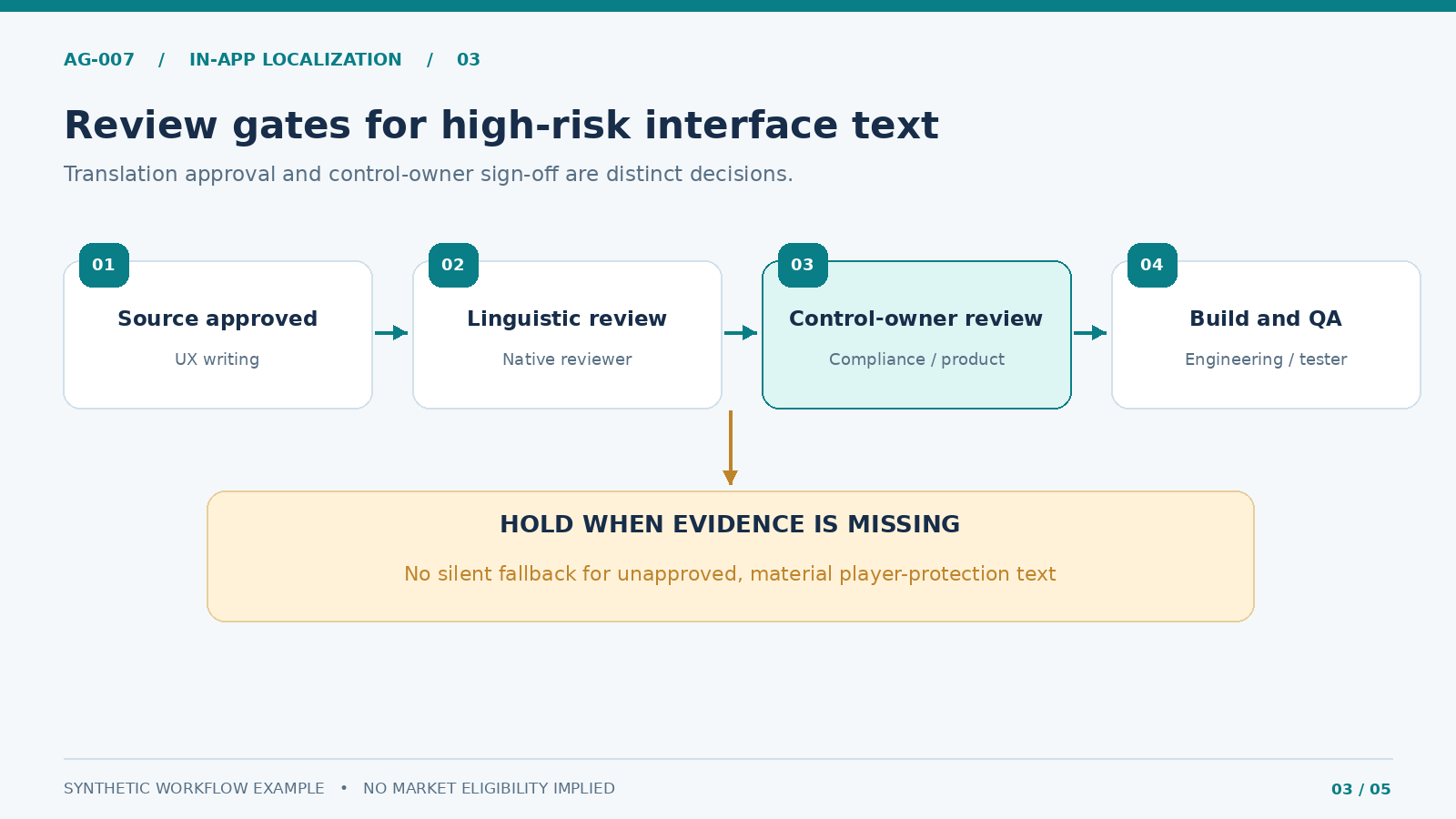
Run translation through explicit states: source approved → localized draft → linguistic review → control-owner review where required → integrated build → visual QA → accepted. Each change should link to the source-string revision; a translator’s approval of an older sentence does not cover a later source edit.
Maintain a terminology glossary for expressions that must remain consistent. Distinguish a deposit limit from a spending limit, a withdrawal request from a completed payout, and temporary account suspension from self-exclusion. A linguistically elegant synonym can be operationally wrong when it changes the player’s understanding of a control or transaction.
For protective or financial microcopy, ask a qualified reviewer to check the actual user journey and the exact market rules. The reviewer should verify intent, timing, consequences, mandatory notices and the availability of help. Do not paste generic legal translations across jurisdictions and assume they satisfy local requirements. Record the reviewer’s name, approval date, applicable market, source revision and any required retest.
A suggested gate model is:
- Linguistic gate: meaning, terminology, grammar, placeholders and tone pass review.
- Compliance gate: locally applicable restrictions and protected user messages have a named approval.
- Technical gate: translations resolve correctly in the build and preserve data/state semantics.
- Experience gate: native-speaker testers can complete and understand the full journey.
When a wording dispute remains open, log the disputed string, risk, owner and decision deadline. Do not bury the issue in a general translation-progress dashboard.
4. Localize Formats Without Changing Financial Meaning
UI language, region settings, currency and time zone may differ. A user could select French text while viewing a balance denominated in another currency; formatting must not convert a monetary amount or change its precision. Preserve authoritative currency codes and numeric values, then render them according to an approved display policy. For ambiguous symbols, show an ISO currency code where necessary.
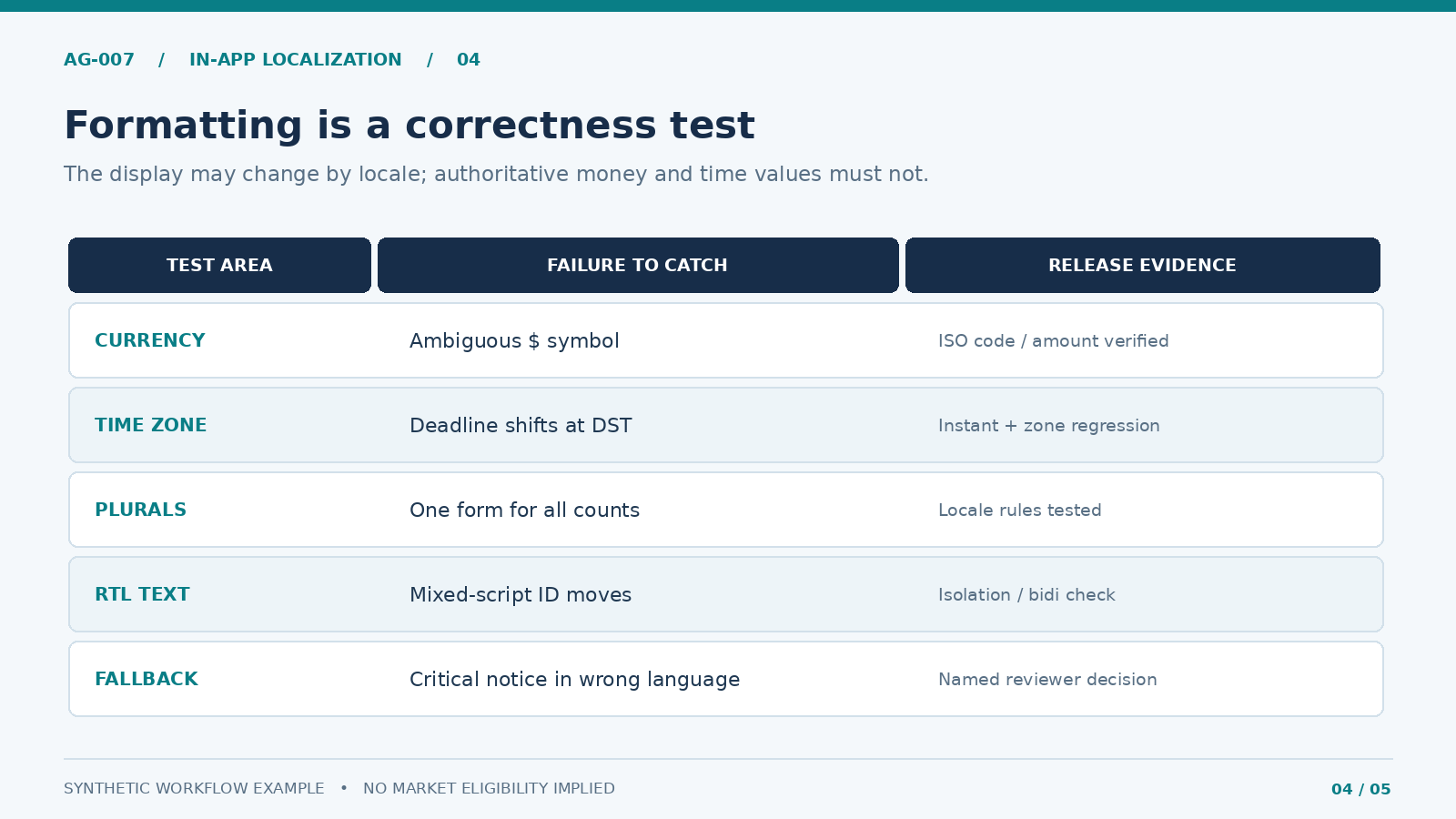
Test decimal grouping, negative amounts, zero balances, currency minor units, calendar formats, localized digits, time-zone offsets and daylight-saving boundaries. Keep timestamps and ledger values unambiguous in back-end systems. A displayed deadline should carry enough context to be interpreted correctly, particularly for limit changes, cooling-off periods or pending withdrawals. CLDR’s number and currency rules and date rules are useful implementation references.
Right-to-left (RTL) layouts need more than mirrored navigation. Check text alignment, back gestures, directional icons, inline numbers, Latin IDs and punctuation. When a reference code is embedded in Arabic or Hebrew text, direction isolation may be needed; W3C’s bidirectional-text guidance explains the underlying issue. Do not mirror logos, numerals or financial graphs blindly.
| Test | Example failure | Expected check |
|---|---|---|
| Currency | $100 shown with ambiguous currency |
Display currency identity and exact amount |
| Time | Account unlock date shifts by one day | Verify timezone, DST and stored instant |
| Plurals | “1 days remaining” | Language-specific plural variants |
| RTL mixed content | Reference ID punctuation jumps position | Directionally isolated identifier |
| Error state | English-only location restriction message | Approved locale copy or blocking fallback rule |
5. Use Pseudolocalization Before Native-Speaker QA
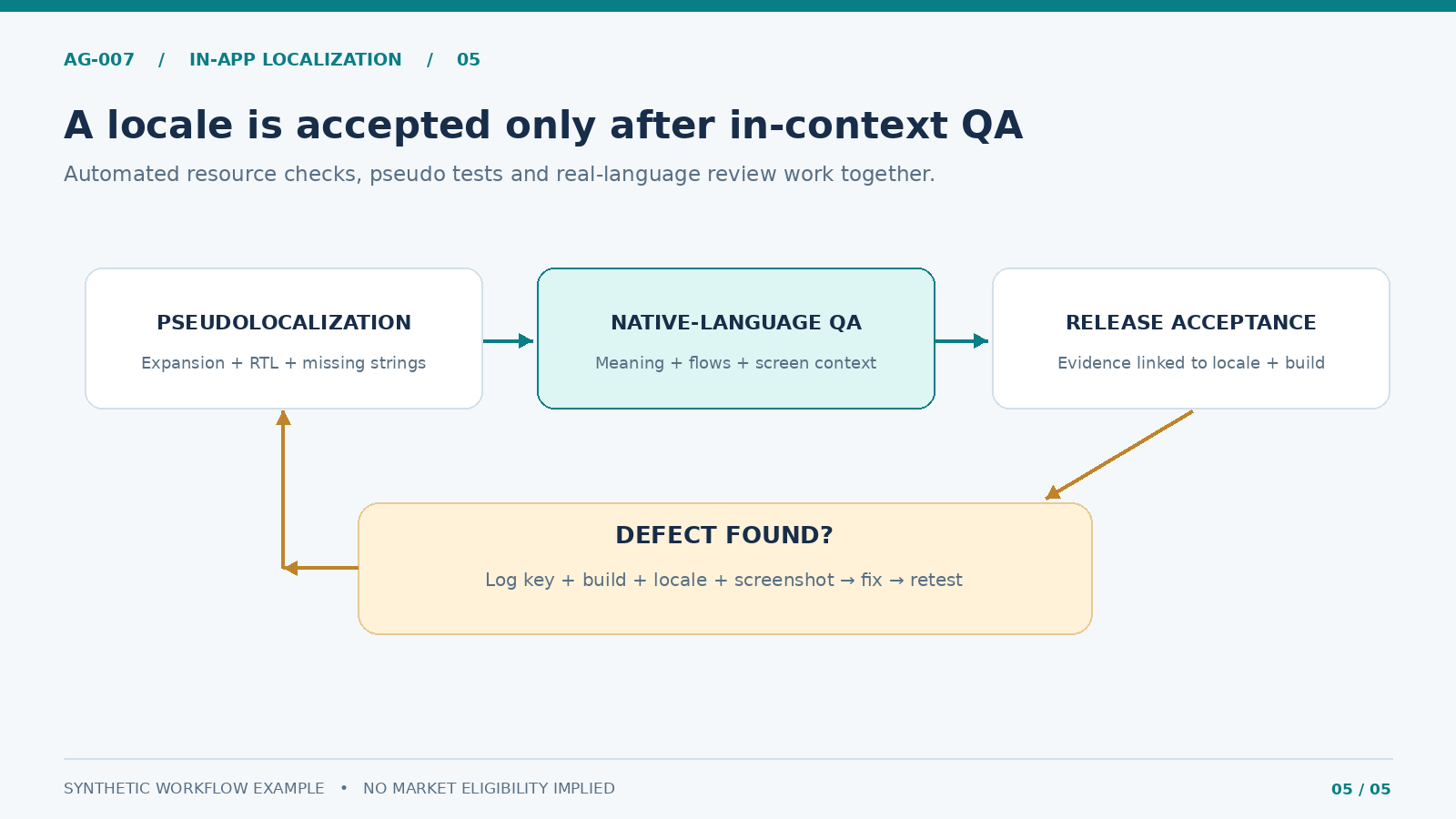
Pseudolocalization exposes hardcoded text, text expansion, broken concatenation and RTL layout problems before the translation is final. Android provides test pseudolocales such as English (XA) and AR (XB); Apple’s Xcode includes accented, double-length, bounded-string and right-to-left pseudolanguages. These are testing aids, not a substitute for genuine linguistic review. See Android’s pseudolocale guide and Apple’s interface-testing guidance.
Run automated checks on missing keys, placeholder mismatches, unsupported glyphs, obsolete translations and resource fallback. Then test real devices or simulators in context: small screens, large text, offline recovery, slow networks, modal dialogs, payment failures and saved account states. Capture screenshots at the failed step with build, locale, device, test data and string ID. Do not record real player credentials or personal data in defect logs.
Native-speaker QA must test meaning and action, not only whether every label fits. Ask whether the withdrawal state is understandable, whether an exclusion confirmation clearly conveys its consequences, and whether help can be located without relying on English navigation. For the selection of device/OS combinations, use a separate risk-based device matrix.
Severity should follow impact: a clipped settings label may be a minor defect, while an incorrect deposit-limit confirmation, misleading balance unit or unavailable self-exclusion instruction should block release until the relevant owner accepts a safe resolution.
6. Complete the Locale Release Handoff
Freeze a content baseline for each candidate build. The handoff record should identify the app commit, resource bundle version, translated-content revision, locale, market-eligibility reference, reviewer approvals, open defects and fallback decisions. Recheck changed strings after a late bug fix; a previously accepted locale does not automatically approve new copy.
A concise locale acceptance checklist is more useful than a single “100% translated” number:
- All mandatory strings and control messages are present and version-matched.
- Placeholders, plural cases, numeric formats and date/time boundaries are tested.
- Regulatory and financial terminology has the required market-specific approvals.
- The high-risk journeys pass functional and native-language review.
- Critical defects are closed or have an explicitly authorized release decision.
- Customer support, monitoring and rollback teams know the locale/content versions released.
Record one outcome per locale and build: GO, HOLD, or NOT IN SCOPE. Translation completion is supporting evidence, not authority to launch. Store review, real-money market eligibility and phased distribution remain separate release tracks; see the store submission checklist and phased rollout plan.
Download the companion locale content matrix, string-context brief, pseudolocalization defect log and release acceptance workbook to adapt this workflow. Their example entries are synthetic and start without production sign-off.
Editable resources: locale QA matrix (Excel); string context inventory (CSV). These templates contain example inputs and require project-specific review before operational use.
Frequently Asked Questions
What is the difference between translation and localization for a gambling app?
Translation changes wording. Localization also tests context, controls, plurals, currencies, dates, directionality, help paths and region-specific terminology across the actual app experience.
Should a language be launched when all strings are translated?
Not on that evidence alone. Critical messages need approved wording, functional and visual QA, plus a documented locale/build acceptance decision. Market eligibility is a separate prerequisite.
Can machine translation be used for regulatory messages?
It may support drafting under an approved process, but it does not replace a qualified market-specific review of player-protection, financial or legally significant text. Keep an auditable source-to-approval record.
How do we test a locale before translations arrive?
Use pseudolocales to expose text expansion, nonlocalizable strings and RTL defects. Follow with professional linguistic review and real-language journey tests before acceptance.