Gambling app quality KPIs measure whether a mobile product works reliably, can be used by people with different access needs, and provides timely help when something goes wrong. They should answer operational questions: Did the app crash? Could users complete essential account tasks? Were serious accessibility defects corrected? Did support respond when required?
A useful scorecard gives each measure an exact denominator, decision owner, data limitation and review action. Revenue, betting frequency and playing time are not quality measures and are excluded here.
These definitions are not industry benchmarks. Set targets after verifying coverage, product risk and applicable obligations.
What Quality KPIs Should Measure
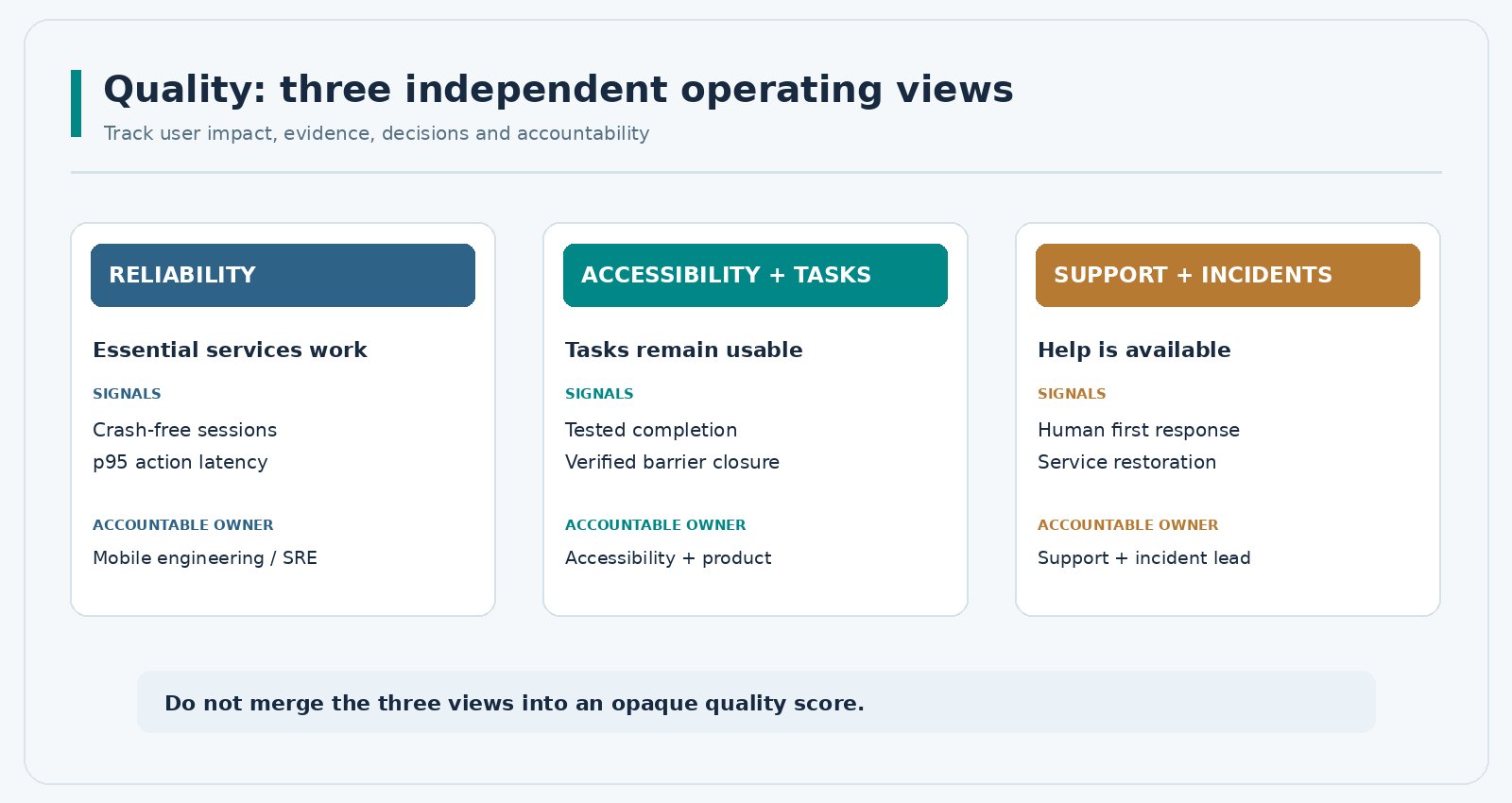
Organize the scorecard around three outcomes: service reliability, accessible task completion and responsive support. Each needs user-impact evidence and diagnostics; one good number cannot offset a serious failure elsewhere.
| Quality area | Primary question | Supporting evidence | Decision owner |
|---|---|---|---|
| Reliability | Does the product remain usable during essential actions? | Crash-free sessions, service success, p95 latency, Android ANRs | Mobile engineering / SRE |
| Accessibility and tasks | Can people reach help and manage their account without barriers? | Verified accessibility fixes, critical-task completion, open severe defects | Accessibility lead / product owner |
| Support and incidents | Can people obtain help and recover from service failures? | First human response within target, unresolved urgent cases, incident recovery | Support operations / incident manager |
Keep definitions consistent across releases. Review affected device models and assistance paths even when overall results improve. The phased rollout plan owns release gates.
Reliability KPIs: Crashes, Availability and Latency
Crash-free sessions versus crash rate
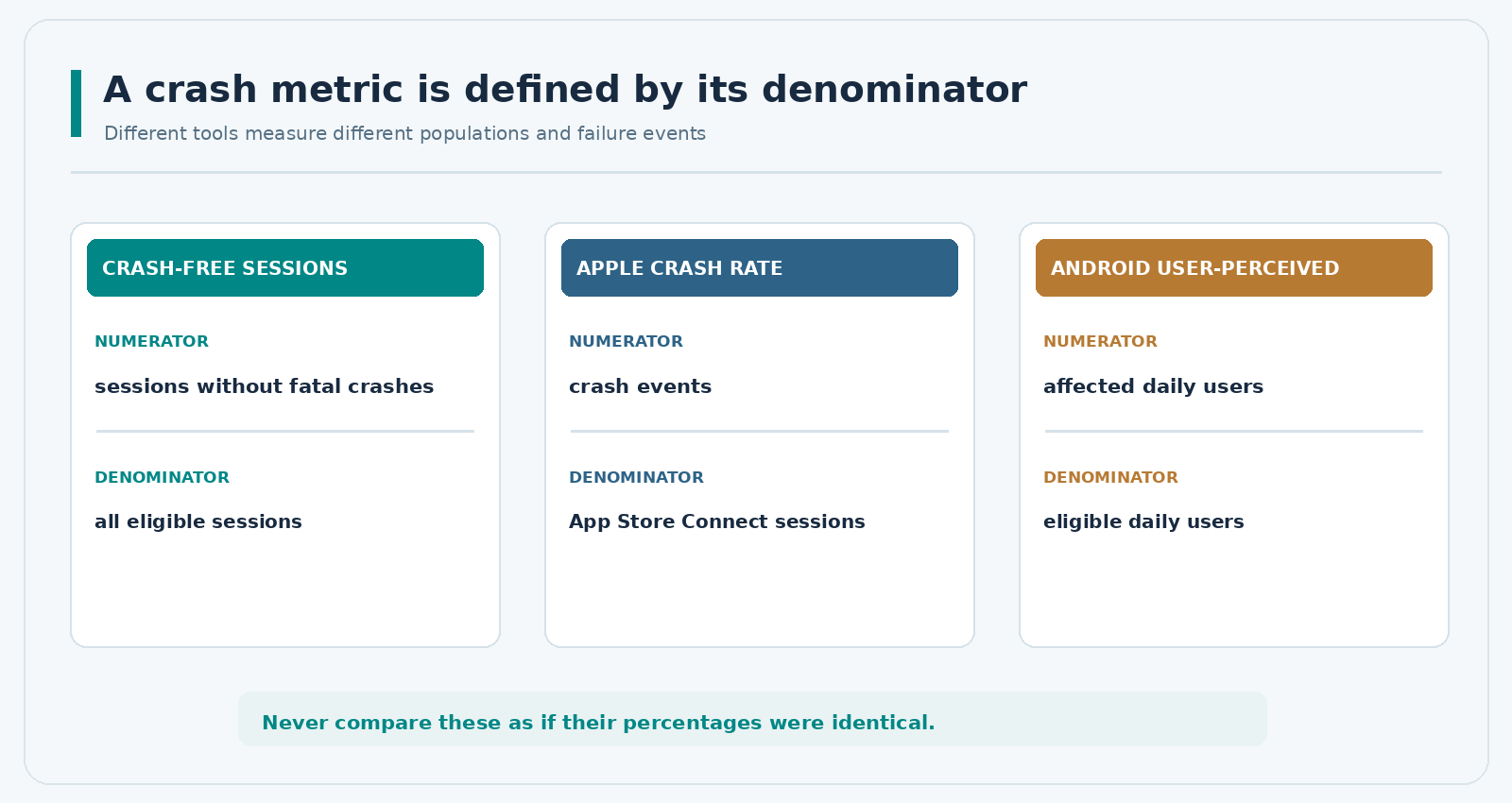
Crash-free sessions (%) = 100 × (all eligible sessions − sessions with at least one fatal crash) ÷ all eligible sessions. Count an affected session once.
For example, 49,950 sessions without a fatal crash out of 50,000 eligible sessions yield 99.90% crash-free sessions. This is a synthetic calculation, not a performance claim or recommended target.
The Firebase Crashlytics definition is based on sessions without fatal crashes. Its SDK and session rules matter; tool percentages are not interchangeable.
- Apple App Store Connect crash rate is crashes divided by sessions for the chosen period. Multiple crashes may affect the numerator; usage reporting also depends on participating devices. See Apple’s metric definitions and App Analytics guidance.
- Google Play Android vitals user-perceived crash rate measures the share of daily users affected by at least one user-perceived crash. Its denominator is daily users, not sessions. Android vitals separately reports user-perceived application-not-responding (ANR) rates. See Google Play’s technical quality guidance.
Do not label 100 minus Android daily-user crash rate as “crash-free sessions.” Show source, denominator, build and window.
Service success and latency
An app can run without crashes while account restrictions or support remain unavailable. Define essential service success (%) as successful eligible requests divided by all eligible requests for a named endpoint or task. Specify which timeouts, client cancellations and expected business-rule rejections count as failures. Do not treat a correct eligibility denial as an outage.
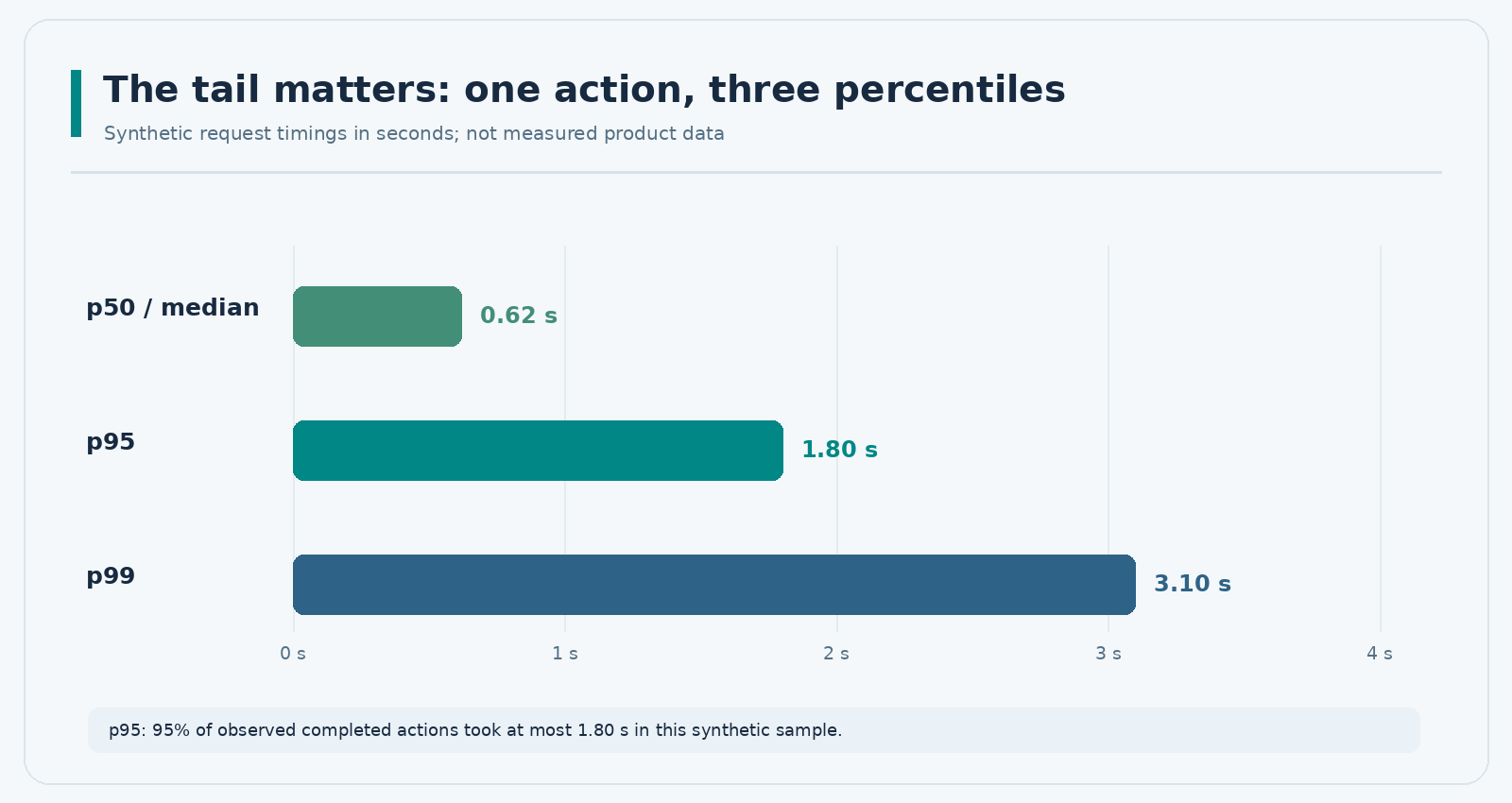
Track latency for the same named operation using a consistent start and stop point. A p95 latency of 1.8 seconds means 95% of observed operations completed at or below 1.8 seconds within that measurement population. It does not mean the average request took 1.8 seconds. Report sample size and separate service-side timing from end-to-end mobile timing.
Xcode Organizer adds launch and UI-responsiveness measures. Do not conflate launch time and network latency.
Accessibility and Essential Task Completion
An accessibility dashboard should measure verified remediation, not simply the number of tickets marked closed. The WCAG 2.2 standard provides web accessibility criteria. The W3C’s WCAG2Mobile guidance is informative guidance for applying those principles to mobile apps, not a separate certification standard.
Use these measures together:
- On-time verified critical accessibility closure: high-priority findings verified as fixed by their due date ÷ high-priority findings due during the reporting period. Define when an issue becomes due, and do not erase overdue items by moving their dates.
- Aged severe accessibility backlog: count of still-open severe findings older than the team’s agreed aging threshold. Show the count and age; a percentage alone hides a small but serious backlog.
- Essential-task completion: participants completing a predefined non-wagering task without assistance ÷ eligible participants who attempted it. Separate assisted and unassisted results and record device, assistive technology, locale and test method.
Tasks can include finding support, checking account status and requesting account restrictions. Recruit participants for testing; do not create covert behavioral profiles.
Retest evidence needs the component, build, platform, relevant assistive technology and observed result. Reopened defects return to the backlog. The W3C’s WCAG Evaluation Methodology 2.0 describes scoping, sampling, evaluation and reporting across digital products, including apps; the method does not replace product-specific acceptance criteria.
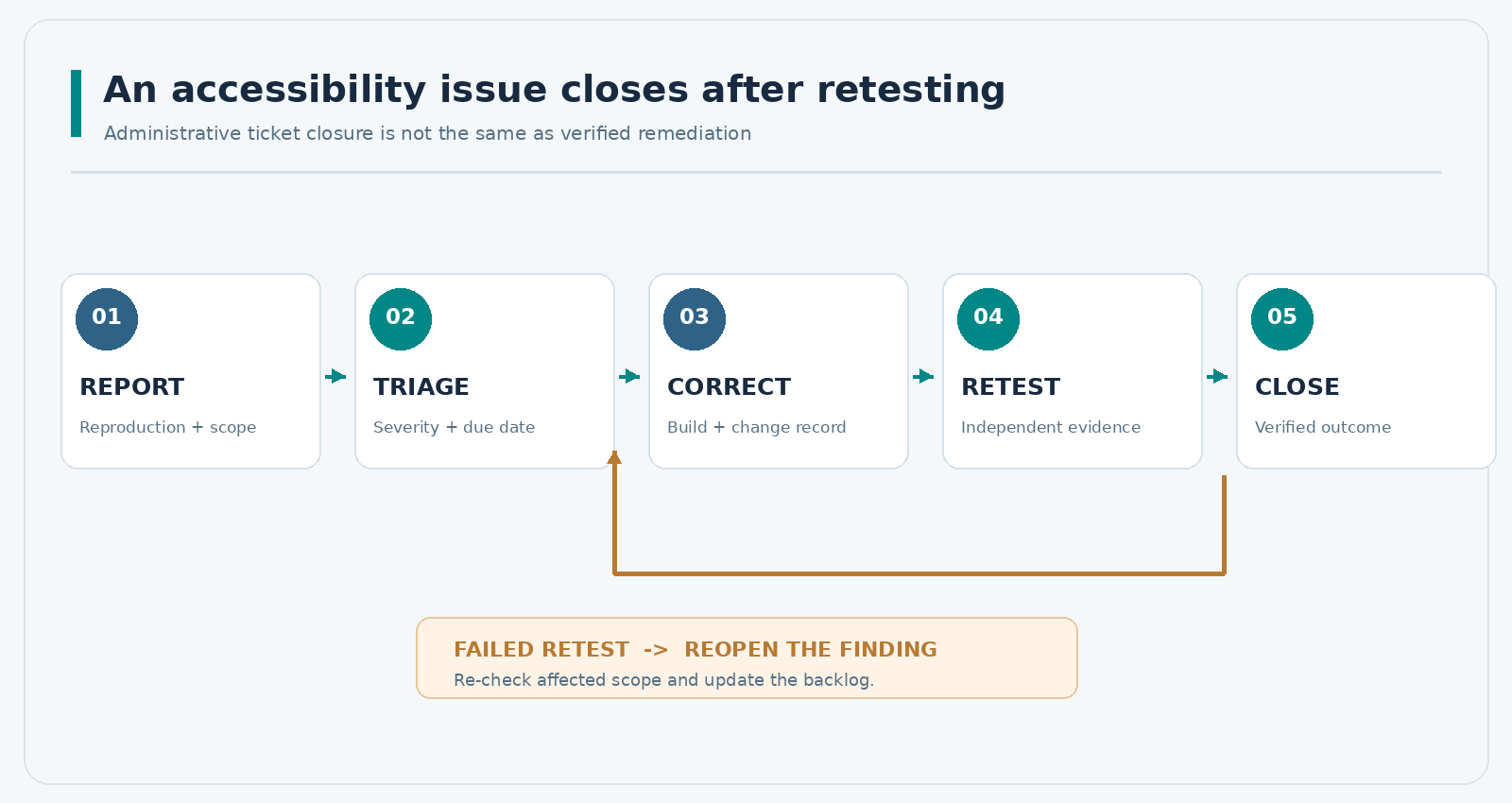
Do not declare an app “95% accessible” because 95% of reported defects were closed. The result describes a tracked issue workflow and tested scope, not conformance or all user experiences.
Support and Incident Measures
A useful support metric reflects meaningful help, not an automated acknowledgment. Define on-time first human response (%) as eligible incoming cases whose first substantive human reply met the case-specific target ÷ eligible incoming cases whose first-response target fell due in the period. Explicitly handle reopened tickets, spam, duplicates, transfers and whether the timer uses business or calendar hours.
Service desks often define first reply differently. For instance, Zendesk’s SLA documentation allows targets to vary by priority and time basis, and certain automated replies can affect reported reply-time behavior. A manually reviewed “human response” measure may therefore differ from the software’s default SLA field.
Pair speed with urgent unresolved cases and repeat contacts about the same unresolved problem. Fast replies that never resolve a blocked account task are not a good outcome. Restrict dashboards to case categories and necessary timestamps; exclude personal narratives and account identifiers.
For production incidents, report median time to restore essential service for a defined severity class. Use the declared incident start and verified restoration timestamps; disclose incidents with uncertain start times and the small-sample count. The incident response runbook should own escalation and customer updates. This KPI page only defines how the outcome is measured.
Quality KPI Dictionary: A Working Example
An editable metric dictionary is available as assets/quality-kpi-dictionary.csv.
| KPI | Numerator / denominator or summary | Cadence | Owner and key caveat |
|---|---|---|---|
| Crash-free sessions | Sessions with zero fatal crashes / eligible sessions | Daily, weekly | Mobile lead; session rules and reporting opt-in |
| Android user-perceived crash rate | Affected daily users / eligible daily users | Daily, weekly | Android lead; not a session metric |
| Essential service success | Successful requests / eligible requests | Daily | SRE; define expected denials and timeouts |
| Essential-action p95 latency | 95th percentile of completed timed actions | Daily, weekly | SRE; state clock and sample coverage |
| Critical-task completion | Unassisted completions / eligible study attempts | Per study | UX research; sample and assistive-tech scope |
| Verified accessibility closure on time | On-time verified high-priority fixes / high-priority items due | Weekly | Accessibility lead; reopened and overdue cases |
| First human response within target | Timely eligible cases / eligible cases due | Daily, weekly | Support lead; business hours and bot exclusion |
| Median essential-service restoration | Median of validated incident restore durations | Per incident, monthly | Incident manager; severity and timestamp uncertainty |
The CSV records metric ID, exact scope, inclusion rules, denominator, segment, owner, source, refresh interval, decision use and failure conditions. Targets remain blank until governance owners agree them. Do not borrow benchmark numbers from unrelated consumer apps.
Read the Dashboard Without False Signals
The sample below illustrates a reporting layout for a fictional product. All values were invented to demonstrate presentation; they are not observed industry data or recommended operating thresholds.
| Measure | Week 1 | Week 2 | Week 3 | Week 4 | Interpretation |
|---|---|---|---|---|---|
| Crash-free sessions | 99.80% | 99.85% | 99.88% | 99.90% | Improving, if coverage is stable |
| Essential-action p95 | 2.0 s | 1.9 s | 1.8 s | 1.7 s | Faster, if timing definition is unchanged |
| First human reply on time | 82% | 86% | 85% | 89% | Check urgent-case backlog alongside trend |
| Aged severe accessibility issues | 7 | 6 | 6 | 4 | Falling count; review every remaining item |
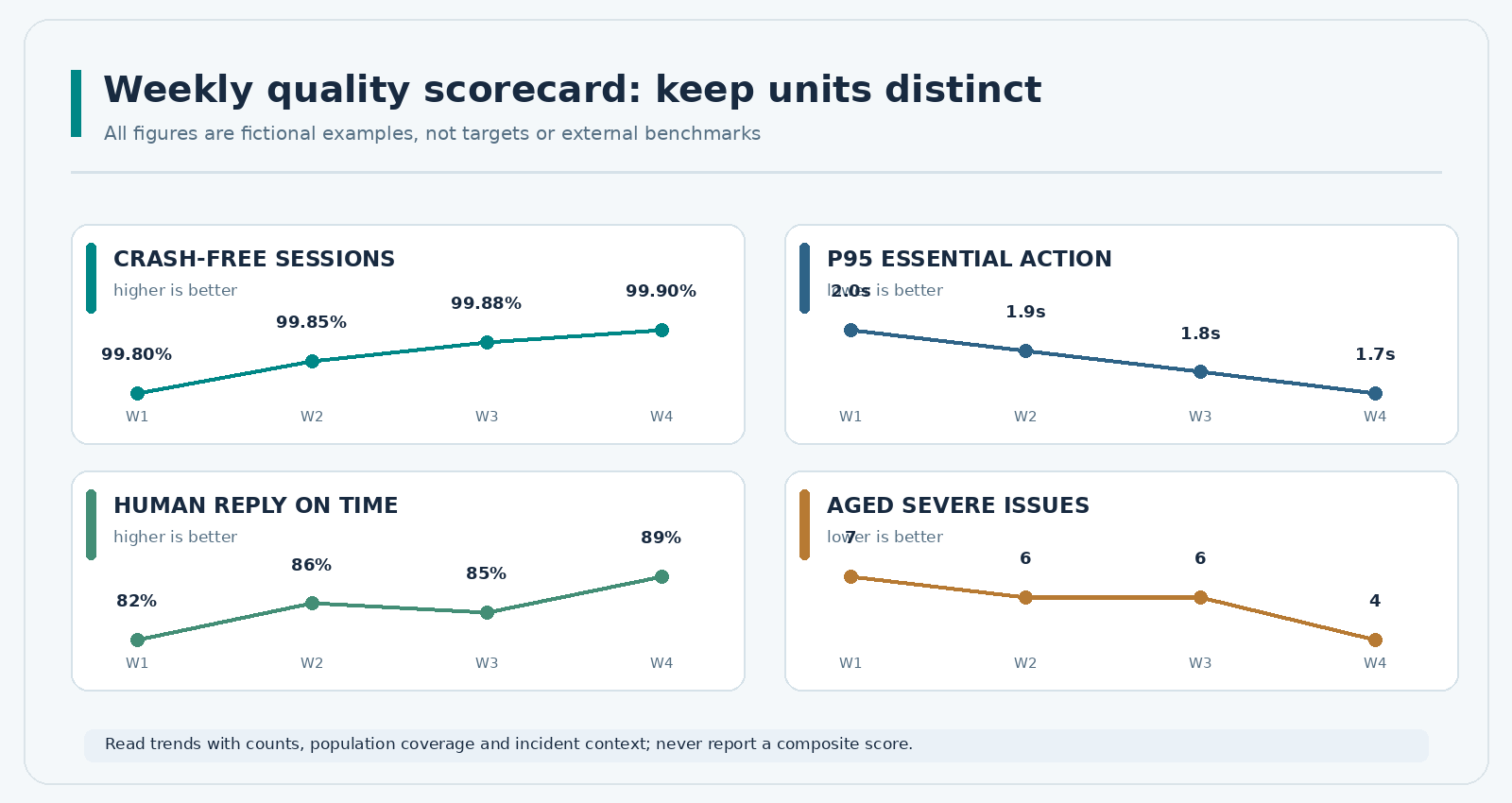
Ask: What changed? Who was affected? Is the comparison valid? Who will act? Segment by build, platform and device; add smaller cohorts only when sample and privacy rules allow.
Data Quality, Privacy and Review Cadence
Before approving any KPI for decisions, review its measurement contract:
- Coverage: who can appear in the data, and whose reports are missing? Apple and Android diagnostic feeds can represent different opt-in populations.
- Window: are observations aligned by time zone, version and the same calendar interval? Is reporting delayed?
- Definition: have session rules, SLA clocks, severity levels or task scripts changed? Add a visible version note if so.
- Denominator: is a small sample making the rate unstable? Show absolute counts alongside percentages.
- Access: do dashboards use aggregated operational measures without unnecessarily collecting sensitive account or gambling-behavior data?
- Action: does a named owner have a documented next step when the measure deteriorates?
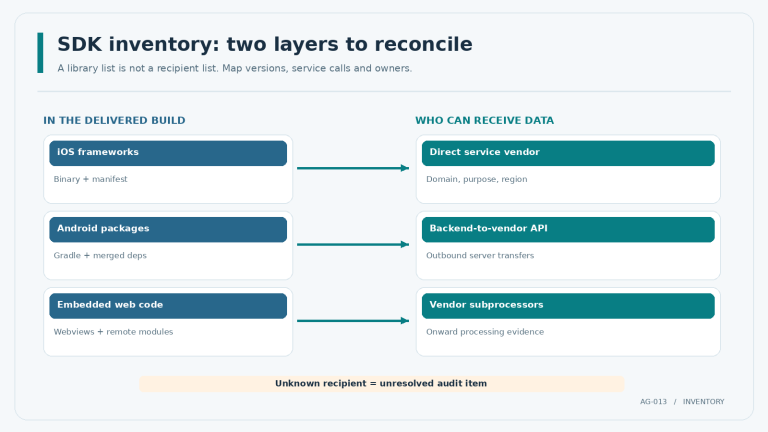
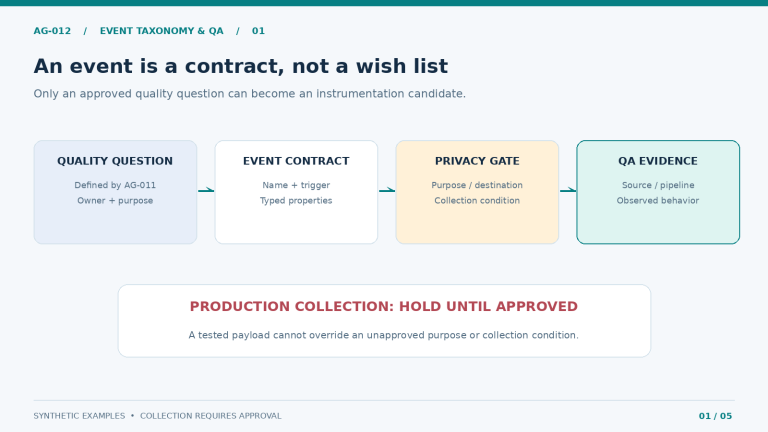
Use a daily reliability and urgent-support review, a weekly cross-functional quality meeting and a monthly definition and coverage audit. These are suggested governance rhythms, not a legal requirement. Route event naming and property-level specifications to the event taxonomy guide (AG-012) and vendor/consent questions to the SDK privacy audit (AG-013).
If stability improves but complaints rise, investigate missing failure modes. If accessibility closures rise while severe defects remain, review those defects, not just the percentage.
Editable resources: quality KPI dictionary (CSV); synthetic weekly scorecard (CSV). These templates contain example inputs and require project-specific review before operational use.
Frequently Asked Questions
What are the most useful gambling app quality KPIs?
Start with crash-free sessions, essential-service success, p95 latency, verified accessibility-fix closure, essential account-task completion and timely first human support response. Add incident restoration measures for products with a formal severity process. Confirm coverage before setting targets.
Is crash-free sessions the same as app crash rate?
No. Crash-free sessions counts sessions without fatal crashes. Apple’s crash rate divides crashes by sessions; Google Play’s user-perceived crash rate counts affected daily users. Label the metric, data source and denominator before comparing values.
How do you measure mobile app accessibility improvement?
Measure verified fixes and aging of severe open findings, supported by repeatable testing of representative tasks, devices and assistive technologies. A ticket-closure percentage is not an accessibility conformance score.
Should response time include chatbot acknowledgments?
Not when the KPI is explicitly first substantive human response. Report bot acknowledgments separately if useful, and document whether the support system’s built-in SLA clock counts automation.
What should teams do when KPI data is incomplete?
Mark the figure as partial, show its eligible population and missing coverage, and avoid treating it as a fleet-wide result. Fix the collection or reporting contract before relying on small differences to make major decisions.
Official Sources and Further Reading
- Firebase Crashlytics: Understand crash-free metrics
- Google Play Console: Monitor technical quality with Android vitals
- Apple: App Store Connect Analytics metric definitions
- Apple: Analyzing shipping app performance
- W3C: WCAG 2.2 and WCAG-EM 2.0
- W3C: Guidance on Applying WCAG 2.2 to Mobile Applications
- Zendesk: Defining SLA policies