A mobile gambling product roadmap is a decision-making plan that connects market eligibility, product discovery, requirements, dependencies and delivery milestones. It should tell a team what evidence is needed before work moves forward—not merely which features are scheduled for a particular month.
For a real-money gambling product, the roadmap must also make unresolved legal, operational and player-protection questions visible. A completed design or build cannot compensate for an unanswered licensing or distribution question. This guide shows how to organize the planning work and includes an editable roadmap canvas.
In brief: define the target market and product boundaries, gather evidence, establish testable requirements, map dependencies, assign decision owners and document the conditions for each milestone. Treat a launch date as a planning assumption until critical approvals and prerequisites have been confirmed.
When a Mobile Gambling Product Roadmap Is Needed
A roadmap is useful before a new app is commissioned, when a licensed operator expands into another market, or when an existing product needs a substantial redesign. It is also the simplest way to keep an operator, an agency and external vendors aligned when none of them owns the full delivery chain.
Unlike a backlog, a roadmap describes decisions and dependencies across teams. Unlike a release runbook, it does not prescribe production traffic percentages, deployment switches or rollback steps. Those operating procedures belong in a separate phased rollout plan.
A useful roadmap answers six questions:
- Where can the product operate? Which jurisdictions and product categories are in scope, subject to legal confirmation?
- Who is it for? Which user needs, accessibility needs and support scenarios have been researched?
- What must it do? Which capabilities and constraints are essential for the initial scope?
- What could block delivery? Which third parties, approvals and technical decisions are unresolved?
- Who can approve the next step? Which named role owns each gate?
- What counts as evidence? Which documents or test results support a decision?
The stages below are illustrative, not a mandatory software development methodology. Some workstreams run in parallel and repeat when new evidence changes the scope.
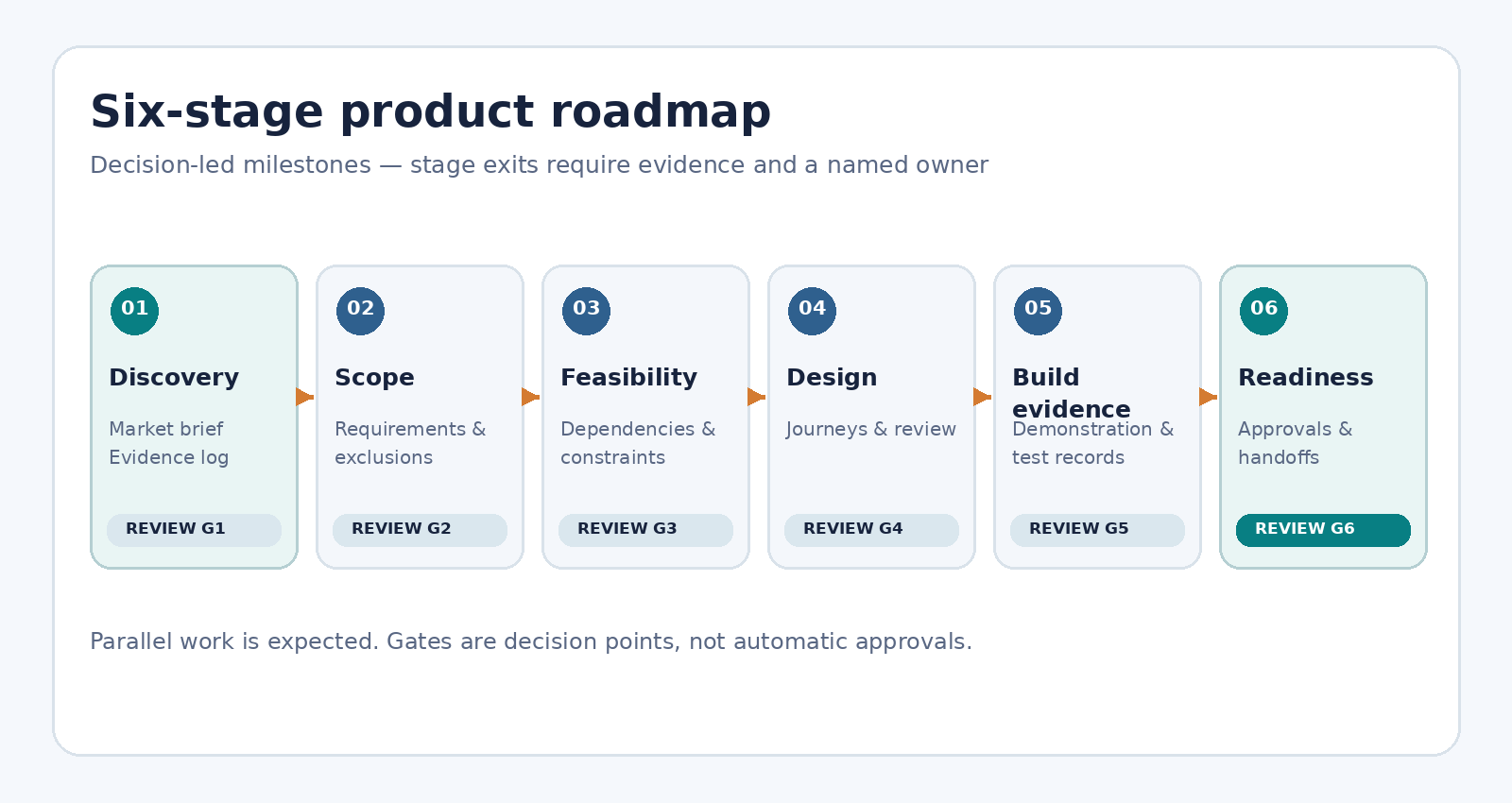
Figure 1. A decision-led roadmap: each stage produces an artifact and ends with an explicit review rather than an automatic handoff.
Discovery Evidence and Deliverables
Start discovery with an evidence inventory, not a feature wishlist. Interview the product sponsor, operational staff, support team, compliance lead, engineering representatives and, where appropriate, adult users in the intended market. Record what is known, what is assumed and what has not yet been verified.
The first decision is market and product eligibility. Identify the intended country or state, gambling activity, operating entity, expected distribution channels and relevant legal advisers. For example, Apple’s App Review Guidelines, section 5.3, contain specific conditions for real-money gaming apps, while Google Play has its own eligibility and application process. These store rules do not replace local law. Apple’s policy and Google Play’s policy should be consulted for each intended market and rechecked before submission.
Discovery should generate a small set of durable artifacts:
| Artifact | What it records | Acceptance question |
|---|---|---|
| Market and product brief | Geography, activity, legal entity, target users and exclusions | Have the right parties confirmed the assumptions? |
| User and service journeys | Account access, verification, help, controls and support handoffs | Do real user needs and failure states appear? |
| Evidence log | Interview findings, references, constraints and confidence levels | Can reviewers trace each major claim? |
| Product outcome statement | User problem, intended improvement and non-revenue quality measures | Can the team explain why the product exists? |
| Open-questions register | Unknowns, owner, due date and decision impact | Is every material unknown assigned? |
Do not convert discovery anecdotes into invented statistics. When research is limited, label the finding as a hypothesis and specify how it will be checked. If the first target market has not been cleared, label localization and distribution work as conditional rather than committed.
A practical discovery review separates facts, decisions and assumptions. A license certificate, for example, is evidence. Choosing to support a particular product type is a decision. Believing an identity provider will support that market is an assumption until the provider confirms it.
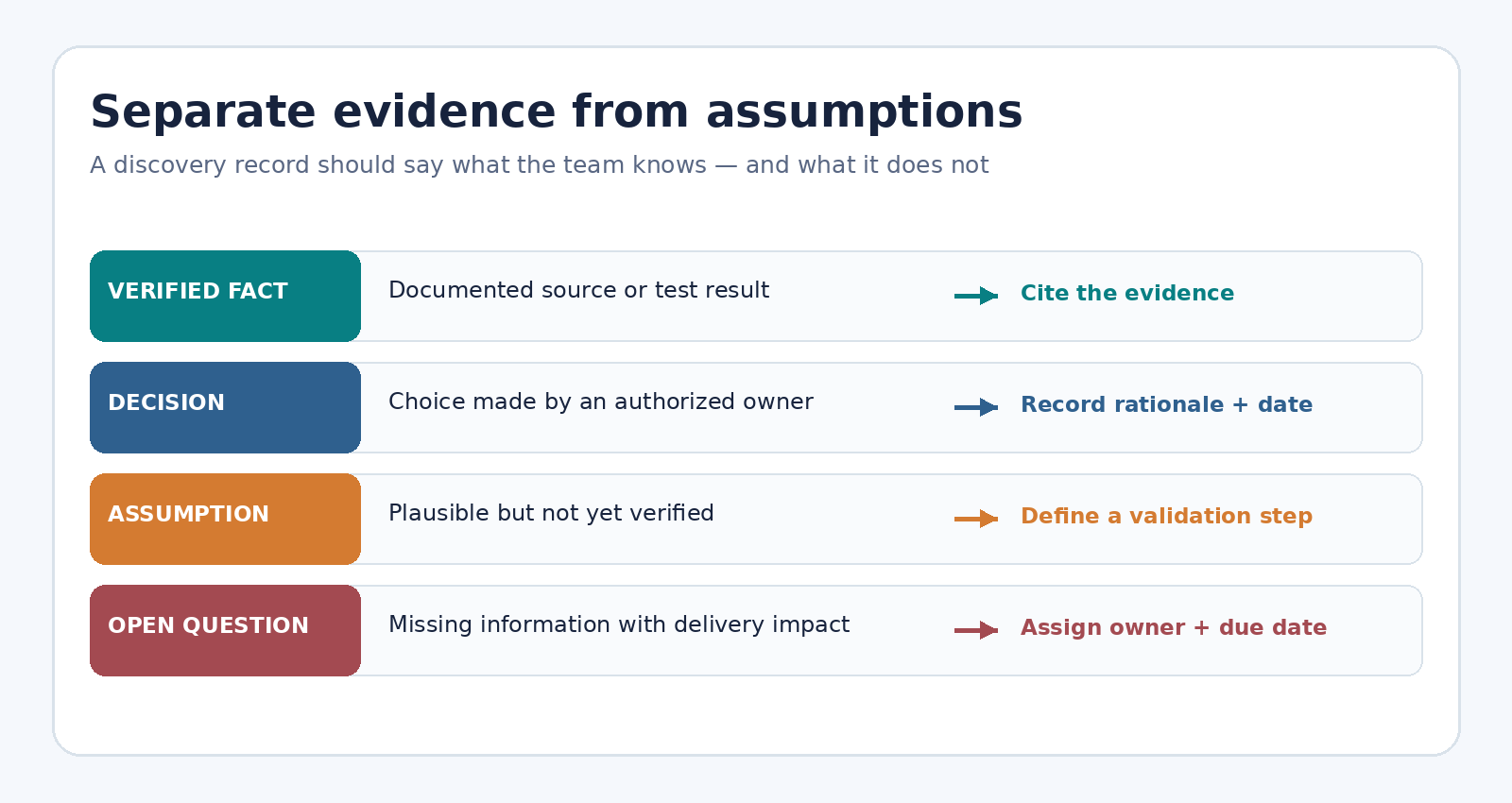
Figure 2. Different evidence states demand different actions. Unverified assumptions should not be presented as approved scope.
Build a Scope and Requirements Map
Once discovery is reviewed, convert findings into capabilities and acceptance criteria. Organize requirements by user or operational outcome, not by the team that requested them. Each requirement needs an identifier, a source, an owner, a verification method and a status.
For a mobile gambling app, common requirement groups include:
- Account and access: account creation, authentication, recovery and session handling.
- Eligibility and player protection: age and identity verification, location restrictions, help access and controls defined for the applicable jurisdiction.
- Core product journeys: only the game or wagering functions actually covered by the proposed legal and product scope.
- Payments and account records: relevant transaction states, failures, support visibility and reconciliation dependencies.
- Service quality: accessibility, performance, reliability, diagnostics and customer-support handoffs.
- Operational readiness: documentation, ownership, monitoring requirements and unresolved approval dependencies.
A requirement such as “verification should be easy” is not testable. A stronger form describes an observable outcome: “When identity verification is unavailable, the user receives a clear status message, cannot bypass a required eligibility check and can find the approved support path.” The exact behavior still needs compliance and product sign-off for the market concerned.
Use a traceability chain: research finding → product requirement → acceptance criterion → verification evidence → decision gate. It prevents a requirement from being declared complete simply because a screen exists.
| ID | Requirement example | Owner | Acceptance evidence |
|---|---|---|---|
| REQ-01 | Eligible users can complete the approved account-access journey | Product + identity integration | Reviewed journey and witnessed test results |
| REQ-02 | A blocked location cannot access restricted functions | Compliance + engineering | Jurisdiction-specific control review and test record |
| REQ-03 | Critical account errors provide a usable recovery or support path | UX + support | Accessibility review and failure-state test |
| REQ-04 | Operational teams can identify and triage a service failure | Engineering + operations | Monitoring demonstration and support handoff |
Examples are illustrative, not a universal compliance specification. Detailed interface requirements for player-protection controls belong in the responsible gambling UX requirements guide, rather than being duplicated in this roadmap.
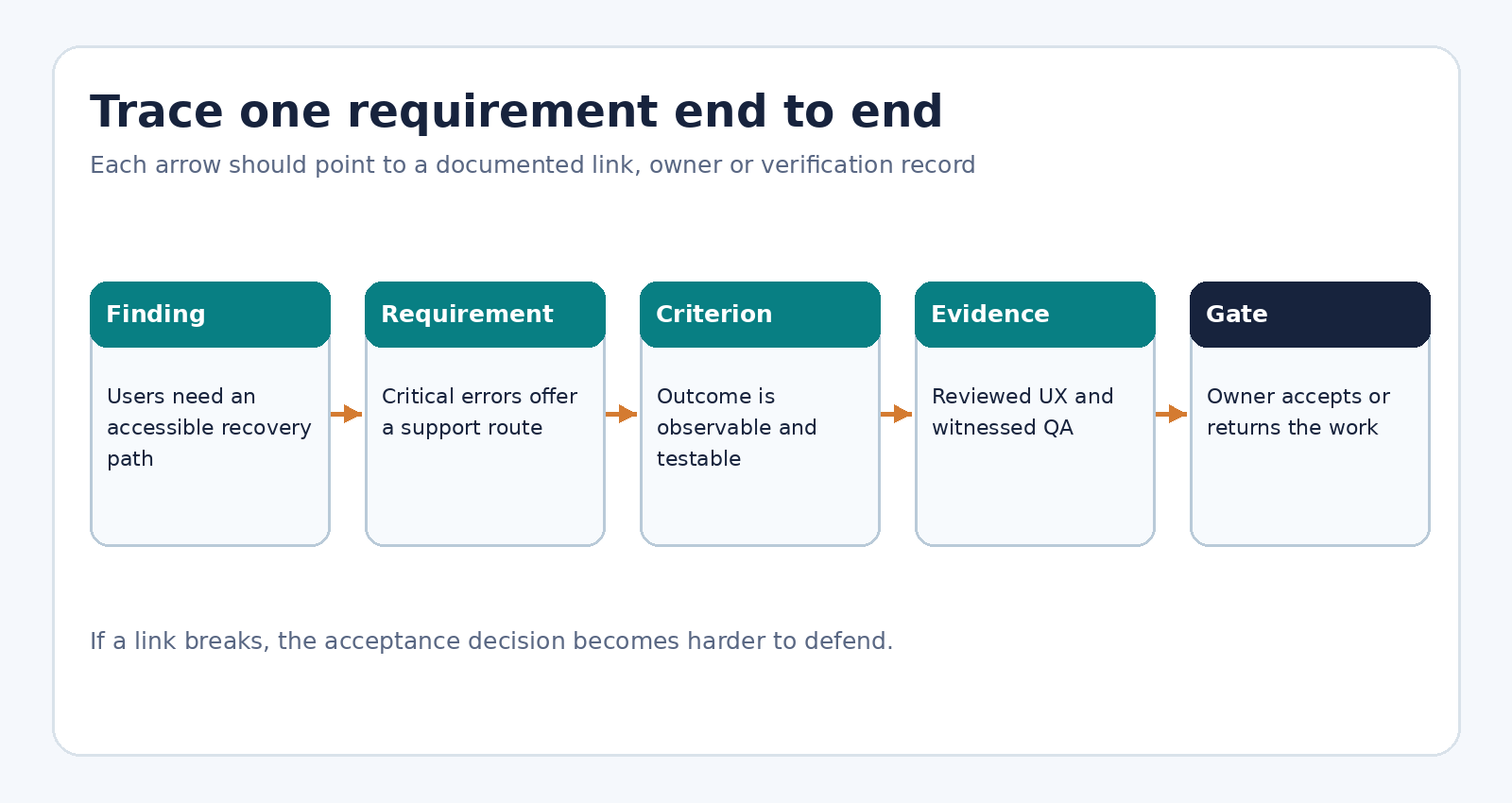
Figure 3. A single traceable requirement is easier to review, test and revise than a loosely defined feature.
Maintain a Risk and Dependency Register
A roadmap that ignores dependencies gives false certainty. Identify the external services, approvals, people and integration points that determine whether work can proceed. Do not confuse a task assigned to a team with a dependency that team can actually control.
Typical dependency classes are regulatory interpretation, identity and location services, payment or account infrastructure, platform policy, specialist testing and operational support. For example, a vendor may be technically ready but unable to provide written coverage for the proposed market. That changes the planning status even if its API works in a sandbox.
Keep one register that can be reviewed at every gate:
| Dependency or risk | Early signal | Accountable owner | Response before the next gate |
|---|---|---|---|
| Market eligibility remains unconfirmed | Legal review has no recorded conclusion | Operator / legal lead | Keep restricted scope on hold |
| Identity provider coverage is uncertain | No market-specific service confirmation | Integration lead | Request written coverage and test approach |
| Accessibility requirements are vague | No measurable criteria or reviewer | Design lead | Agree acceptance criteria and ownership |
| Support process is incomplete | No escalation route for failed verification | Operations lead | Map failure journey and support handoff |
| App-store distribution assumptions change | Policy check is outdated or market changes | Distribution owner | Recheck official store guidance and update scope |
Each entry should include an ID, impact, likelihood assessment, evidence source, owner, due date, mitigation and current status. Use plain-language impact descriptions before assigning numerical scores; scores can suggest more precision than the evidence warrants.
Dependencies also have direction. If jurisdiction review defines where an app may be distributed, localization and store preparation depend on that decision. If account recovery depends on an identity provider, the provider contract and failure-handling specification precede final acceptance. Visualizing these relationships helps the team find the true blocker instead of pushing every date forward.
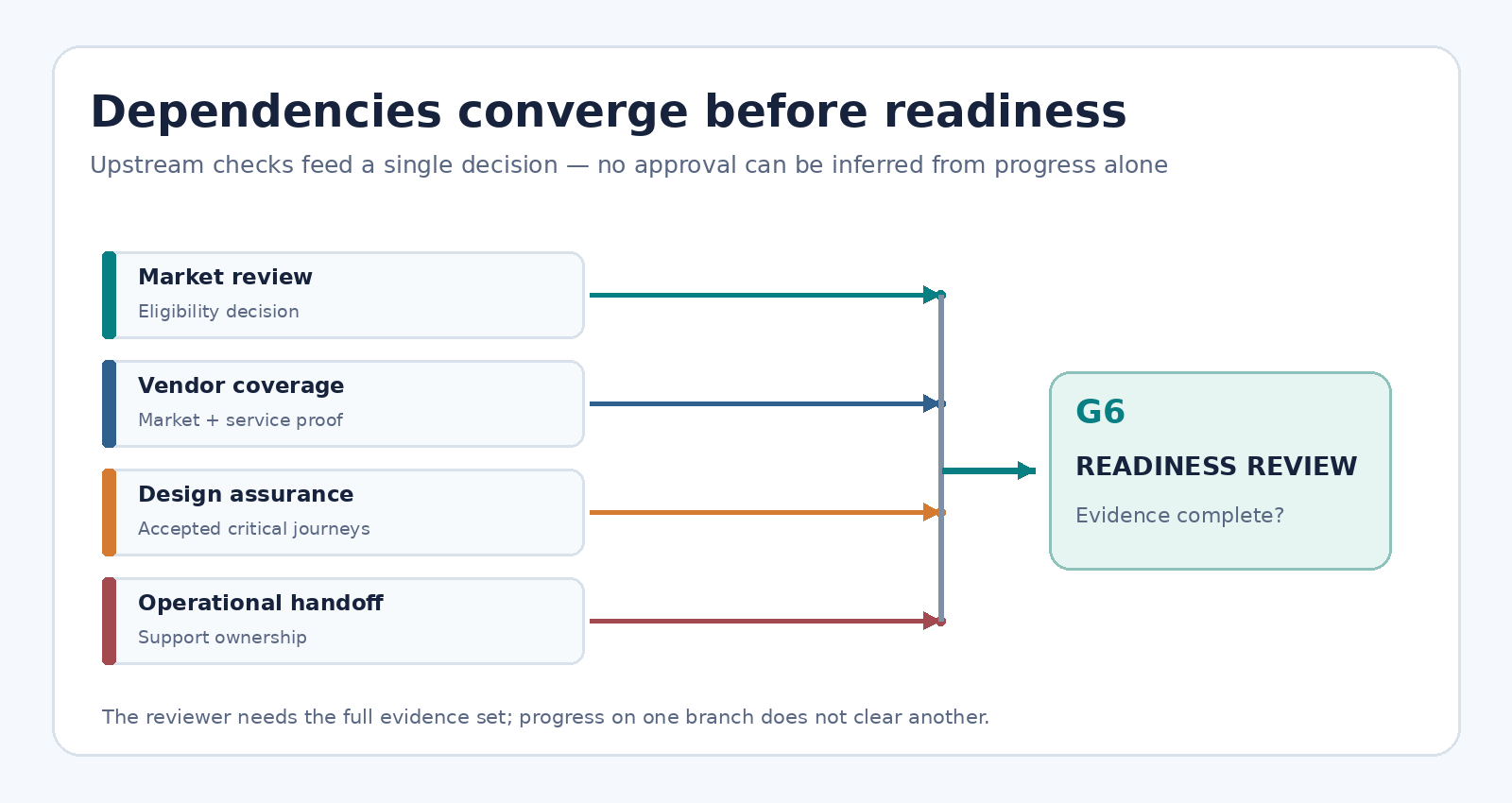
Figure 4. Dependencies converge at a milestone. A missing upstream approval blocks a downstream commitment.
Assign Ownership and Decision Gates
Every stage needs one accountable decision owner, even when several functions contribute evidence. A product manager can coordinate a gate without being authorized to approve legal eligibility or security risk. Record decision rights explicitly rather than assuming that attendance at a meeting equals sign-off.
A lightweight RACI model distinguishes the accountable person who makes or owns the decision, the responsible people who prepare the work, the consulted specialists and the informed stakeholders. The particular names depend on the organization’s governance and licenses.
| Decision gate | Required evidence | Typical accountable role | Available outcome |
|---|---|---|---|
| G1 — Discovery accepted | Market brief, evidence log, open questions | Product sponsor | Proceed, revise or pause |
| G2 — Scope approved | Prioritized requirements, exclusions, acceptance ownership | Product owner | Baseline, revise or pause |
| G3 — Feasibility accepted | Integration assumptions, architecture constraints, unresolved risks | Engineering lead | Proceed, run a spike or pause |
| G4 — Design accepted | Reviewed journeys, critical error states, accessibility approach | Design/product lead | Approve or return for changes |
| G5 — Build evidence accepted | Demonstrated capabilities, defect disposition, test records | Delivery lead | Enter readiness review or rework |
| G6 — Readiness reviewed | Required approvals, operational handoffs, remaining risk decisions | Authorized sponsor and relevant control owners | Authorize next process or hold |
The last gate is not a production deployment instruction or a guarantee of store approval. It only establishes whether the project has collected the evidence needed to enter the organization’s separate release and submission processes. For concrete store paperwork, see the real-money gambling app submission checklist.
Record every gate in a decision log containing the meeting date, evidence versions, participants, decision, conditions, owner and next review date. “Approved with conditions” is not the same as approved. List the conditions and verify that the next phase can safely begin with them outstanding.
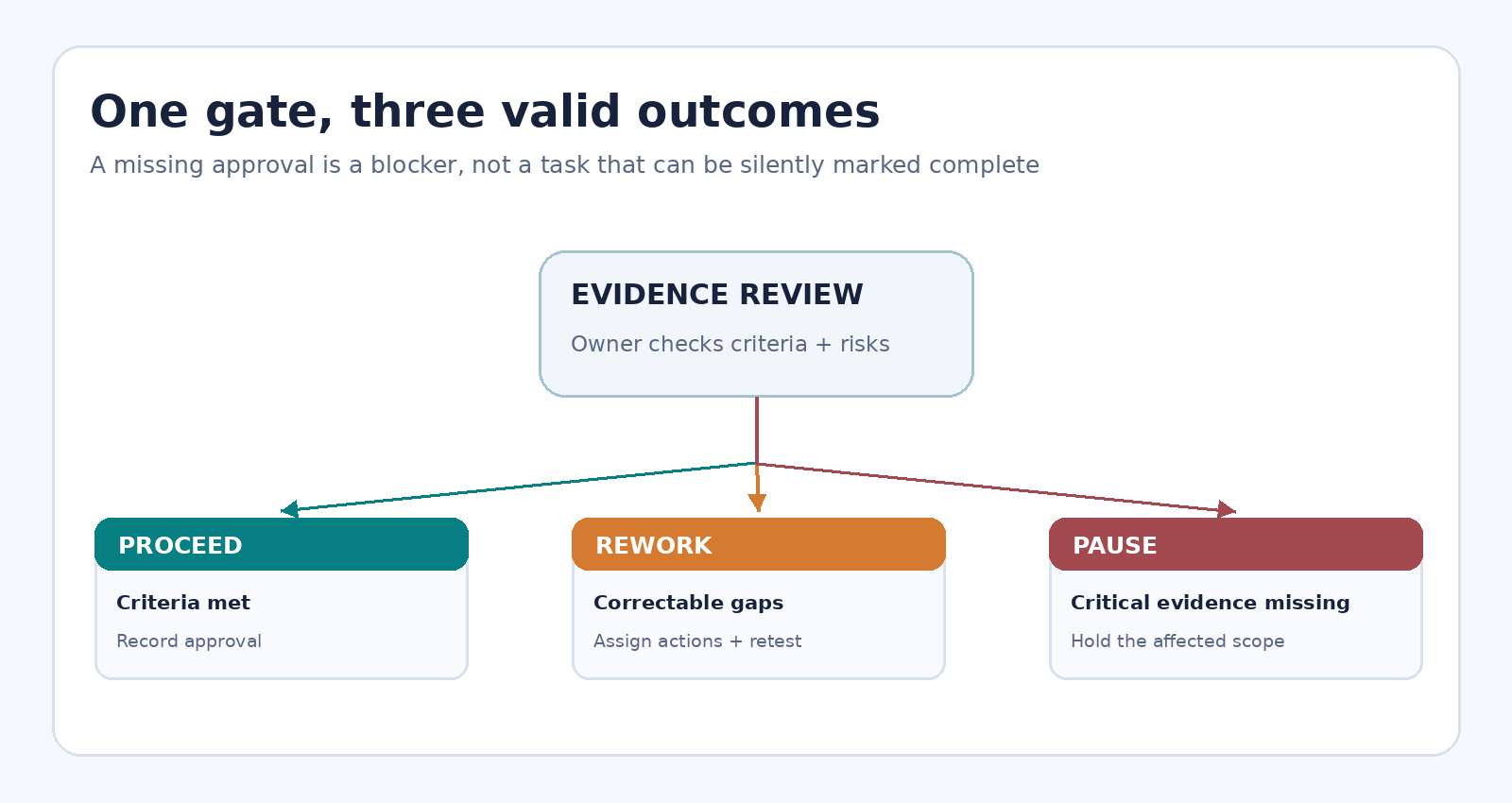
Figure 5. A gate has three honest outcomes. A pause is a useful decision when critical evidence is missing.
Editable Product Roadmap Canvas
The roadmap canvas CSV accompanying this guide is designed for a working project meeting. Open it in a spreadsheet and replace the example entries. Its purpose is to expose ownership and gating assumptions, not to prescribe a fixed calendar.
Use one row per meaningful workstream or milestone. A separate task board can hold implementation tickets. These are the minimum fields to keep:
| Field | What to enter |
|---|---|
| Stage / milestone | Discovery, scope, feasibility, design, build evidence or readiness |
| Outcome | The observable result required to complete the stage |
| Owner | One accountable person or role |
| Evidence link | Current decision memo, research artifact or test record |
| Entry criteria | What must be true before work begins |
| Exit criteria | What must be demonstrated before the next gate |
| Dependencies | Referenced risk, vendor, approval or workstream IDs |
| Target window | Planning range, not a guaranteed delivery date |
| Status / decision | Proposed, in progress, blocked, accepted or revised |
A worked example: an identity-service dependency
Imagine a project planning account access for a market that has not yet been legally cleared. The team has selected a candidate identity provider but has no written confirmation of jurisdiction coverage. It may continue drafting failure-state journeys and integration questions. It should not mark eligibility verification as approved or use the assumed provider coverage to justify a committed launch date.
The milestone remains conditional until the appropriate operator and control owners approve the scope, the provider confirms coverage and verification criteria are documented. If that evidence changes, revise the roadmap and keep the earlier assumption in the decision history.
How to keep the roadmap useful
Review blocked dependencies weekly during active delivery and rerun formal gates when evidence changes materially. Keep one canonical version of the roadmap. Archive accepted snapshots so stakeholders can see why the scope changed without inventing a retrospective explanation.
Cost assumptions should connect to, but not be calculated inside, this page’s planning method. Use the separate development cost estimation worksheet for work packages and budget ranges. The delivery sourcing decision belongs in the white-label versus custom app matrix. Device selection and test coverage belong in the device testing matrix.
Frequently Asked Questions
How long does it take to create a mobile gambling product roadmap?
There is no reliable universal duration. It depends on the number of target jurisdictions, the maturity of the product, access to internal stakeholders, the complexity of integrations and whether necessary approvals already exist. Estimate discovery and planning work from named deliverables and unresolved dependencies rather than a generic number of weeks.
Is a roadmap the same as a development plan?
No. A roadmap explains the sequence of outcomes, decisions and dependencies. A development plan allocates people, tasks and engineering effort. They should agree on major milestones, but the roadmap should remain readable without a sprint board.
What is the most important milestone before development?
An approved product scope supported by evidence and named decision owners. For a regulated gambling product, unresolved market eligibility, player-protection or distribution assumptions must be clearly flagged; some may prevent the team from committing to restricted functionality at all.
Can one roadmap cover multiple countries?
Yes, if it separates shared work from market-specific gates. Keep a jurisdiction matrix with its own legal and distribution review status. A control approved for one territory should never be silently inherited by another.
Reference Material
- Apple — App Review Guidelines, section 5.3. Check requirements for gambling apps in the planned distribution markets.
- Google Play — Real-Money Gambling, Games, and Contests. Check eligibility, approvals and location-specific rules.
- UK Gambling Commission — Remote gambling and software technical standards. A jurisdiction-specific example of why technical requirements need a designated owner; not a substitute for the rules applicable to other markets.
Editorial scope: This article provides a product-planning framework, not legal advice, a licensing determination, a store-approval prediction or a production rollout runbook. Requirements and policies should be checked against official sources for the intended market and date.